
The Divine Mercy devotion has become one of the most widespread devotions in modern Catholic life. Its imagery, prayers, and promises are familiar to millions.
But beneath its popularity are a number of serious concerns — historical, theological, and spiritual — that deserve careful attention.
The Dispatch
Here are ten facts that raise important questions about the devotion and its origins.
1. It is influenced by Polish Messianism
The Divine Mercy message emerged in early 20th-century Poland, a time marked by a strong current of Polish Messianism — the idea that Poland, rather than the Church, had a unique, redemptive role. This context shaped several religious movements and writings of the Sr. Faustina, raising questions about whether broader cultural ideas influenced the message. Among the writers who promoted this theory were Adam Mickiewicz, a member of a condemned heretical sect, and Juliusz Slowacki, who was noted for anti-clericalism and saw much of his work condemned by the Church. Yet, John Paul II frequently quoted Mickiewicz and alluded to Slowacki.
2. Similar phenomena appeared among the Mariavites.
Before Sr. Faustina, the founder of the Mariavite movement in Poland in the late 19th century, Sr. Maria Franciszka Kozłowska, claimed private revelations, interior locutions, and a special mission tied to divine mercy. She recruited many Catholic priests to her cause. These similarities in her locutions are strikingly similar to those of Sr. Faustina, especially since the Mariavites were ultimately condemned by St. Pius X in 1906.
3. Sr. Faustina worked in immediate proximity to Mariavite influence
Sr. Faustina worked in a convent bakery in Płock — the very center of the Mariavite movement, which had tens of thousands of adherents in the region. The Mariavites maintained a prominent presence in the city, including their well-known Temple of Love and Mercy. Notably, the convent-run bakery where Sr. Faustina worked was located only 500 meters from this center. This placed her daily life in direct proximity to a community deeply shaped by a theology of “mercy” and private revelations strikingly similar to those later recorded in her own Diary.
4. Early spiritual direction was cautious — even resistant
One of Faustina’s early confessors, Fr. Bukowski, warned her explicitly about illusions, self-deception, and possible diabolical influence. He did not immediately affirm her experiences, but urged caution—exactly what the Church’s spiritual tradition recommends in such cases.
5. Polish bishops recommended suppression
When the Holy Office examined the devotion in the 1950s, Polish bishops — many of whom had access to the original Diary — recommended that the devotion be restricted. This was not a hasty or uninformed decision, but one based on direct familiarity with the source material. It ultimately led to Cardinal Alfredo Ottaviani issuing a notification in 1959 prohibiting the distribution of “images and writings that promote devotion to Divine Mercy in the forms proposed by Sister Faustina.”
6. The Diary was not fully available at the time — and still raises questions
Supporters often explain the original prohibition as resulting from “faulty translations.” However, the 1978 lifting of the ban referred instead to “new documents and changed circumstances” without identifying them. Questions remain about the integrity and completeness of the text as it is now known, since the original handwritten manuscripts have never been made fully available to independent researchers and a number of editorial changes were made.
7. The Diary contains serious theological tensions
A number of passages in Sr. Faustina’s Diary raise concerns when compared with established Catholic teaching — particularly regarding mercy, justice, justification, and the role of the sacraments. These are not minor nuances, but issues that touch core doctrines. In one entry, she said of Our Lord told her He was “uniting myself with you so intimately as with no other creature,” which is blasphemous as Our Lady is united with Christ more than all other creatures.
8. John Paul II often quoted a member of a condemned heretical sect
Adam Mickiewicz, a celebrated Polish writer, was closely associated with the mystical movement of Andrzej Towiański — a circle whose ideas were condemned and suppressed by the Catholic Church. Despite this, John Paul II frequently quoted Mickiewicz in his speeches and writings, drawing on Polish Messianic themes that also appear in Sr. Faustina’s Diary.
9. The Chaplet includes problematic formulations
Most of the Divine Mercy Chaplet was adapted from earlier approved prayers, including the Chaplet of the Holy Wounds and elements of the Byzantine Trisagion. However, the insertion of the phrase “and Divinity” in the offering (“Eternal Father, I offer You the Body and Blood, Soul and Divinity…”) introduces language that has no precedent in traditional devotional practice and raises questions of theological precision.
10. The image raises theological questions
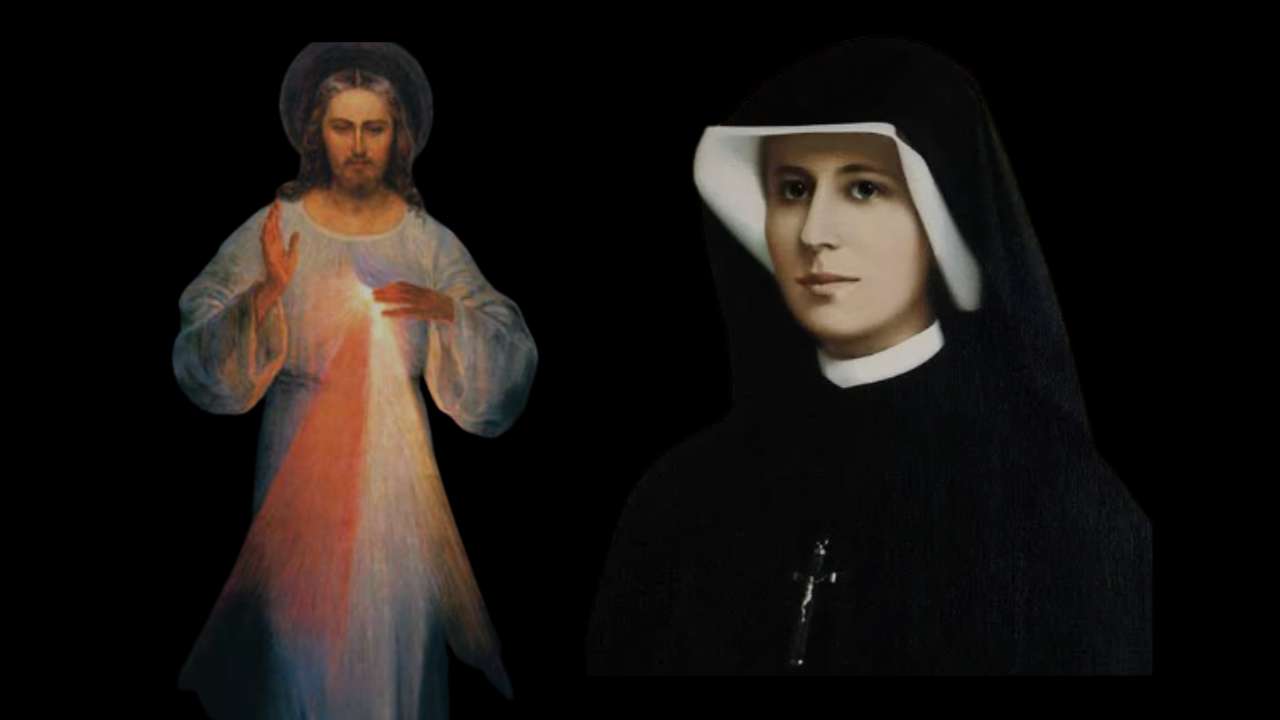
The Divine Mercy image is presented not merely as devotional art, but as a special channel of grace tied to specific promises. This goes beyond the traditional Catholic understanding of sacred images, which are honored insofar as they direct the soul to the person they represent—not as instruments of grace in themselves. Moreover, few are actually aware that Eugeniusz Kazimirowski, who painted the image in 1934, was a Freemason, who eventually committed suicide.