
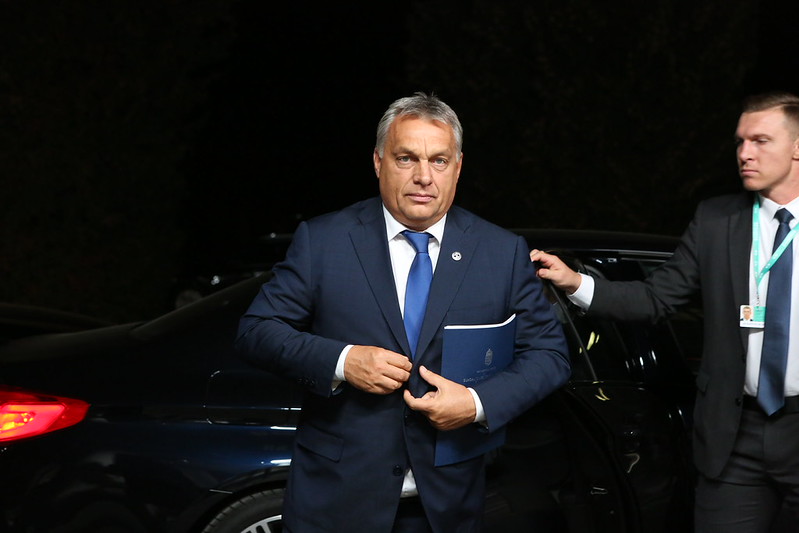
Hungary’s parliamentary elections sent shockwaves across Europe on April 12. The result was an overwhelming defeat for the ruling Fidesz party, led by former Prime Minister Viktor Orbán, and a landslide victory for the opposition Tisza Party.
Following the elections and a meeting with Hungarian President Tamás Sulyok, Tisza’s leader Peter Magyar became the newly designated prime minister. In his concession speech, Orbán congratulated Magyar and his party on their win, telling his followers that “[w]e are going to serve the Hungarian nation and our homeland from opposition.”
Magyar, meanwhile, thanked his supporters in a speech that echoed US President John F. Kennedy’s inaugural address: “Today, we won because Hungarians didn’t ask what their homeland could do for them — they asked what they could do for their homeland. You found the answer. And you followed through.”
European Commission President Ursula von der Leyen said on X that Hungary chose European unity. “Hungary has chosen Europe. Europe has always chosen Hungary. Together, we are stronger. A country returns to its European path. The Union grows stronger.”
Other European leaders sent messages as well, including Ukrainian President Volodymyr Zelenskyy, Poland’s Prime Minister Donald Tusk, and Slovakia’s Prime Minister Robert Fico, an Orbán ally who expressed a desire for cooperation with the new government, while noting Slovakia’s protection of “energy interests” remains a “key goal.”
The electoral defeat marks the end of the Orbán era, which saw him as a skeptic and sometimes opponent of many EU and NATO globalist projects. Staunchly conservative on some social issues and an ally of Donald Trump and the MAGA movement, Fidesz and Orbán governed the country for almost 16 years. A new chapter in Hungary now begins.
Who is Peter Magyar?
Magyar comes from a Hungarian conservative family. According to Euronews, his grandfather was television personality and lawyer Pál Erőss, while his godfather Ferenc Mádl was the President of Hungary from 2000 to 2005.
Prior to entering politics, Magyar was a career lawyer specializing in international law. He completed his legal studies at Humboldt Univeristy in Berlin and at Pázmány Péter Catholic University in Budapest, where he earned his law degree in 2004.
A former member of the Fidesz party, Magyar served as an envoy for Hungary at EU Headquarters in Brussels from 2010 to 2015. He then continued to serve as a Fidesz political insider, including in the prime minister’s office, until he left in 2024 and joined the Tisza party as its head.
The name “Tisza” is a portmanteau of two Hungarian words: tisztelet (respect) and szabadság (freedom). Hence, the party is called in its full name the “Respect and Freedom Party.”
Founded in 2020 by two local entrepreneurs and politicians Attila Szabó and Boldizsár Deák, Tisza unsuccessfully challenged Fidesz in the 2022 Hungarian parliamentary election, mainly due to lack of sufficient campaign funds.
Upon Magyar joining the party in 2024, Tisza re-emerged as a viable opposition party. In the run up to the 2026 elections, the party published its platform (titled “The Foundations of a Functioning and Humane Hungary”).
At the outset, the platform appears “conservative” on fiscal issues, such as lowering taxes, balancing the national budget, and reforming the government through anti-corruption measure. However, it also features buzzwords typically found in UN and EU documents, such as promoting “gender equality” in the context of equal pay and opportunities and the Green agenda.
Furthermore, the platform seeks to promote the expansion of in-vitro fertilization, which reduces human embryos as commodities. The pro-life legal firm Thomas More Society has highlighted numerous cases which warrant human embryos deserving full, legal protections.
While his party platform claims to support a “100% family program,” Magyar avoided mentioning any social issues during the campaign. Indeed, his victory speech raised alarms from conservatives when he declared that Hungary should be a place “where no one is stigmatized for loving someone differently than the majority.”
The Dispatch
Those words allude to a potential rollback of “conservative legislation” targeting the LGBT agenda in education, as well as an attempt at revisiting the Hungarian Constitution’s definition of marriage as “the union of one man and one woman established by voluntary decision, and the family as the basis of the survival of the nation.”
In another move that signaled an overture to the left, Magyar appointed pro-LGBT academic Judit Lannert as his education minister. Her social media profile pictures indicate support for left-wing causes including one in 2021 showing solidarity with the LGBT agenda, which caused backlash at the time when the Hungarian Parliament passed the Child Protection Act.
Fidesz politician Balázs Orbán criticized Lannert’s appointment in a Facebook post, calling the Tisza party part of a “rainbow coalition.” He further warned that “a world is coming where there will be a greater need than ever to stand up for our traditional values and common sense.” The news of her appointment shocked numerous conservative commentators on X, including American Michael Knowles:
Hungary’s geopolitical strategy: a regional alliance?
As for foreign policy, Magyar wants to reset relations with Hungary’s Central European neighbors to potentially create a regional alliance. According to an article in Politico, Magyar wants to “put the Austrian-Hungarian empire back on the map.”
“We were once one country, and Austria is a key economic partner for Hungary,” said Magyar. “I would like to strengthen relations between Hungary and Austria for historical, as well as cultural and economic reasons.”
One proposal is to merge the two existing regional alliances: the Visegrád Group (Hungary, Poland, the Czech Republic, and Slovakia) and the Slavkov group (Austria, the Czech Republic, and Slovakia). However, any attempt at creating a regional or supranational entity could be met with opposition. Austria made a similar attempt back in the early 2000s, but failed due to fears from Poland and Slovenia that “Vienna was seeking to reassert its hegemony more than 80 years after the collapse of the Austro-Hungarian Empire.”
Notably, Magyar is poised to visit Poland and then Austria in his first foreign trips. Former Austrian diplomat and historian Emil Birx opined on their significance.
“The visit to Warsaw is about sharing experiences regarding the transition back to a liberal democracy,” she said to Politco. “The visit to Vienna has more to do with European policy and with the fact that it is necessary to develop our own proposals from within this region.”
On other foreign policy topics, Magyar is signaling a shift from Orbán’s views on the situation in the Middle East. At a press conference shortly after his victory, he vowed to halt Hungary’s withdrawal from the International Criminal Court (ICC).
“It is the firm intention of the Titsza government to halt this and ensure that Hungary remains a member of the International Criminal Court,” said Magyar. “If a country is a member of the International Criminal Court and a person who is under an arrest warrant enters its territory, then that person must be taken into custody.”
Prime Minister Orbán ordered Hungary’s withdrawal from the international body when its prosecutors issued an arrest warrant for Prime Minister Benjamin Netanyahu over war crimes committed in the genocide in Gaza.
Daniel McAdams, Executive Director of the Ron Paul Institute for Peace and Prosperity and an expert on Eastern Europe, blamed Fidesz for falling “for a lot of stupid internationalist schemes,” including bringing the “worst type of neocons from the US” and rolling out the “red carpet” for “blood-stained genocider Netanyahu.”
Magyar was sworn in earlier this month. While he is poised to shift away from the Euroscepticism of Orbán, it remains to be seen how far he will integrate Hungary into the European Union and if social issues such as the protection of the nuclear family will become a bargaining chip.