
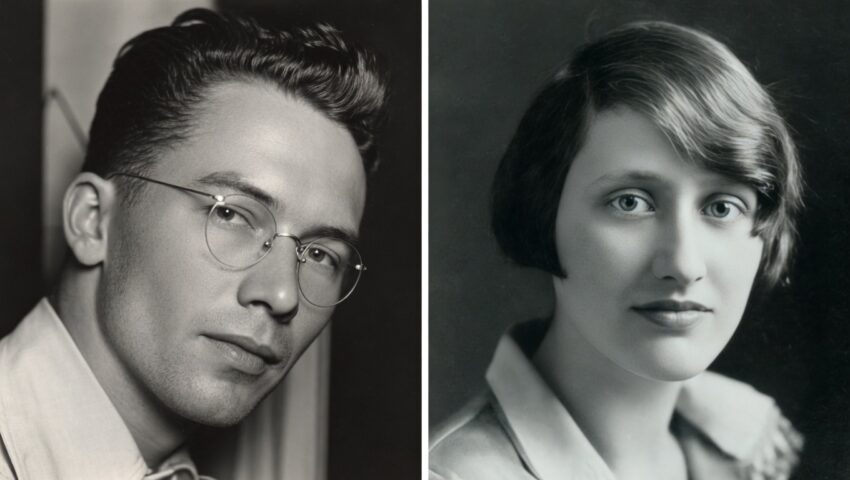
Integrity was founded in New York City in 1946 by two of the most fascinating and insightful lay American Catholics of the 20th century: Ed Willock and Carol Robinson, born in 1916 and 1911, respectively.
Uniquely penetrating, stringently Catholic, and decidedly counter-cultural, Willock and Robinson’s articles on the Industrial Revolution, pop culture, suburban life, fatherhood, spirituality, and economics — to name a few of the eclectic topics they wrote about — would, if more souls read them, help reignite what St. Pius X called the “arduous task of the restoration of the human race in Christ.”
The Dispatch
‘We must do what is right, come what may.‘
Not only did Willock and Robinson expose the lie that the post-war 1940s and 50s was a sort of golden era that should be maintained, they offered a competing, alternative political system for U.S. Catholics to go about constructing.
Alex Barbas is a family man living in Canada who has done Catholics the enormous favor of reprinting every issue of Integrity released over its 10-year lifespan for his Arouca Press website. He has also republished many of Robinson’s writings she published in the decades that followed. Click here to purchase them.
Chock full of Willock’s humorous illustrations and witty poems (“Mr. business went to Mass, He never missed a Sunday. Mr. Business went to hell, For what he did on Monday), Integrity’s first three editions made it clear that they had no intention of marrying their faith to the liberal principles of the American Founding, or to the modern world.
“We must make a new synthesis of religion and life,” their flagship editorial reads. “Integral Catholicism … does not mean piety so much as wholeness.” Whereas “the guiding policy of contemporary society” is to compromise, adjust, and water down, integral Catholicism “is at the opposite pole from expediency … we must do what is right, come what may.”
Willock’s artful cartoons and amusing quips are also unforgettable. “Modern economics would be shot full of holes, If personnel managers found that workers had souls,” reads one of his poems. “There was a fond parent named Reedy, whose children were frightfully greedy, each Christmas he gave them, something more to enslave them, while prayers he said for the needy,” reads another.
Collectively, Integrity’s message was this: America is a missionary country desperately in need of conversion. Modernity and its obsession with work and materialism wars against the life of a Catholic. Followers of Christ must live out their faith by undertaking not just in politics but in their immediate and professional spheres of influence natural and supernatural efforts aimed at defending and advancing the Kingdom of God.
Carol Robinson, lay theologian
The real star of Integrity was without a doubt Carol Robinson, who wrote under the pen name Peter Michaels. An eventual columnist for The Wanderer and an SSPX-attendee later in life, Robinson took to task those who selectively presented or distorted the truths of the Catholic faith in order to fit in. She had no time for what she deemed the “naturalistic” proposals of parliaments, Congress, or the United Nations. The cure to the problems of the day was always supernatural.
“We tend to overly preach the natural law, especially in matters of social reform and economic planning,” she wrote in Integrity’s first issue. But “all these things the heathens do.” A man “does not, by becoming more and more zealous in the practice of natural virtue, grow into supernatural life.” Are “we trying to convert them to the Church via private property…?”
“Western society is in an unprecedented mess,” she also noted, “because we have been trying to run it without grace.” The “salvation of America will depend not on converting Americans to the idea of goodness and unselfishness. They take to it quite readily. But they must be converted to a sense of the life of grace, a desire to do penance, a love of solitude and quiet, a respect for contemplation.”
Robinson’s advice stands in stark contrast to that which is offered by many leading Catholic writers in America, who never tire of talking about the need to go back to the “Founding Fathers.” But she knew that you can’t have a virtuous country without a corporate, nation-wide submission to God. This awareness helped prevent her from falling for the lie that American-style liberal democracy was the solution to atheistic communism. She always unashamedly called for the conversion of the West to the Catholic faith.
Ed Willock, the ‘gentle prophet’
In his own essays, Willock, who was often ill, railed against everything from the vacuity of sports and the growing effeminacy of men. He also called out the dangers of television and the glorification of enjoying the finer things in life. Quotes from his slender 1948 book, “Ye Gods,” a collection of short essays that was published by Sheed and Ward, gives ample proof of his inimitable perspective on modern life:
- Pontius Pilate’s sentencing of the Son of God to death was “murder by remote control.”
- “A car or radio that is slow to warm up provides the modern speed demon with the same kind of torture formerly generated by a hair-shirt.”
- “In a society that has made Economics of primary importance…having money would be considered as being in the state of grace.”
- “Efficiency will be considered a virtue as long as it is profitable to reduce men to the level of automatons.”
So unique were Willock’s writings that a religious sister attending Marquette University in 1969 wrote her Master’s thesis (“The Social Vision of Ed Willock”) about him.
It is fair to categorize Willock, as well as Robinson, as being of the same caliber and of the same anti-modernist, anti-Americanist school of thought as Fr. Clifford Fenton and Fr. Francis J. Connell. Fenton and Connell are most known for having warred against Liberal Catholics like Fr. John Courtney Murray, the main architect of Vatican II’s document on religious liberty, on the pages of the American Ecclesiastical Review.
One is left to wonder what would have happened if Willock, who died in 1960 before Vatican II, lived as long as Robinson, who passed away in 2002, did and if the Second Vatican Council never took place. Would they be held in as high regard as other American Catholic writers and outlets? Would the United States have become a Catholic country?
One can’t know for sure, but surely Ed Willock and Carol Robinson would have played a central role in making that happen. I look forward to reviving their insights and applying their wisdom in the 21st century. It is needed now seemingly more than ever.