
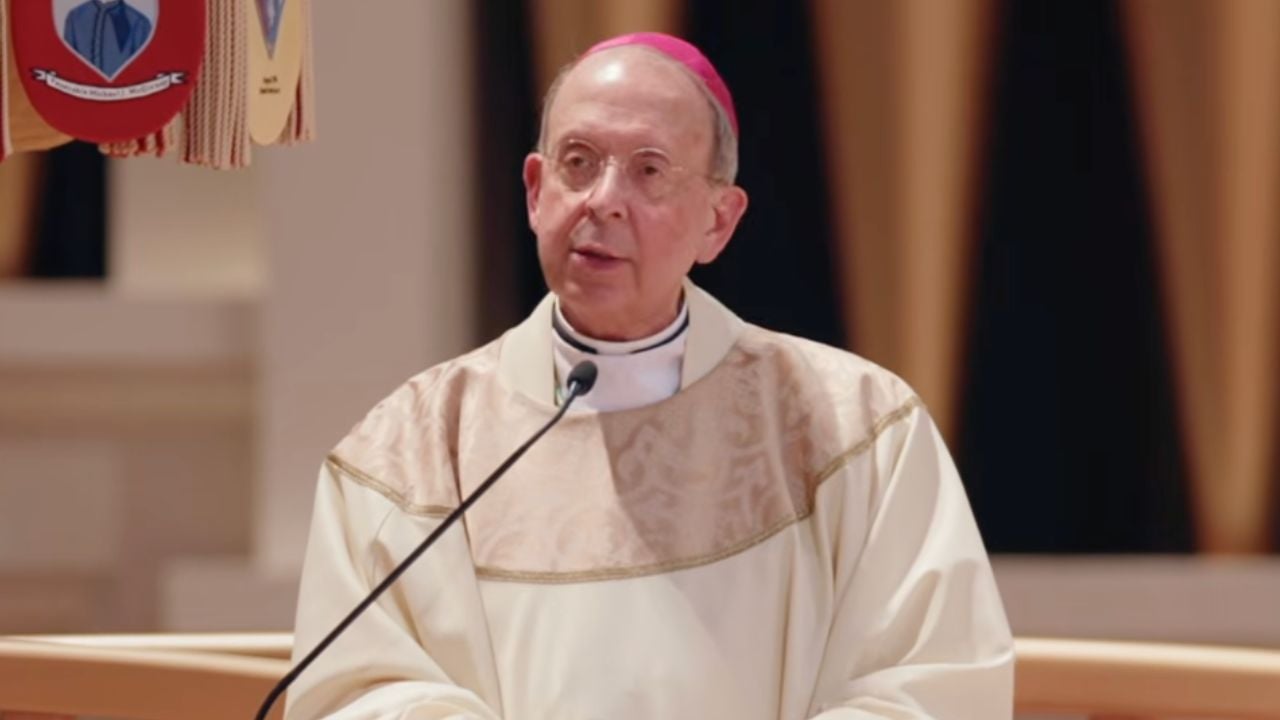
On the Feast of the Sacred Heart of Jesus, the United States Conference of Catholic Bishops (USCCB) marked the 250th anniversary of the founding of the United States by consecrating the nation to the Sacred Heart.
Many Catholics — even those in the Traditional sphere — understandably welcomed the event. Any public invocation of the Sacred Heart in an age of secularism seems like a positive development, and the Sacred Heart devotion is among the Church’s greatest treasures.
But it didn’t take long for questions around its substance to be raised. A careful examination of both Archbishop William Lori’s homily and the text of the consecration prayer itself reveals troubling elements and even casts a shadow over the validity of the consecration.
The prayer’s language echoed the priorities of the Conciliar Church rather than the language, theology, and spirit found in traditional consecrations to the Sacred Heart.
One of the biggest questions — though not the only one — is whether this consecration truly affirms the Kingship of Christ or whether it was used as a vehicle for synodal, modernist, ecclesial, and liberal-woke political priorities.
Traditional devotion to the Sacred Heart is inseparable from the reality of sin, reparation, penance, conversion, and Christ’s social kingship. Consider Pope Leo XIII’s famous consecration of the human race to the Sacred Heart in 1899. His prayer repeatedly spoke of Our Lord’s dominion over individuals, families, and nations. It further acknowledged that many have rejected His sovereignty, while asking that they be brought back into the Church.
Likewise, Pope Pius XI’s 1925 encyclical Quas Primas taught that nations are obligated to recognize the Kingship of Christ — a teaching presented not as a private devotion but as a public obligation.
In contrast, the USCCB prayer avoids these themes like the plague. It speaks of “friendship” with Christ, healing relationships, repairing injustices, and promoting peace and happiness. These are not historically associated with a consecration to the Sacred Heart.
There is also no explicit mention of Christ’s kingship over the United States or of the need for the conversion of its public institutions. America’s legal support for abortion, sodomy, pornography, religious indifferentism, and attacks on the natural family go unmentioned as well.
The disappointing and tragic result is a prayer that sounds more like a call for social harmony than a solemn act of national submission to the true faith.
Human dignity: A core doctrine of the Vatican II religion
One of the most dismal parts of the prayer is when it says reparation is offered “for the offenses against you and against human dignity that have taken place in this nation.”
The synodal religion’s omnipresent god of “human dignity” strikes again!
Traditional Catholic prayers of reparation focus first and foremost on offenses against God. The synodal practice, however, is to place “human dignity” at the center of nearly every discussion.
While human dignity is certainly a legitimate Catholic concept, it functions in Francis and Leo XIV’s contemporary “Church” as a substitute for explicitly supernatural categories.
The Dispatch
Throughout the homily and prayer, one witnesses a strong anthropocentric tendency. The emphasis falls on healing, reconciliation, belonging, inclusion, relationships, identity, and human flourishing; while hardly any attention is paid to repentance, judgment, grace, conversion, sacrifice, and the necessity of conforming oneself to Christ.
Over the past decade, post-conciliar leaders have often used calls for “unity” and “reconciliation” to avoid more important and much needed truths which they see as “divisive.” The language of unity is a cheap and unconvincing substitute for the proclamation of truth.
In his remarks, Lori spoke repeatedly of overcoming division, yet said virtually nothing about the specific sins destroying both Church and society: abortion, gender ideology, the collapse of marriage, contraception, pornography, or the crisis of faith, which are precisely the wounds to Christ’s Sacred Heart that demand national repentance.
Another notable feature was the emphasis he placed on right relations. Lori stated that Christ desires “not merely our obedience, but our friendship.” True, Our Lord called his disciples “friends,” and traditional Catholic spirituality has never opposed friendship alongside true obedience. However, the overemphasis on this sort of lovey-dovey language seems unfitting in these times given that rebellion to and disrespect for true authority have reached epidemic levels.
Was it a valid consecration?
Serious questions need to be asked about the validity of the consecration. The prayer contained no explicit act of self-offering or surrender. A consecration, by its very nature, involves the dedication of a person, community, or nation to God through a deliberate act of entrustment. Yet nowhere does the prayer actually state, “we consecrate ourselves,” “we dedicate this nation,” or “we are yours,” although Lori did use similar terminology in his sermon.
Second, the prayer remained entirely in the realm of petition rather than entrustment. The closest it came to the language of consecration is the request, “May our hearts be united to yours.” However, this was expressed as a petition asking God to bring about such a union, rather than a declaration by the faithful to freely commit themselves to the Sacred Heart.
True consecration requires an active offering by the one being consecrated. It is a performative act: something is accomplished precisely through the act of saying it. In traditional formulas of consecration, one finds explicit language of dedication, surrender, and belonging. The USCCB’s prayer, by contrast, asks for blessings and spiritual favors but never performs the act of entrustment itself.
Finally, the prayer also contains a phrase that should make any counter-revolutionary Catholic’s hair stand on end. It praised America’s founding upon “the self-evident truths that our Creator has endowed all people with the right to life, liberty, and the pursuit of happiness.”
This John Locke-inspired line comes from the Declaration of Independence. But the uncomfortable truth is that the American experiment’s philosophical foundations are not compatible with Catholic teaching. The Declaration was drafted by Protestants, Masons and anti-Monarchists — hardly men you want to quote when consecrating your country to the Sacred Heart of the King of Kings.
A final and particularly problematic issue, one that was raised by Fr. William Jenkins of the Society of St. Pius V, concerns its credibility.
Because a consecration is a solemn act of entrustment that should reflect genuine submission to Christ, one can’t help but reasonably ask whether these bishops, who have spent decades accommodating secular culture and promoting soft and not-so soft Marxist and anti-Catholic ideologies, can credibly lead such an act.
Indeed, the same episcopal conference that has carried out this “consecration” has repeatedly embraced inter-religious initiatives that blur the uniqueness of the Catholic faith, promoted synodal processes that minimize doctrinal clarity, allowed Pride “Masses,” been hesitant to denounce politicians who claim to be Catholic but promote abortion, and persecuted faithful Catholic laity and clerics for their orthodoxy.
All of these are precisely what offend the Sacred Heart of Jesus. It therefore seems especially hypocritical — and even inappropriate — for such an institution to carry out this consecration unless it is accompanied by serious repentance and a reversal of the doctrinal and ecclesial destruction they have been complicit in for decades.