

In accurately addressing matters of natural science, a number of principles need to be known and understood. One also needs to be wary of pitfalls.
A science is an organized body of knowledge. The highest of the sciences is theology, which is considered the “queen of the sciences” because its object is God Himself — there is not a higher object of knowing.
The natural sciences deal with knowledge of the various physical aspects of God’s creation, be it living organisms via biology, the atomic and molecular structure and interactions of physical reality via chemistry, and so forth.
The natural science to be addressed in this series of articles is geology, the study of the non-living solid natural structures and processes of our world. Liquids and gases are included insofar as they are directly connected with the solids, otherwise they each have their own sciences, among which are meteorology and oceanography.
Any science relies on two things: observations and a way of organizing those observations so that an underlying pattern can be discerned, a pattern that not only makes sense of the observations but can even be predictive.
A collection of observations is called a data set. The more observations, the better as there is less likelihood of overlooking something that can unexpectedly contradict or overturn the pattern that one is beholding.
A pattern is seen through the interpretive framework employed by the person pondering the significance of the observations; this framework is a paradigm.
Unlike an observation — which is an aspect of reality imposing itself on the observer — a paradigm is chosen by the observer. The best paradigm is selected through Occam’s Razor, the principle that the simplest and most comprehensive explanation for something is usually the most accurate.
There is, of course, reasoning involved in using a paradigm in tandem with a data set to reach a conclusion about that data set. There are generally two kinds of reasoning.
Deductive reasoning is reasoning from general principles to a particular conclusion. For example, when I see widespread dead palm trees, bird-of-paradise plants, and croton bushes in Florida after abundant rain for multiple days, that large set of data points makes multiple principles come to mind: First, that plants aren’t dead unless killed or unless they’ve reached the end of their lifespans. Second, that plants can be killed by drought, a freeze, or a disease. Third, that palms, crotons, and birds-of-paradise do not each have the same susceptibility to drought or a particular disease, and each species has a different lifespan. When overlapping these three principles, I can reasonably conclude that the area suffered a recent freeze that killed these plants.
The Dispatch
The other type of reasoning is inductive, that is reasoning from many particulars to a general principle.
For example, if an ash tree were to possess an intellect, it would, growing for decades, experience thousands of sunrises and sunsets, many rainstorms, snow in a particular time of the year, and much wind. It’s life would be predictable because all of its particular observations point to the general conclusion that the sun will rise tomorrow, it will snow in the winter, rain in the summer, and the wind will most likely blow each day.
Pros and cons of deductive and inductive reasoning
Now, each of these forms of reasoning has a pitfall.
In deduction, one can overlook a general principle. In the Florida example, it could be that the regional mosquito-spraying agency employed a pesticide formulation that specifically, albeit unintentionally, targeted the three species of aforementioned dead plants.
In induction, one does not have access to the future and is thus unaware of an upcoming contradictory data point. In the example of the ash tree, it is a lack of knowing that tomorrow the landowner will be cutting the ash tree down to make furniture from it.
There are also pitfalls in one’s choice of paradigms.
One pitfall is a self-serving religious and/or philosophical bias. Such bias entails a denial of aspects of reality that do not fit one’s pre-conceived desires or ideas. Consequently, the conclusion reached from employing a paradigm upon a data set ends up being false.
Another pitfall is credentialism, the mistaken belief that someone’s level of education, position in society, religious vows, ordination, and similar factors make their conclusions more accurate. A conclusion has to be backed up by data and by a paradigm that is realistic — anyone making a claim about things needs to produce these alone for validity.
Enjoying this article? Join the Counter-Revolution today!
There is also the evolutionism-inspired fallacy of temporal snobbery: people in the modern era are more intelligent/sophisticated, etc. than the bumpkins of old, so the claim goes, ergo data and conclusions from past ages need to be regarded with condescension and suspicion.
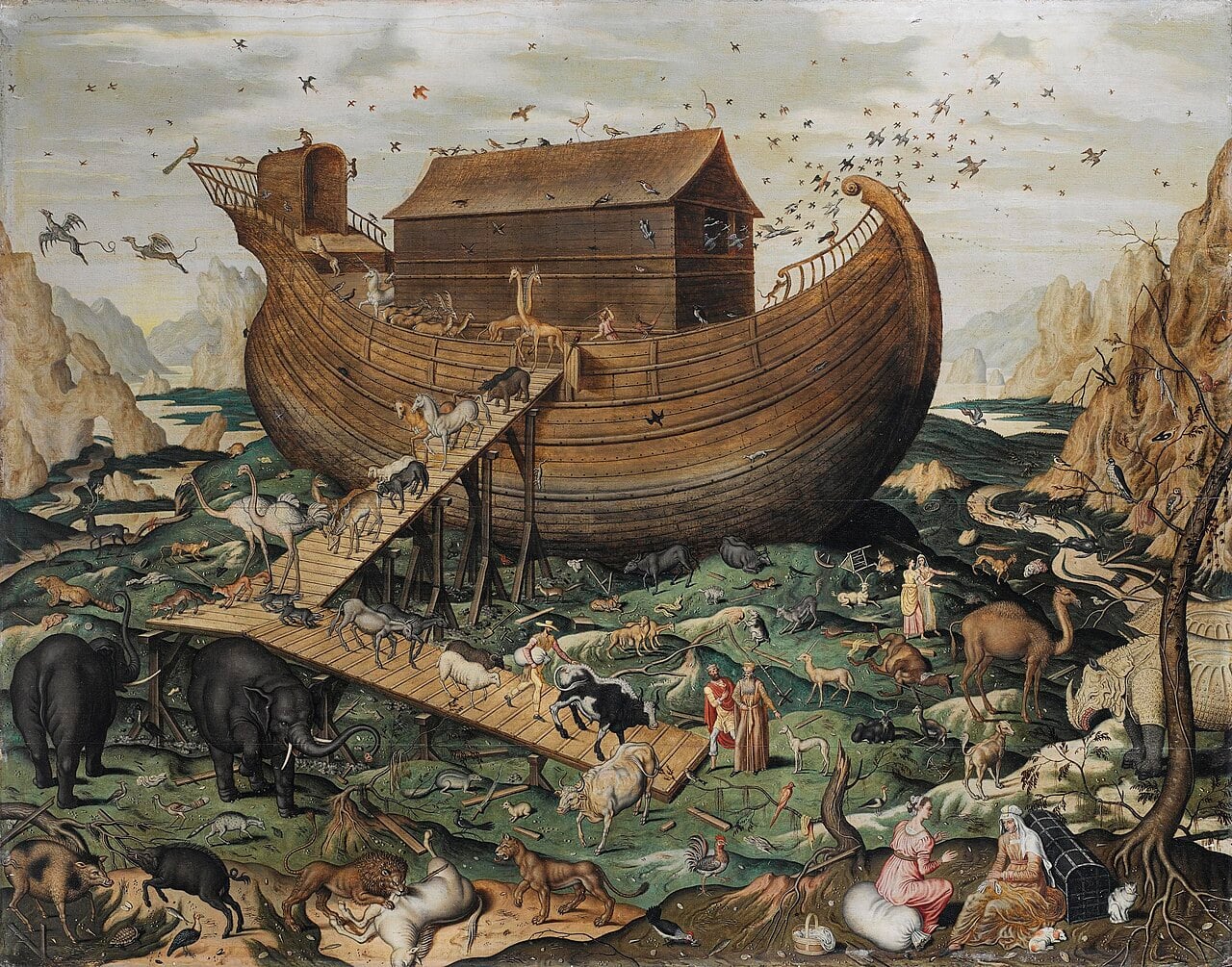
The above treatment of correct thinking is not by any means exhaustive, but it does provide a sufficient framework with which to approach the various items of Great Flood evidence (data) that we will be considering in this series.
Finally, it is the author’s intention, through each of his examples of evidence, both to point the reader in the direction that the example indicates, and to encourage him to delve into its content further on his own.