
The Society of Saint Pius X (SSPX) has entered a new phase in its decades-old confrontation with Rome by formally appealing the Vatican decree issued after the episcopal consecrations at Écône on July 1.
Unlike the events following Archbishop Marcel Lefebvre’s consecrations in 1988, the Society is now making full use of the Church’s canonical procedures to challenge the penalties imposed upon it.
The appeal does not alter the underlying dispute over the consecrations themselves, but it introduces a legal process that could shape how the conflict develops in the months ahead.
On July 1, Bishop Alfonso de Galarreta consecrated four priests as bishops without the required pontifical mandate. Rome had repeatedly requested that the consecrations not proceed, arguing that they would constitute a grave act against ecclesiastical unity. The Society, however, maintained that the Church is facing an extraordinary crisis and that new bishops were necessary to preserve the traditional priesthood and the Faith.
The following day, the Dicastery for the Doctrine of the Faith declared that the consecrations were “an act of a schismatic nature” and announced that the consecrating bishop, the co-consecrator, and the four newly consecrated bishops had incurred excommunication. The decree also warned the faithful against formal adherence to the Society.
The announcement not only opened old wounds but drew comparisons with the 1988 consecrations. At that time, Rome likewise declared the participants excommunicated. Archbishop Lefebvre rejected the penalties as being invalid because he believed he had acted out of a state of necessity, but he never pursued the formal appeal procedures available under canon law. Those excommunications were later remitted by Pope Benedict XVI in 2009, although the underlying canonical issues remained unresolved.
This time the Society has adopted a different strategy.
On July 11, it submitted what canon law calls a preliminary recourse to the Dicastery for the Doctrine of the Faith. Under Canon 1734, anyone who believes they have been harmed by an administrative decree has the right to ask the authority that issued it to revoke or amend its decision before making a higher appeal.
The Society describes this not as an act of rebellion but as the exercise of a right recognised by the Church itself. In its official communiqué, the SSPX stated that it seeks the correction of the decree “in a spirit of respect for ecclesiastical authority and of faithful attachment to justice, truth and the good of the Church.”
The legal process is relatively straightforward.
The Dicastery now has thirty days to respond. It may revoke the decree, modify it, or reject the request entirely. If the Society receives an unfavourable response, or if no response is given within the required period, it may then lodge a formal hierarchical recourse before the competent higher authority under Canon 1737.
The Society also argues that Canon 1353 means the filing of the appeal automatically suspends the execution of the decree while the matter is being considered. In practical terms, it maintains that the penalties declared by the Vatican cannot be enforced until the canonical process has run its course.
The Dispatch
The appeal itself rests on several familiar arguments.
First, the Society rejects the accusation that the consecrations constituted schism. It argues that schism requires a refusal of submission to the Roman Pontiff or a rejection of communion with the Church. According to the Society, neither condition applies because it continues to recognize Leo XIV as the legitimate Roman Pontiff while disputing what it considers to be an unjust administrative act. In its view, disobedience in a particular case should not automatically be equated with schism.
Secondly, the Society again invokes the principle of necessity. Drawing on Canons 1323 and 1324, it argues that those acting under grave necessity or to prevent serious harm may not incur canonical penalties in the ordinary way. It maintains that the current crisis in the Church creates precisely such a necessity, echoing the reasoning first advanced by Archbishop Lefebvre nearly four decades ago.
Supporters of the Society also point to previous cases where canonical appeals have succeeded. One frequently cited example is the Hawaii case of the early 1990s, when several Catholics associated with SSPX chapels successfully appealed decrees of excommunication after Rome concluded that their actions did not amount to formal schism. While the circumstances differ considerably from the present dispute, the case demonstrates that canonical recourse can sometimes result in the reversal of ecclesiastical penalties.
Nevertheless, the appeal has also attracted substantial criticism.
Some canonists argue that the Society cannot simultaneously maintain that the decree is legally null while also seeking its amendment through the very legal system whose authority it questions. Critics see this as an internal contradiction, suggesting that appealing under the 1983 Code implicitly recognises the authority of the Code and of the Dicastery that issued the decree.
Others dispute the Society’s interpretation of Canon 1353.
While there is broad agreement that the appeal may suspend the execution of the decree itself, some argue that this does not suspend the underlying latae sententiae excommunication, which, if validly incurred, would already have taken effect automatically at the moment of the consecrations.
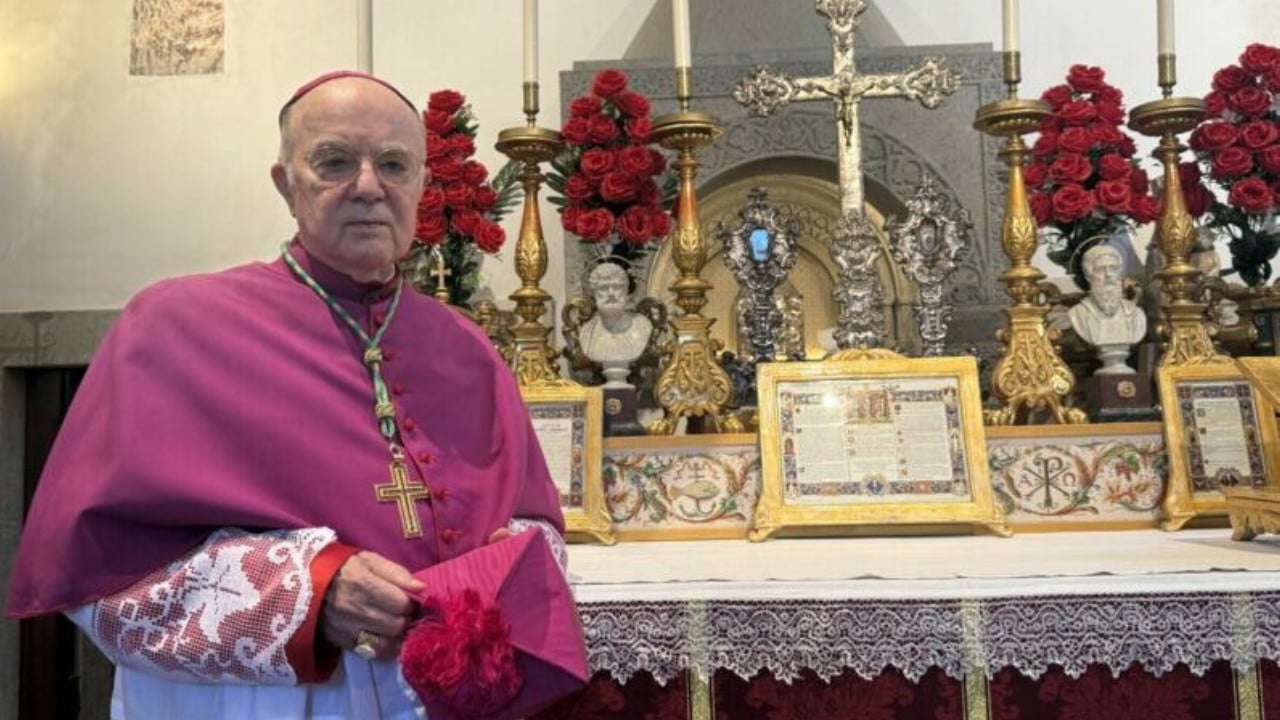
Among those welcoming the Society’s decision is Archbishop Carlo Maria Viganò. Writing on X, he described the appeal as “canonically correct and strategically opportune.” His Excellency also rejected any suggestion that it represented compromise or surrender, calling it “an exercise in defending its own rights within the ecclesiastical order.”
Viganò further argued that the appeal places the burden upon the Holy See itself. “Whatever the Vatican’s response may be,” he wrote, “the Society is forcing its interlocutor to reveal its true intentions.” His Excellency concluded simply: “Excellent move.”
Where do things go from here?
There are doubts about the likely outcome. The arguments based on necessity and the absence of schism closely resemble those advanced after the 1988 consecrations and were rejected by Rome at the time. Whether the present Vatican will reach a different conclusion remains uncertain.
Whatever the final decision, the appeal seeks to ensure the dispute will proceed through the Church’s own legal structures rather than remaining solely a theological and public controversy.