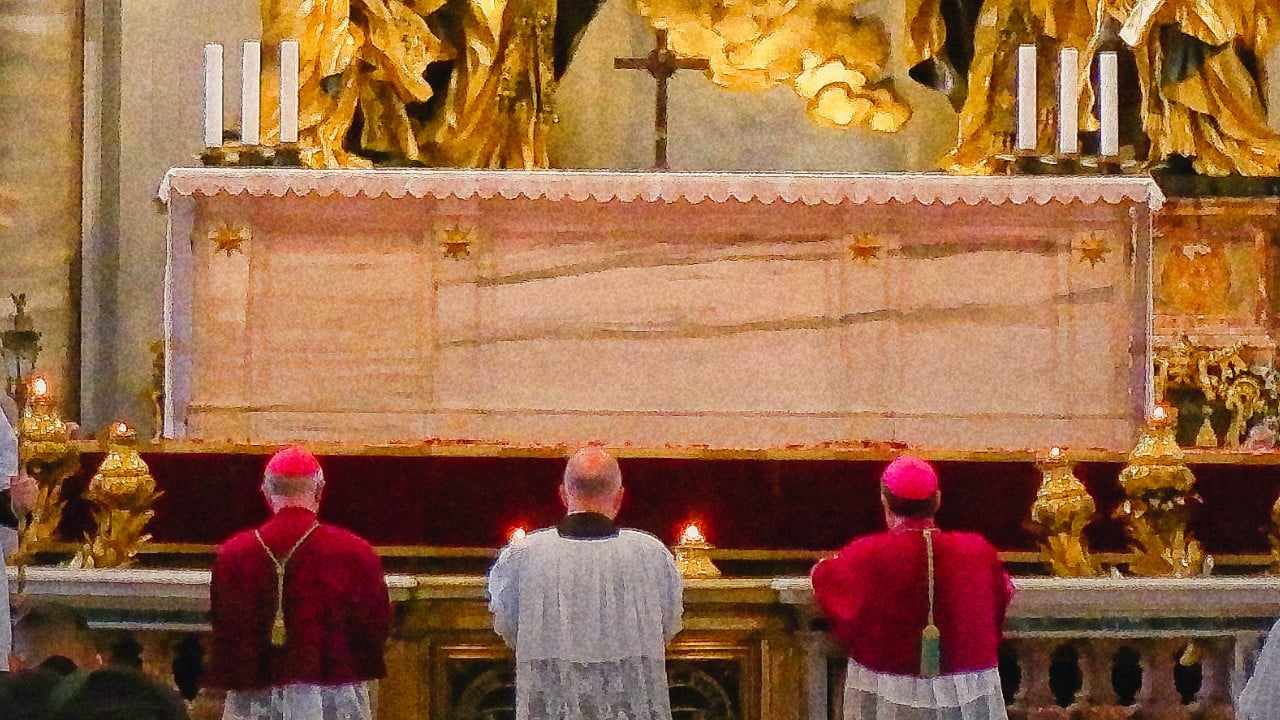
On June 26 and 27, the extraordinary consistory convoked by Leo XIV will take place at the Vatican.
This will be the second such gathering since the 2025 conclave and forms part of his stated intention to convene the College of Cardinals annually. The meeting will conclude with the Solemnity of Saints Peter and Paul on June 29, when Leo will impose the pallium on newly appointed metropolitan archbishops.
The initiative marks a notable change from his predecessor, who rarely held extraordinary consistories and who relegated the College of Cardinals to a more limited role. Prevost, on the other hand, has repeatedly stated that he wishes to strengthen collegiality and “mutual listening” within the government of the Conciliar Church.
These are, of course, euphemisms for strengthening the “synodal” character of the new “church” he is erecting.
The consistory will gather clergy from around the world for two days of “prayer, discussion and reflection.” The Latin Mass was infamously scrapped from the original agenda. Proceedings will begin with Mass in Saint Peter’s Basilica, followed by four major sessions in Paul VI Hall and the New Synod Hall located within the Paul VI complex.
The first session will consider the question: “In what world are we called to proclaim the Gospel?” No doubt the “gospel” of this session refers to the Marxist social justice ideology which both Bergoglio and Prevost advance. Cardinal Grzegorz Ryś of Kraków will deliver the introductory “biblical” meditation. Cardinals will then discuss the tensions, sufferings, and hopes present in their local Churches and in the societies they serve.
The second session, entitled “The Culture of Power and the Civilization of Love” — a theme that sounds like a lost Star Trek episode from the 60s — will be introduced by Synodal pornographer-in-chief Víctor Manuel Fernández, Prefect of the Dicastery for the Doctrine of the Faith.
Drawing from Leo XIV’s paean to secular humanism and the worship of Man, Magnifica Humanitas, the discussion will examine wars, social fractures, geopolitical instability, and the means by which the Church can promote reconciliation, coexistence, and peace — all hot-button topics for devotees of the wokeism that has poisoned the Tiber these days.
The third session will be introduced by Cardinal Stephen Brislin of Johannesburg, and will focus on the common good and the challenges facing contemporary societies. In other words, more insipid how-can-we-build-an-earthly-paradise-without-Christ garbage. The cardinals will reflect on social fragmentation, unmet expectations among the faithful, and possible pastoral responses by local Churches and the universal Church. As with the two first sessions, nothing remotely Catholic will be on the agenda.
The fourth and final session will concern the implementation of the Synod on Synodality. This will possibly become a permanent feature at all important gatherings of the Synodal Church until it finally tries to drive a stake through Mother Church’s heart at the World Synod in 2028. Cardinal Mario Grech will present the preparatory document for the synodal assemblies planned for 2027 and 2028, after which the cardinals will discuss the future direction of the synodal process. In other words, the new religion is in full swing.
Avoiding the liturgy like the plague
The methodology adopted for the consistory closely follows the format used during the recent synodal assemblies in Rome. The cardinals will be divided into twenty working groups. Nine will consist primarily of diocesan ordinaries and cardinal electors, while eleven will contain curial officials and non-elector cardinals. Each group will have a president and a secretary responsible for moderating discussion and preparing a final report.
Interventions will be strictly timed. Cardinals will receive three minutes for their initial contributions and two minutes in a second round intended to identify important themes rather than introduce new arguments. Group reports will then be presented to the full assembly in brief summaries. Only the opening and closing addresses of Leo will be broadcast publicly. The discussions themselves will remain confidential, and participants have been asked not to speak to the press during the proceedings. Official summaries will be released by the Holy See Press Office.
Concern has been expressed by naïve traditionalists and conservatives about the subjects chosen for discussion. Questions of liturgical peace, the restrictions surrounding the traditional Roman rite, the crisis of priestly vocations in many parts of the West, and unresolved doctrinal controversies from the previous pontificate do not appear on the agenda and likely won’t in the future either.
The Dispatch
The “Latin Mass only” camp has pointed out that the liturgy remains absent from the program despite continuing tensions throughout the Church over Traditionis Custodes and its implementation. This is, of course, a totally misguided concern, as having the Latin Mass without the doctrine it represents will not stop the Modernist revolution.
The speakers are also a firm indication that the Synodal juggernaut will continue until Christ obliterates it. Both Fernández and Grech remain closely identified with the theological and ecclesial priorities of the heretic Bergoglio and their prominence are evidence of the continuity that Leo is so keen to maintain.
The SSPX does what the consistory should do
Meanwhile, to add some spice to this dour anti-Catholic event, the Society of Saint Pius X (SSPX) has addressed an open letter accompanied by a 154-point Profession of Faith to the nemesis they love to hate, Leo XIV, and to the cardinals gathered in Rome for the consistory.
The intervention comes at a particularly sensitive moment in relations between the SSPX and the Holy See as the Society’s episcopal consecrations are set for July 1. As everyone in Tradland knows by now, should the current impasse continue, the SSPX will be designated schismatic and excommunicated. Rumors have it that the SSPX faithful might be included in this farcical decree.
The lengthy Profession sets out, in systematic form, the doctrinal principles which the Society believes must guide any authentic renewal of the Church.
The Society explicitly frames the present crisis not as a dispute over preferences or ecclesiastical styles but as a conflict touching the very substance of the Catholic faith. “The current crisis therefore cannot be reduced to a mere conflict of sensibilities, liturgical preferences, or pastoral options,” the text states. “It touches upon the very foundations of faith and morals, of the priesthood and worship, of the Church and the Kingship of Christ.”
The declaration repeatedly contrasts what it calls the permanent teaching office of the Church with more recent appeals to adaptation and dialogue. “The Holy Ghost was not promised to the successors of Peter so that they might manifest new doctrine, but so that they might guard holily and expound faithfully the Deposit transmitted by the Apostles.” It continues: “The Pope and the bishops are not the masters of Revelation; they are its guardians and are subject to it as a disciple is subject to his master.”
Particularly striking, given the themes dominating the present consistory, is the document’s direct criticism of synodality and the ecclesiology associated with it. The Society warns against “the perpetual dialogue established in the spirit of the last Council” and rejects “synodal procedures by which what the Church has received from God is put in question.” The text insists that “the Spirit of truth cannot today inspire the contrary of what He inspired yesterday” and that the Church’s mission is not “to listen to the world in order to receive its aspirations from it” but rather “to teach the world, to convert it, and to sanctify it.”
Perhaps the most provocative sentence in the entire document comes in its final analysis of the post conciliar crisis, where it declares that “collegiality and synodality attack the divine constitution of the Church in her hierarchy” and that “liturgical anthropocentrism attacks the Holy Sacrifice of the Mass.”
A praiseworthy intervention
Released as the cardinals gather to discuss listening processes, participation structures, and future synodal assemblies, the SSPX’s intervention amounts to a direct challenge to many of the assumptions that have shaped ecclesiastical life during the last decade.
Whether Rome chooses to engage with these arguments or dismiss them, the Society has ensured that questions of doctrine, liturgy, and the limits of ecclesial reform will continue to hover over the proceedings in the Vatican
Sadly, both the consistory and the ongoing SSPX saga are tragic signs of how far Rome has fallen down the abyss of apostasy.