
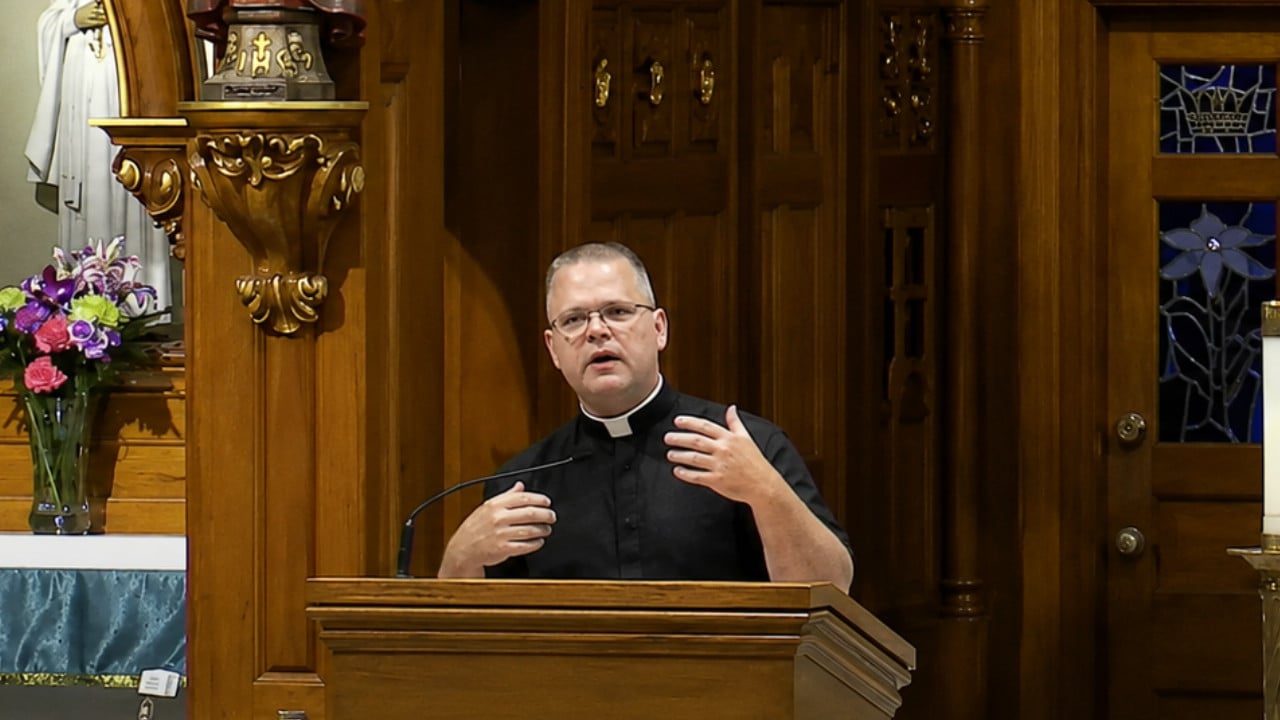
Fr. Chris Alar recently devoted considerable time to responding to criticisms of the Divine Mercy devotion raised on a recent Integrity Magazine podcast with myself, Sebastian Malik, Nate Vaughan, and Stephen Kokx.
I welcome his response (which you can watch below) since debate on this issue is sorely needed. If a private revelation has profoundly shaped modern Catholic spirituality and has been promoted throughout the world for decades, then it should be able to withstand careful historical and theological examination.
After listening carefully to his entire response, I found myself surprised not by how often he failed to engage the actual arguments we presented. Time and again, his remarks shifted away from the text of Sr. Faustina’s Diary to his interpretations, broad historical assertions, or entirely different questions than the ones we raised.
This is particularly disappointing because there are many serious questions that have not received adequate answers, such as:
- Did the Catholic Church truly lose its awareness of Divine Mercy for centuries, as Fr. Alar repeatedly suggests? If so, when?
- Which council, catechism, papal encyclical, Roman Missal, or Doctor of the Church demonstrates such a loss?
- If the extraordinary promise of Divine Mercy Sunday is neither a sacrament nor a plenary indulgence, into what category of Catholic theology does it fall?
- If Christ really intended St. Faustina to mean “first among the virgins alive on earth at that time,” why are those crucial qualifying words absent from the Diary itself?
- If Fr. Sopoćko’s academic credentials are the principal defense of his spiritual direction, why was the actual question of whether he followed the principles of discernment taught by St. John of the Cross left almost entirely unanswered by Fr. Alar?
These are not peripheral objections. They lie at the heart of the debate.
Read More: 10 Concerning Facts about the Divine Mercy Devotion
In his presentation, Fr. Alar portrays our criticism as a rejection of God’s mercy itself. It is nothing of the sort. The issue has never been whether Catholics should believe in Divine Mercy. Every Catholic must. The issue is whether the claims contained in a twentieth-century private revelation faithfully reflect the perennial teaching of the Catholic Church.
For the sake of brevity, I will not address every error, misstatement, or historical assertion contained in Fr. Alar’s presentation. Several could easily merit articles of their own. Instead, I will focus on several representative examples. They reveal a recurring pattern that leaves the principal questions raised in my book The Divine Mercy Devotion: A Critical Examination, and the website realdivinemercy.org, substantially unanswered.
I. Did the Church lose its awareness of Divine Mercy?
Perhaps the most astonishing claim in Fr. Alar’s entire presentation was his repeated assertion that, for centuries, the Catholic Church had lost its awareness of Divine Mercy. At one point he states: “probably between Trent and Vatican II the emphasis was placed more on God’s justice. We’re not saying you shouldn’t focus on God’s justice, but when all you do is focus on God’s justice and you remove His mercy as being as important, you miss it.”
This is an extraordinary historical claim. Fr. Alar is not speaking about a handful of priests or isolated theologians. He is speaking about the Catholic Church herself and her preaching over nearly five centuries. If this is true, several questions immediately arise.
- Exactly when did this loss of awareness occur?
- Did it begin immediately after the Council of Trent?
- If so, what was it about the Council that caused this shift?
- Was there something about the Council itself that diminished the Church’s understanding of Divine Mercy?
- If the Council marked the beginning of this decline, are we to believe that the Holy Ghost, who guides the Church in ecumenical councils, somehow presided over a period in which one of God’s central attributes faded from the Church’s consciousness?
Or did the loss occur later?
- If so, when exactly?
- During the Counter-Reformation, the very period many historians regard as a golden age of Catholic renewal? The age that produced St. Charles Borromeo, St. Philip Neri, St. Francis de Sales, St. Robert Bellarmine, St. Teresa of Ávila, St. John of the Cross, and St. Alphonsus Liguori?
- Was this truly an era in which the Church had somehow forgotten Divine Mercy?
- Did the Church also neglect mercy during the First Vatican Council?
Fr. Alar offers no historical evidence. Since he makes the assertion, he must answer:
- Which ecumenical council neglected mercy?
- Which Roman Catechism?
- Which Roman Missal?
- Which papal encyclical?
- Which Doctor of the Church?
- Which official act of the Magisterium demonstrates that the Church lost awareness of one of God’s defining attributes?
Instead, Fr. Alar merely points to Jansenism. He says: “Back in Jasenism, we focused on God’s justice only.” But this example undermines rather than supports his argument.
Visit RealDivineMercy.org to learn more
Jansenism was not a teaching of the Catholic Church. It was a condemned heresy. The Church repeatedly opposed it precisely because it distorted the proper relationship between God’s justice and His mercy. A condemned error cannot be presented as evidence of the Catholic Church’s official teaching. If anything, the Church’s repeated condemnation of Jansenism demonstrates that she never lost sight of Divine Mercy.
The Church’s condemnation of Jansenism is significant because it cuts off at the knees Fr. Alar’s allegations and central themes of Sr. Faustina’s Diary itself. The claim in Diary 378 that the Church’s splendor had been “dormant for a long time.” This assertion suggests a state of spiritual diminishment during the very eras of profound doctrinal clarity and vitality. Fr. Alar’s historical narrative appears intended to this entry. However, he just digs himself into a deeper hole because history simply does not cooperate.
The Catholic Church did not suddenly discover Divine Mercy in the twentieth century. The Church preached it continuously through Scripture, the liturgy, the sacraments, the Fathers, the Doctors of the Church, and centuries of spiritual theology. To suggest otherwise requires far more than assertion. It requires compelling historical evidence. Fr. Alar provides none.
II. A new means of obtaining complete remission of sins?
Perhaps the most revealing portion of Fr. Alar’s response concerns Diary 699, where Christ allegedly promises that “the soul that will go to Confession and receive Holy Communion shall obtain complete forgiveness of sins and punishment.”
My book argues that this promise presents a serious theological difficulty because it appears to introduce a new means of obtaining what Catholic theology has traditionally associated only with Baptism or, under carefully defined conditions, a plenary indulgence.
Fr. Alar claims this criticism misunderstands the devotion. Interestingly, he repeatedly emphasizes that the extraordinary promise of Diary 699 is not a plenary indulgence. Rather, he argues that it is a distinct grace received directly through Christ’s promise in a private revelation.
Ironically, this “clarification” sharpens the question rather than answering it. If the extraordinary promise is neither Baptism nor a plenary indulgence, then what is it? More precisely, by what category of Catholic theology should it be understood?
Catholic theology has always carefully distinguished the ordinary means by which God has promised to communicate particular spiritual benefits:
- Baptism remits both guilt and all punishment due to sin.
- Sacrament of Penance remits guilt and eternal punishment but ordinarily leaves temporal punishment to be satisfied through penance, indulgences, or Purgatory.
- Plenary indulgences remit temporal punishment under the specific conditions established by the Church.
Fr. Alar explicitly distinguishes Diary 699 from a plenary indulgence while simultaneously affirming that it produces essentially the same or better result: the complete remission of sins and punishment.
He goes further. Unlike a plenary indulgence, he explains, the extraordinary promise does not require complete detachment from every sin, even venial sin. Instead, he argues that sincere trust in Divine Mercy is sufficient.
This is where the theological difficulty becomes even more acute. If Diary 699 promises effects traditionally associated with Baptism and with a plenary indulgence, yet operates through neither, has it not introduced a new means of obtaining the complete remission of sins? Where has the Church ever recognized such a means?
- No ecumenical council, including Vatican II, describes it.
- No traditional catechism explains it.
- No classical sacramental theologian identifies it.
Instead, Fr. Alar asks Catholics to blindly accept a new means of receiving one of the greatest spiritual benefits known to Catholic theology solely on the authority of a twentieth-century private revelation.
This raises an obvious historical question. Why would Christ wait nearly nineteen centuries to reveal such an extraordinary means of obtaining complete remission?
If this promise truly provides what Baptism provides and what the Church has historically attached only to her sacraments and indulgences, why did “Jesus” withhold such a gift from countless generations of Christians… centuries after public revelation was closed?
How many souls are in hell or still languishing in Purgatory since they didn’t have access to this extraordinary means of grace until the late 20th century?
Join the Counter-Revolution: Support Integrity today!
Throughout Fr. Alar’s presentation, “trust” becomes a theological catch-all. Repentance, amendment of life, penance, reparation, and conversion are all said to be “included” within trust. Yet Catholic theology has traditionally distinguished these realities. Genuine trust may well give rise to repentance and the works befitting repentance, but it is another matter to identify them with trust itself.
Fr. Alar’s discussion on trust is a simply a reformulation of the Protestant view on faith. Protestants claim that if one has faith, good works will follow. Fr. Alar, similarly says that if one has faith, good works will follow. Though trust (like faith) is a good first step, works will not necessarily follow.
If Alar’s additional qualifications are indispensable to understanding Diary 699, then one would expect the Diary itself to state them explicitly rather than requiring them to be inferred through later theological explanation.
But where does Diary 699 say this? The text doesn’t add Fr. Alar’s qualifications. It simply promises complete forgiveness to the soul that goes to Confession and receives Holy Communion. The additional qualifications arise not from the wording of the Diary but from Fr. Alar’s personal interpretation.
This illustrates a recurring pattern throughout Fr. Alar’s response. Rather than defending the text itself, he repeatedly adds to the text to attempt to explain what it means.
However, the Diary makes this tactic hypocritical: “My daughter. This Work of mercy is Mine; there is nothing of you in it. It pleases Me that you are carrying out faithfully what I have commanded you to do, not adding or taking away a single word. And He gave me an interior light by which I learned that not a single word was mine …” (Diary 1667).
The tired old excuse, given by defenders of the diary, that orthodoxy “is implied” in unorthodox entries just doesn’t cut it based on Diary 1667. If the promises of the Diary require substantial theological qualification before they can be reconciled with Catholic doctrine, then those qualifications deserve as much scrutiny as the promises themselves.
The Dispatch
Visit the official Integrity Magazine shop
Finally, Fr. Alar rejects the description of this grace as a “second baptism,” insisting instead that it is merely “like a second baptism.” And then moments later he explains that it effects a complete renewal of baptismal grace, remits both sins and punishment, and may be received repeatedly throughout one’s lifetime.
Changing the terminology does not resolve the theological question. He tells us it’s not a second baptism but has the same effects as a new baptism. Whether one calls it a “second baptism” or merely something “like” one, the central issue remains unchanged:
Has the Diary introduced a new means of obtaining a grace that Catholic theology has traditionally associated with the sacramental economy established by Christ? That is another question Fr. Alar never answers.
III. Is Fr. Alar explaining the Diary or rewriting it?
As I continued listening to Fr. Alar’s response, one recurring pattern became increasingly apparent. Again and again, when confronted with a difficult passage from St. Faustina’s Diary, he did not defend the text itself. Instead, he defended his own interpretation of the text. This distinction is important.
The issue is not whether his explanations might make some sense. The question is whether they are actually found in the text that Catholics are being asked to accept. Several examples illustrate the point.
When discussing Diary 282, “Christ” is recorded as saying to Sr. Faustina: “I give you first place among the virgins.” Recognizing the obvious theological difficulty this creates, Fr. Alar claims that Christ meant only “first among the virgins alive on the earth at that time.”
That qualification softens the difficulty, but the problem is that those words do not appear in the Diary. They are just an interpretation by Fr. Alar to try to explain the problem away. Indeed, his interpretation immediately raises further questions. If “Christ” intended only the virgins then living on earth, why did he not simply say so?
Moreover, Fr. Alar has elsewhere promoted the writings of Luisa Piccarreta, another twentieth-century mystic whose lifetime overlapped that of Sr. Faustina. The proposed explanation therefore resolves one difficulty only by introducing another.
Sr. Faustina writes: “I give you first place among the virgins.” (Diary 282) But Luisa Piccarreta writes that “Jesus” told her essentially the same thing: “That is why I want you always in my Will: to give you the first place inside My Sacramental Heart.” (page 1559)
Both of these statements cannot be true. At least one of them must be false. Again, Fr. Alar’s explanations only raise more questions.
The same pattern appears in his treatment of Diary 699.
The Diary promises complete forgiveness of sins and punishment to those who go to Confession and receive Holy Communion on Divine Mercy Sunday. As noted earlier, Fr. Alar repeatedly explains that this promise presupposes repentance, conversion, amendment of life, penance, reparation, and numerous other interior dispositions. Those are all authentic Catholic principles.
But where does Diary 699 actually say this? The explanation comes from Fr. Alar and not from the text itself.
Again, throughout his presentation, the added necessity of “trust” becomes a theological catch-all. Trust includes repentance. Trust includes penance. Trust includes amendment of life. Trust includes reparation. But these are all different things, so again, his explanations only add confusion. Those explanations are doing the theological work that the text itself does not do. The same pattern appears elsewhere.
When discussing the Easter Octave, Alar devotes considerable time to the symbolism of the eighth day of the Octave and provided quotations from the Fathers. None of it addressed our concerns. My criticism concerned something he never really addressed: the placement of a modern devotional framework within the Church’s most ancient and unified liturgical octave. The historical question remained completely untouched.
The same pattern appears in Fr. Alar’s response to my observation that Divine Mercy Sunday rose to prominence during a period in which many modern theologians increasingly proposed neo-universalism, which is a hope for universal salvation while minimizing traditional themes of penance and reparation.
Rather than addressing that historical and theological climate, Fr. Alar responds by pointing out that Sr. Faustina believed in hell and even claimed to have seen it. But that entirely misses the point.
My argument was never that Sr. Faustina denied the existence of hell. In fact, the Diary contains vivid descriptions of hell. I devote a section of my book to her description of hell and how it mirrors other popular depictions of hell.
The question is whether the extraordinary promises associated with the devotion, coupled with their widespread promotion during the latter half of the twentieth century, fit comfortably within a broader theological movement that increasingly emphasized salvation while de-emphasizing traditional Catholic preaching on judgment, penance, satisfaction, and reparation. Whether Sr. Faustina described hell is simply a different question.
Likewise, when discussing Fr. Michał Sopoćko, Fr. Alar emphasized his impressive academic credentials. The chapter in my book on Fr. Sopoćko never questioned his intelligence or education. In fact, I explicitly acknowledge that he was a highly educated theologian familiar with the principles of mystical theology. My question concerns whether he exercised the prudence recommended by St. John of the Cross in directing a visionary. Credentials answer a different question … a question that had never been asked in the first place.
This pattern recurs so frequently that it becomes difficult to ignore. When the Diary presents a theological difficulty, the defense repeatedly depends upon explanations supplied by later Divine Mercy theologians rather than upon the words of the Diary itself. That raises an important methodological question.
Is he defending the Diary, or is he defending modern interpretations of the Diary? There is a significant difference. If the Diary consistently requires later theological qualifications before its claims can be reconciled with Catholic doctrine, then those qualifications deserve every bit as much scrutiny as the Diary itself.
Ultimately, this is not merely a disagreement over interpretation. It is a question of method.
Nate Vaughan’s material on RealDivineMercy.org and my book evaluate the Diary according to the text that was allegedly given by Christ. Fr. Alar’s approach is to present it through the filter of its promoters. Those are two very different things.
IV. An unexpected tension with John Paul II
In responding to my comments about the theological climate surrounding the rise of the Divine Mercy devotion, Fr. Alar repeatedly rejects “neo-universalism.” Neo-universalism is the belief that there is a reasonable hope that all men are saved. To demonstrate that the devotion cannot possibly be associated with such a tendency, he points to St. Faustina’s vivid descriptions of hell.
As noted earlier, my point concerns the broader theological climate in which the Divine Mercy devotion achieved worldwide prominence. During the latter half of the twentieth century, many modern influential theologians increasingly emphasized hope for the salvation of mankind while giving comparatively less attention to traditional themes of penance, satisfaction, reparation, and divine judgment.
It is here that Fr. Alar’s presentation becomes particularly interesting. He said: “There’s no universalism in Faustina. She said souls really do go there (hell).”
No one did more to promote the Divine Mercy devotion than John Paul II. He established Divine Mercy Sunday for the post-conciliar Church, and repeatedly presented the devotion as one of the defining spiritual emphases of his pontificate.
Yet Bishop Robert Barron has explicitly stated that John Paul II held Hans Urs von Balthasar’s famous hope that all men might ultimately be saved. Therefore, Fr. Alar’s vigorous rejection of neo-universalism creates an unexpected conflict with the theological outlook of the individual most responsible for spreading the Divine Mercy devotion throughout the world.
Whether or not he understands the meaning of neo-universalism, Fr. Alar’s presentation of the Diary does not align with John Paul II’s beliefs regarding neo-universalism. At the very least, the issue deserves clarification.
- Did John Paul II fundamentally misunderstand the theological trajectory associated with the devotion he so enthusiastically promoted?
- Has Fr. Alar presented that trajectory in terms considerably different than John Paul II.
- Or is Bishop Barron wrong?
These are important questions because they reveal that the theological debates surrounding the Divine Mercy devotion are far more complex than Fr. Alar’s presentation suggests. Simply pointing to Sr. Faustina’s vision of hell does not resolve them.
V. Conclusion
Fr. Alar repeatedly frames this discussion as though critics of the Diary are, in some way, critics of Divine Mercy itself.
Nothing could be further from the truth.
Catholics believed in God’s infinite mercy long before St. Faustina was born. They believed it before the Diary was written. They believed it before Divine Mercy Sunday was established. The Church proclaimed God’s mercy through Sacred Scripture, the Holy Sacrifice of the Mass, the sacraments, the Fathers, the Doctors of the Church, and nearly two thousand years of Catholic preaching.
The question has never been whether Catholics should believe in Divine Mercy. Every Catholic must. The question is whether the claims found in a twentieth-century private revelation faithfully reflect the perennial teaching of the Catholic Church.
That is a legitimate question. Indeed, it is precisely the kind of question the Church herself has always asked when examining alleged private revelations.
I appreciate Fr. Alar taking the time to engage these issues publicly. Serious theological discussion benefits the Church. But after carefully listening to his response, it appears that the central historical, theological, and methodological questions raised in The Divine Mercy Devotion: A Critical Examination, and on RealDivineMercy.org, have not been answered.
- His premise that the Church somehow lost Her awareness of Divine Mercy remains unsupported and is extremely problematic.
- The extraordinary promise of Diary 699 still raises profound questions about its relationship to the Church’s sacramental economy.
- And perhaps most importantly, the recurring reliance on interpretive expansions rather than the words of the Diary itself suggests that the discussion has increasingly shifted from defending the text to defending later explanations of the text.
Ultimately, private revelations should be evaluated in the same manner as any other theological claim: With careful attention to Sacred Scripture, the consistent teaching of the Church, sound theology, and the principles of discernment handed down by the saints.
That is all we are attempting to do. If the Diary withstands that examination, great. If it does not, Catholics need to reach the logical conclusion.