
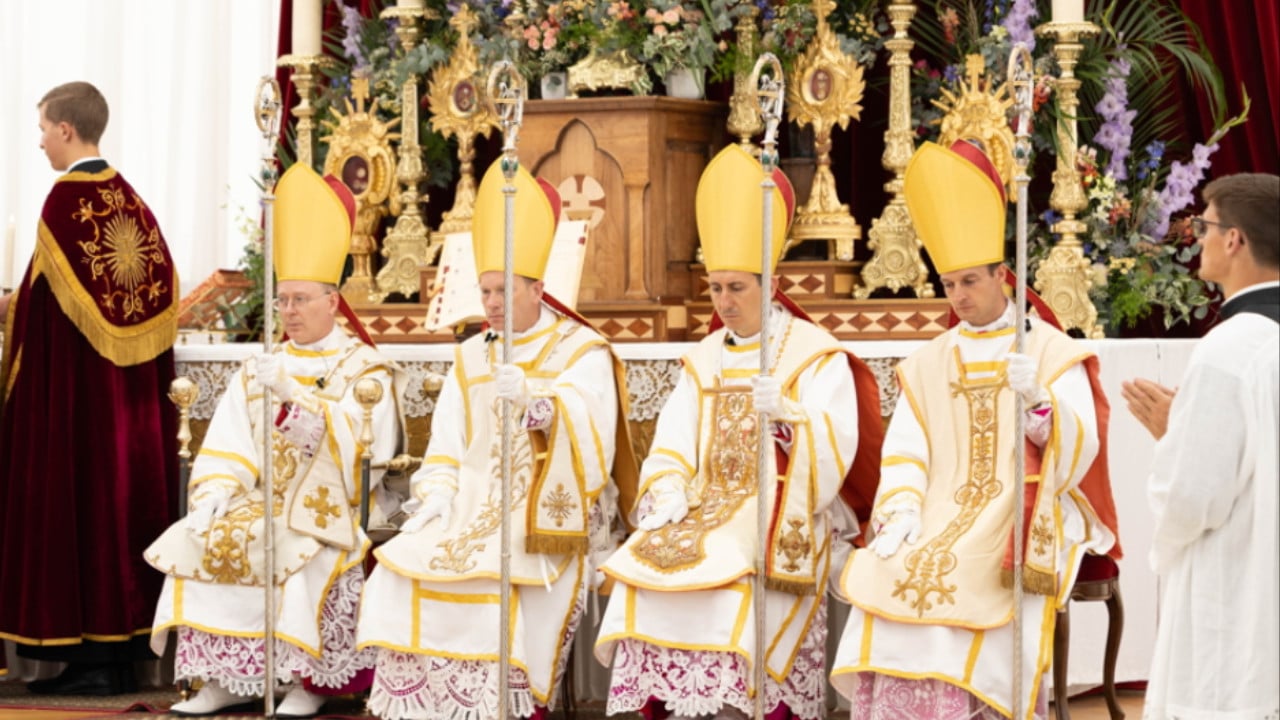
According to an article published on July 11 on the Spanish website InfoVaticana, Leo XIV’s last- minute appeal to the Priestly Fraternity of Saint Pius X (SSPX) might not have been such a “heartfelt letter” after all, but rather a brilliantly sinister final chess move.
Sent on June 29, just two days before the episcopal consecrations, the letter was presented by many as the final “paternal” attempt of Prevost to persuade the Society not to proceed.
Now it seems that its real intention was to lay the legal foundation for treating the consecrations as something far more serious than the offense already foreseen by canon law.
Most of the Catholic world — including Trad Inc. and conservative commentators — lauded Leo’s statement for its warmth and concern. Addressing Superior General Father Davide Pagliarani, Leo began by recognizing “the devotion to liturgical life, commitment to priestly formation, apostolic zeal and desire for fidelity to Tradition” that characterize many within the SSPX.
Rather than immediately threatening penalties, he made a “heartfelt” appeal, writing, “please turn back!” Leo also warned that the episcopal consecrations would constitute a “schismatic act” while urging the Society to consider “the spiritual good of the faithful,” who could be deprived of “the licit and, in some cases, even valid reception of the Sacraments.”
Leo concluded by reminding the SSPX that “to tear the seamless garment of Christ is a sin of extreme gravity,” while insisting that “The Church is open to a path of dialogue and understanding.”
While everyone was entranced by Leo’s supposed fatherly concern, it now seems he was surreptitiously changing the legal character of the act itself.
What does Canon Law say?
As the InfoVaticana article points out, canon law has long treated episcopal consecration without papal approval as a distinct canonical offense.
Under the 1917 Code, canon 2370 imposed suspension on the parties involved. In 1951, Pope Pius XII strengthened the penalty in response to illicit episcopal consecrations in Communist China, imposing excommunication latae sententiae reserved to the Holy See.
The 1983 Code incorporated that penalty in canon 1382, while the 2021 revision of Book VI transferred the provision to canon 1387 without substantially changing its content.
That canon, 1387, says that the bishop who confers episcopal consecration without a pontifical mandate and the person receiving it incur automatic excommunication reserved to the Apostolic See.
The wording here is of the utmost importance because the offense is specifically referring to a consecration sine mandato, or without a pontifical mandate.
Again, canon 1387 identifies only two categories of offenders, the consecrating bishop and the bishop being consecrated. It says nothing about priests, seminarians, or lay faithful connected with them. The canon is deliberately limited and cannot simply be extended to others.
The Dispatch
The charge of schism
The accusation of schism belongs to a different part of canon law. Canon 751 defines schism as the refusal of submission to the Roman Pontiff or the refusal of communion with those subject to him.
Classical canonists described this as detractatio subiectionis, a rejection of the Pope’s authority as the principle of unity within the Church.
That definition has traditionally distinguished schism from ordinary disobedience. A person may refuse to obey a particular command while still recognising the Pope’s office and authority. Canon 1364 imposes the penalty of excommunication for heresy, apostasy and schism, making it a separate offence from the one described in canon 1387.
If every episcopal consecration sine mandato automatically constituted schism, there would have been little reason for the legislator to create a separate offense under canon 1387. The existence of two distinct canons suggests that they address different kinds of wrongdoing. One concerns an unlawful episcopal consecration, while the other concerns the rejection of papal authority itself.
The real reason for Leo’s warning?
This is where Leo’s letter assumes such importance. According to the InfoVaticana report, after receiving Leo’s appeal, the Society was no longer simply preparing to consecrate bishops sine mandato, or without a pontifical mandate. Once Leo personally ordered them not to proceed, the act became one committed contra mandatum, or against an explicit papal command. That distinction is what allowed the consecrations to be presented not merely as an illicit episcopal act but as evidence of a schismatic intention.
This distinction is important because canon 1321 requires canonical offenses to be committed with imputable guilt, while canon 18 requires penal laws to be interpreted strictly. Canon 221 §3 further states that no one is to be punished except according to the law.
InfoVaticana therefore argues that the intention required for schism cannot simply be inferred from an act of disobedience and maintains that detractatio subiectionis must be positively demonstrated rather than presumed.
‘Against’ vs. ‘without’ Rome’s approval
The Society has consistently maintained that it recognizes Leo as the Roman Pontiff, prays for him during the Canon of the Mass, and does not seek to establish a rival Church with its own jurisdiction. Whether those claims are sufficient to rebut an accusation of schism remains a point of disagreement.
Some canon lawyers have drawn attention to canon 1347 §1, which regulates prior warnings before certain canonical penalties. They argue that a warning normally serves to encourage repentance before punishment is imposed. It therefore seems that Leo’s letter performed a different function by providing the canonical basis for arguing that the consecrations were carried out contra mandatum.
There are others that dispute this conclusion, however. They argue that every consecration carried out contra mandatum is still necessarily one performed sine mandato.
But, as Bishop Richard Williamson often warned, the Romans are masters at diplomacy and deception with 2,000 years of experience on their side. Observers can’t be blamed for suspecting the true motives behind the letter as Modernist Rome is hardly a bastion of Catholic orthodoxy.
InfoVaticana‘s analysis gives weight to a theory that has been held for a while in counter-revolutionary Catholic circles: that Leo XIV’s excommunications were not punishment for disobedience, but an attempt to rid the Synodal Church once and for all of the last vestige of “traditional” Catholics left within its tyrannical confines