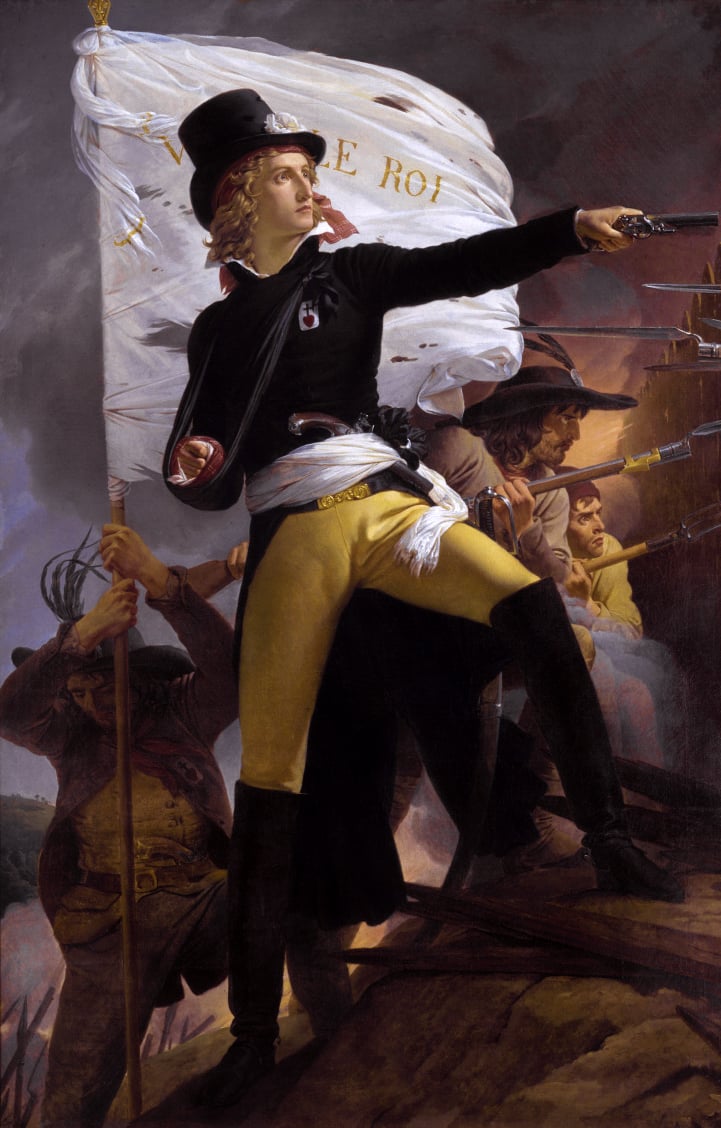
The attempted beatification of Bishop Fulton J. Sheen, scheduled for September 24 of this year, is being heralded by many media outlets and prominent public figures as a long-overdue development.
This offers us a timely occasion to reexamine the problems — many of them still obscure — that marked Sheen’s career, particularly because of the deep admiration he commands from American Catholics.
Just this week, Leo XIV, who was born in Chicago in 1955, praised Sheen as “a light of faith, hope, and love.” He said his television program “touched millions with the hope of the Gospel.”
In light of the gravity that a declaration of beatification — which is usually a precursor to canonization — brings with it, we will ask whether there is sufficient reason to doubt Sheen’s orthodoxy and his witness to the Catholic faith.
Who was Bishop Sheen?
Doubtless, nearly every American Catholic is familiar with Fulton Sheen, who is most famous for his award-winning television show “Life is Worth Living.” Airing in the 1950s, this program, along with his earlier, lesser known “Catholic Hour,” catapulted him to the status of a household name in the US.
Born to an Irish Catholic family in 1895, Sheen left Peoria, Illinois and traveled to St. Paul Seminary in Minnesota to begin his priestly studies. In 1919, he was ordained by Bishop Edmund Dunne. After earning several degrees in theology and philosophy, then-Father Sheen advanced through the ecclesiastical ranks while writing many books, eventually being chosen by Pope Pius XII to be an auxiliary bishop for the Archdiocese of New York. He was consecrated in Rome in 1951.
In 1952, Sheen began starring in a weekly television program, the aforementioned “Life is Worth Living.” His non-sectarian message quickly found a large audience, captivated as they were by Sheen’s rhetorical gifts, charisma, and intelligence.
When asked by Bob Considine, a reporter for Cosmopolitan Magazine, whether he avoided explicitly Catholic doctrines so as not to alienate Protestant or Jewish viewers, Sheen gave a revealing response.
“Catholic dogma has been given certain disrepute it doesn’t warrant. There is dogma in everything in life. I make no deliberate effort to avoid what I know is true,” he replied.
Sheen then added — apparently without recognizing any contradiction — “There is nothing in my television sermons that one cannot find in Aristotle.” 1
Sheen’s response indicates that he was comfortable presenting Catholicism exclusively through the lens of pre-Christian philosophy, withholding Divine Revelation and the dogmas of the Church.
Considine then recounts the very next moment in their conversation: “Then, because Bishop Sheen is an infinitely polite man, he felt he might have possibly made too sharp a reply. So he picked up his latest book, asked if I wanted it, and autographed it flatteringly. Then he smiled radiantly. ‘Did you hear of the nice lady who went into Brentano’s and asked for Rabbi Sheen’s A Piece of My Mind?’”2
This hyper-sensitivity to religious sensibilities is compounded by the fact that Sheen was simultaneously serving as the US director of the Society for the Propagation of the Faith from 1950 to 1966. What this means is that at the height of his popularity, the man officially charged with promoting Catholicism in America was operating on the principle that he should deliver his message in a way that does not directly offend non-Catholics’ religious beliefs.
For his efforts, Sheen won an Emmy in 1953 for “Most Outstanding Television Personality,” regularly drawing some 30 million weekly viewers, his two largest audiences being — according to the Russell Kirk Center — Protestants and Jews.
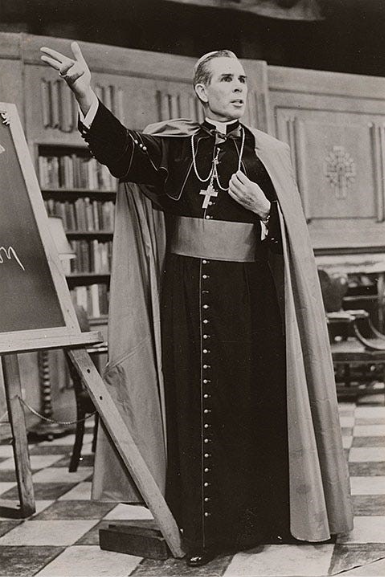
Enthusiast of Vatican II and its revolutionary changes
Following the Second Vatican Council, Sheen distinguished himself as one of the most progressive figures operating in what Paul VI called in 1966 “the conciliar Church.”
“On television, I was no longer talking in the name of the Church under the sponsorship of its bishops,” Sheen would write. “This new method had to be more ecumenical and directed to all people of good will. It was no longer a direct presentation of Christian doctrine but rather a reasoned approach to it with something common to the audience.”
It was at this time that Sheen began embracing the ecumenical movement, which had been gaining momentum in the early 20th century thanks to dissident European clergy such as Dominican Yves Congar, who wanted closer relations with Protestants, Eastern Orthodox, and Jewish sects.
Pope Pius XI condemned such endeavors in his 1928 encyclical Mortalium Animos. Pope Pius XII also warned Catholics against any form of ecumenism other than the return of dissidents to the true Church of Christ. Yet Bishop Sheen exuberantly embraced the Council’s rejection of those teachings.
According to Tradition In Action, in January 1969, Sheen spoke at a Sunday ecumenical “service” hosted at a Presbyterian church. Referring to the “person of Christ,” he told the estimated 1,000 attendees: “You love Him deeply … We have differences in expressing truth, but these are merely ‘lovers quarrels.’”
In his autobiography, Treasure in Clay, Sheen went even further (p. 148), stating: “The good Hindu, the good Buddhist, the good Confucianist, the good Moslem are all saved by Christ and not by Buddhism or Islam or Confucianism but through their sacraments, their prayers, their asceticism, their morality, their good life.”
These are a remarkable comments given that in his introduction to Radio Replies: Volume III, a book published in 1942, Sheen said: “Modern religion has enunciated one great and fundamental dogma that is at the basis of all other dogmas, and that is, that religion must be freed from dogmas. Creeds and confessions of faith are no longer the fashion; religious leaders have agreed not to disagree over those beliefs for which some of our ancestors would have died.”
The Dispatch
In 1966, Paul VI appointed Sheen bishop of Rochester, New York. While there, he vigorously committed his the diocese to the conciliar reforms. However, he resigned after just three years in 1969.
Over the course of the next decade, Sheen wrote many books and articles while making numerous media appearances. In December of 1979, while praying in his private chapel, Bishop Sheen died and went to his eternal reward.
A short list of problematic words and actions
Below is a non-exhaustive compilation of some of Sheen’s greatest exploits in advancing the Conciliar Revolution beginning in the late 1950s up until his death.
- 1958 — While speaking about converting unbelievers, he said that “though the Protestants are separated from the rock upon which the Church was built, they are not separated from Him who laid that rock” (The Catholic Advocate).
- 1963
- Proposed the inauguration of an annual “Science Sunday” where Protestants, Jews, and Catholics could join together in thanking God for the blessings of modern science (The Catholic Standard and Times).
- After the death of John XXIII, Sheen approvingly stated, “[He] in four years undid 400 years!” (TIA).
- 1965 — Described Gaudium et spes as a “master stroke under the inspiration of the Holy Spirit” (TIA).
- 1967
- Nominated a young priest in his diocese associated with what The New York Times called a “militant Negro organization” that was organized by Saul Alinksy to serve as a special vicar (TIA).
- Praised notorious neo-modernist, Teilhard de Chardin, and speculated that he “will appear like John of the Cross and St. Teresa of Avila, as the spiritual genius of the twentieth century” (TIA).
- Approved of Protestant biblical commentaries and their “mission” (TIA).
- Announced a plan to merge St. Bernard’s Seminary with Baptist and Episcopalian schools of study. He said the time had come for an “ecumenical theological center” so Catholics could “become introduced to the elements of goodness and truth which other religions possess.” (TIA).
- 1969 — Ominously declared that the Church is “at the end of an era,” while confessing that “What era we will get into we do not know, before the conversion of the Jews” (The Catholic Commentator).
- 1971
- Appearing on William F. Buckley’s “Firing Line” program, Sheen downplayed the gravity of heresy and — appearing embarrassed of doctrinal intransigence — narrowed the list of excommunicable offenses to only the most flagrant violations (WM Review).
- Proposed an idea in an airplane conversation, which was later realized, for an interdenominational chapel in a shopping mall (The Catholic Transcript).
- 1978 — Warned against the Society of St. Pius as a “schismatical sect” and erroneously claimed that the Novus Ordo Missae was merely a translation of the Traditional Mass into the vernacular (The Angelus).
Friend of the Synagogue
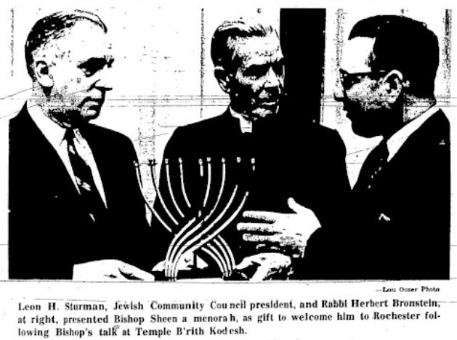
Lesser known are Bishop Sheen’s philosemitic tendencies.
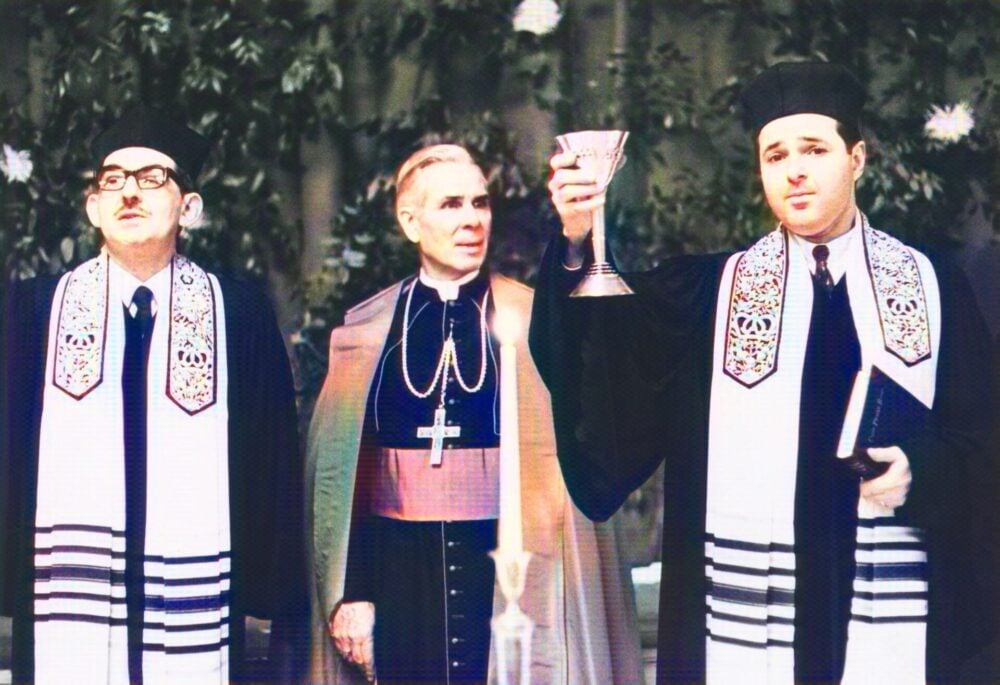
In 1967, Sheen accepted the invitation of Rabbi Marc H. Tannebaum to speak at his Temple B’rith Kodesh. Although members of Tannebaum’s progressive congregation did not wear yarmulkes, Sheen placed one on his head and gave an unusual speech, carefully avoiding preaching Christ crucified (Act. II, 36).
In his remarks, Sheen maintained that both Jews and Catholics are “revolutionists, uneasy upstarts and restive catalysts who disturb the molds and philosophies of this world.” He further remarked that because both maintained the importance of religion, “[W]e will draw closer … as we realize that we are both called by God to this task.”
After his address, Sheen accepted a menorah from Tannebaum, who wanted to show his appreciation for the ecumenical first. The event was sponsored by the Diocese of Rochester, the American Jewish Committee, and the local Jewish Community Council.
Only one year later, while attending a Friday Sabbath service, Sheen accepted the “Brotherhood Award” from Dr. Edward Jacobs, president of the Metropolitan Conference of the National Federation of Temple Brotherhoods. The latter noted — approvingly — that “there is a growing rapprochement between Jews and Christians.”
It is not difficult to see in these trailblazing efforts a prefiguring of the conciliar rapprochement with the Synagogue that took place after the Council. One here is reminded of the 1986 ecumenical visitation of John Paul II to the “Great Synagogue of Rome,” Benedict XVI’s active participation in a Jewish service at Mainz in 2005, and Cardinal Jorge Bergolio’s 2013 celebration of Hanukkah in a Buenos Aires synagogue.
Conclusion
Taken together, the foregoing evidence presents not as an isolated misstep, an ambiguous formulation of doctrine, or a one-off, bad example, but rather a convergent pattern of compromise and abandonment of the Catholic faith as it had always been taught before Vatican II, the seeds of which likely existed within Sheen at that point but blossomed with the “aggiornamento” of John XXIII and accelerated under Paul VI afterwards.
It would be unjust to deny the natural gifts Sheen possessed. However, the question before us is not whether he was an eloquent speaker, effective communicator, or a compelling figure, but whether his public witness is orthodox and worthy of universal praise. Bonum ex integra causa, malum ex quocumque defectu — something is good when it is good in every respect, and it is bad when it is wrong in any respect — states the principle of philosophy. A Catholic saint stands athwart the spirit of the age, waging war on the deceit and false peace of the world. Can the same be said of Bishop Sheen? The evidence, however uncomfortable to accept, suggests that it cannot.