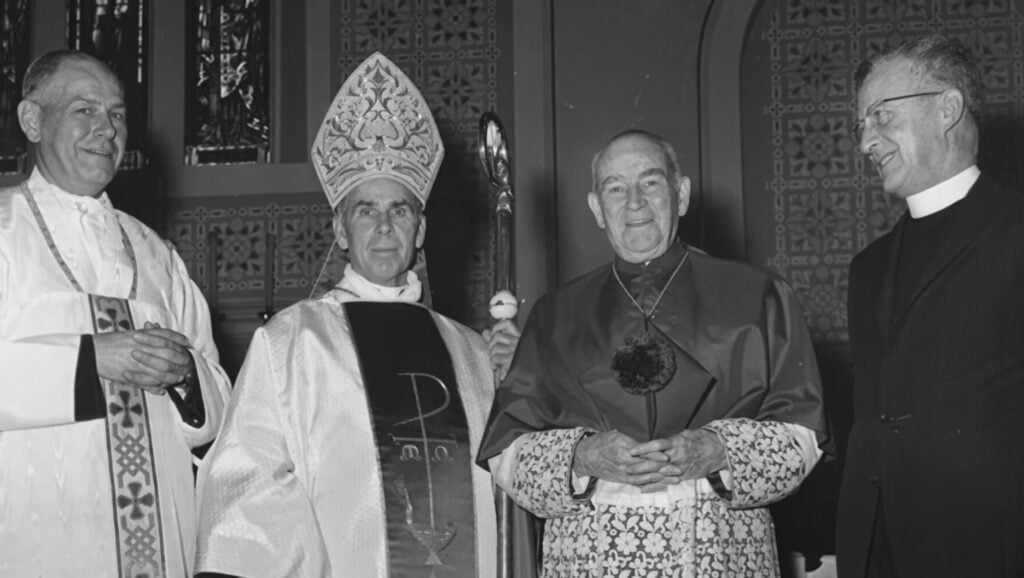

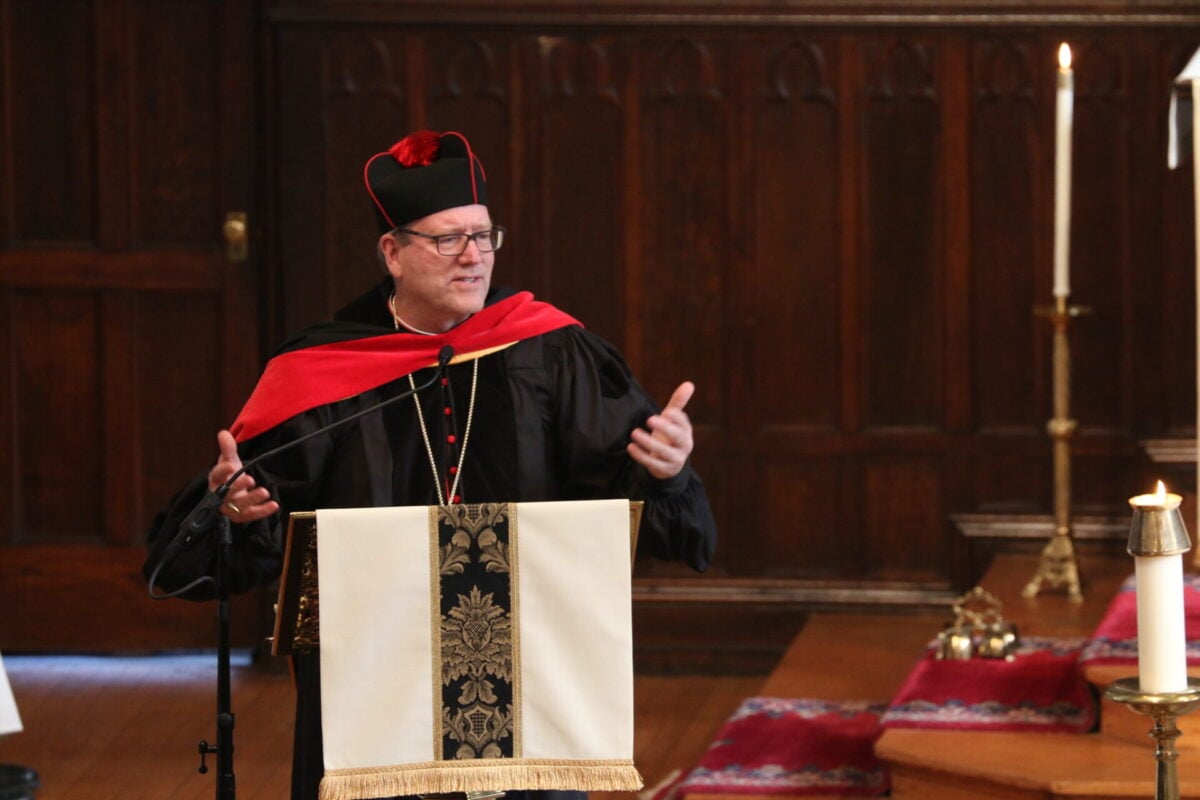
In a recent X post, Bishop Robert Barron attempted to marshal a defense of the natural law and its immutability 1 against fellow conciliar prelate Archbishop Vincenzo Paglia.
While lamenting the liberal changes Paglia ushered in when he was head of the John Paul II Institute for Studies on Marriage and Family Life, Barron said “the worst suspicions that many of us had” were confirmed when Paglia admitted in a recent interview to making decisions that sought to usher in a “very profound” rethinking of the natural law.
“Instead of absolute moral norms grounded in a keen understanding of the basic goods, he [Paglia] and his colleagues were proposing a moral theory rooted in historical discernment of subjective and cultural experience,” Barron exclaimed.
“Is slavery wrong?” he asked, trying to prove his point. “I imagine any decent person would say yes. But that yes is predicated upon precisely what the tradition calls the natural law and the basic goods. There are some values so fundamental that acts repugnant to them are by their very nature wicked.”
The irony of Barron’s attempt to defend the natural law by attacking slavery — which is not intrinsically evil — without any qualification, shows he is wholly unfamiliar with what Scripture, Tradition, canon law, the Magisterium, and the natural law teach on the subject.
The true Catholic position on slavery was presented by the Holy Office in 1866 under Pius IX: “Although the Roman Pontiffs have left no intention of abolishing slavery everywhere among the nations […] nevertheless, servitude itself, considered absolutely, is in no way inconsistent with natural and divine law” (emphasis added).
Barron’s theological ineptitude was made all the more apparent when, at the end of his X post, he inveighed against liberal German clergy who at the Synod on Synodality were, according to him, seeking to “relativize or radically change the principles undergirding classical morality” under the guise of the “development of doctrine.”
The Dispatch
Yet, Barron essentially does the exact same when he states that that “One of the very smartest persons that ever lived, the philosopher Aristotle, thought it [slavery] permissible.”
“Who is to say whether the consensus might shift back again [on slavery]? Who is to say that ‘lived experience’ might come to justify it?” he then asks. “What any truly coherent moral program requires is the very thing that Archbishop Paglia and his colleagues were endeavoring to eliminate, namely, absolute moral norms.”
Tellingly, Barron fails to mention other, more important figures than Aristotle, such as St. Peter 2, St. Paul 3, St. Thomas 4 , Pope St. Gregory the Great 5, and Pope Leo XIII 6 , all of whom taught that slavery, while contrary to the first intention of nature is not against the second, meaning it is lawful under certain conditions.
As for the origin of the claim that slavery — understood properly and distinct from all un-Christian forms and abuses — is contrary to the natural law, Barron tipped his hand when he cited what he called “a highly articulate presentation” of the topic in John Paul II’s 1993 encyclical Veritatis Splendor.
In reality, Veritatis Splendor simply reiterated an error presented in Gaudium et Spes (no. 27). John Paul II therefore taught (no. 80) — without any qualification — that slavery is to be considered “intrinsically evil” in light of the Second Vatican Council’s teaching on “the respect due to the human person.”
Doubtless, this is why Leo XIV misrepresented the Church’s traditional teaching on slavery in his first encyclical Magnifica Humanitas.
While perhaps overlooked by many, the subtle yet far-reaching error committed by Barron on the subject of slavery serves to reveal, yet again, the dialectical struggle in the conciliar paradigm: Conservatives fighting Liberals over a competing program of Modernism, the former being moderates while the latter radicals — both accepting the basic tenets of the evolution of dogma and morals.