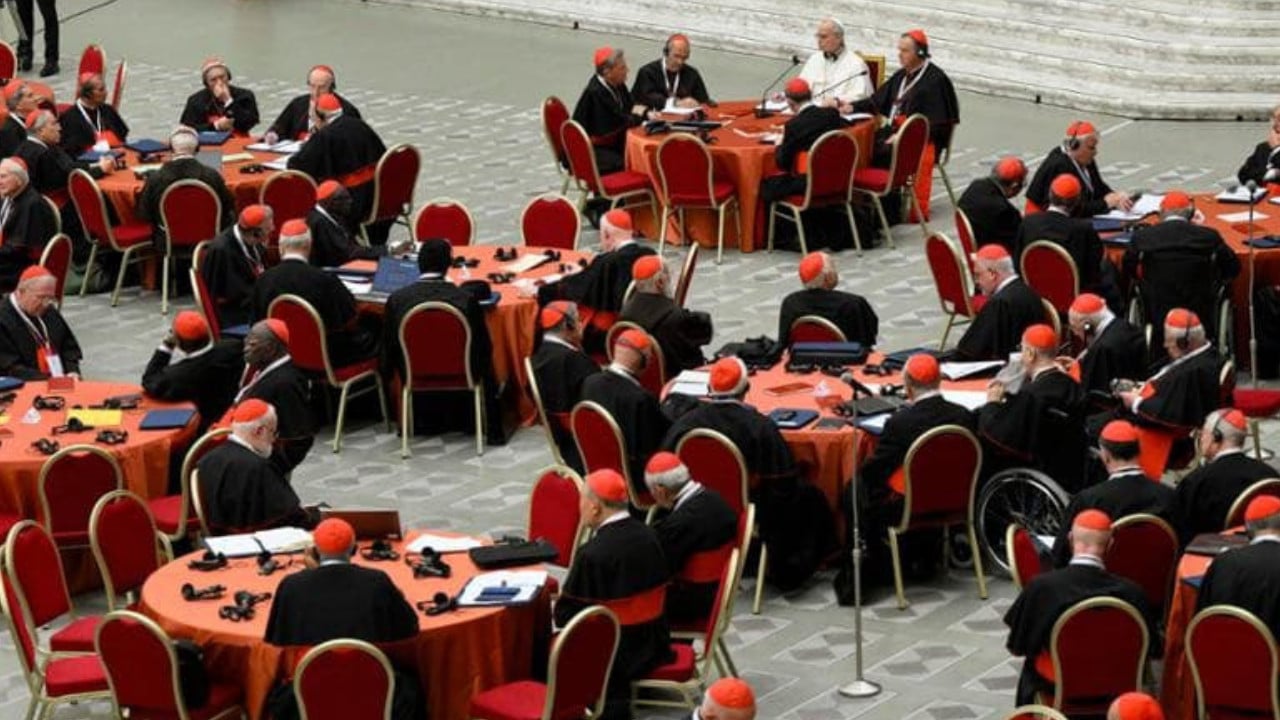
“Magnifica humanitas entrusts the Church with a specific responsibility: to face the struggles of history in its own distinctive way, through a synodal approach rooted in the theological virtues and focused on serving the human person,” reads Vatican News’ summary of Cardinal Stephen Brislin’s remarks during the third session of the Extraordinary Consistory on June 27.
This may prove to be one of the most revealing reports yet on the ecclesial vision and religion emerging from Rome: a Church that no longer exists first for the glory of God, the proclamation of Jesus Christ, and the salvation of soul, but in service to mankind.
The consistory overwhelmingly proved that the anthropocentric orientation of the religion of the Second Vatican Council has now reached its most developed expression in synodality and confirmed it is the central organizing principle of Leo’s reign.
Throughout the proceedings, synodality was presented not merely as a practical method of governance but as a defining characteristic of the Church’s life and mission. Leo XIV repeatedly defended the concept against critics who regard it as incompatible with traditional understandings of authority and hierarchy. Addressing the cardinals, he insisted that synodality is not opposed to authority but instead reveals its authentic nature through “listening, participation, and shared responsibility.”
This emphasis continued throughout the gathering, with terms such as listening, discernment, participation, encounter, and accompaniment dominating the discussions and being thrown around with almost lustful abandon. Needless to say, themes that historically occupied the center of Catholic discourse, such as doctrinal clarity, the defense of orthodoxy, missionary conversion, or the salvation of souls, were conspicuously absent.
At the outset, Leo XIV appealed for “strong, explicit and public” support for synodality from the College of Cardinals. This was not surprising, as it is now all hands on deck in the run up to the World Synod of 2028, which surely will be one of the defining moments in the construction of the Synodal Golden Calf.
This marks an important development. Whereas previous pontificates presented synodal structures largely as consultative mechanisms, the current “pope” and his effeminate enforcers present synodality as a theological principle in its own right.
The magnificence of man
The consistory largely revolved around the themes contained in Leo XIV’s first encyclical, Magnifica Humanitas. This encyclical not only celebrated man as the new God in its unambiguous title, but also its content.
The discussions surrounding Magnifica Humanitas once again continued the perverse obsession with human dignity, participation in history, service to society, and the Church’s role in accompanying humanity through contemporary challenges. Gone are the days when the Church was the Ark of salvation which accompanied souls to their eternal destination.
Brislin’s intervention argued that the Church is called to enter the works of history through a synodal method directed toward service of the person. For the South African prelate, Leo, and his fellow destroyers, anthropology displaces theology as the primary framework of the Church.
Another significant feature of the consistory was the discussion surrounding the traditional Catholic doctrine of just war.
The Dispatch
Several interventions suggested that the classical formulation inherited from Augustine and Thomas Aquinas may no longer be adequate for “contemporary circumstances.” Prevost himself stated that “war is never worthy of humanity” and can “never be considered blessed by God.” This is not only contrary to the previous teachings of the Church, Saints, popes, and doctors, but also to Holy Scripture in which it is clear that war is sometimes justified and blessed by God.
The Catholic Church has always regarded war as a grave evil, but also maintained that political authorities may possess both the right and, in some circumstances, the duty to employ force in defense of justice and the innocent.
Calls to revise or move beyond the just war tradition therefore are the latest attempt to undermine and invert Catholic doctrine by reinterpreting long-established doctrinal categories through the lens of contemporary moral and political concerns.
Archbishop Viganò rebukes Müller
One noteworthy intervention came from Cardinal Gerhard Müller, who argued for continued dialogue with the Society of Saint Pius X and the reinstitution of an Ecclesia Dei type body. This, of course, had the conservative and quasi-traditionalist establishment frothing at the mouth with desperate glee and excitement. Surely, “they were so back.”
But, ever-faithful son of Mother Church, Archbishop Carlo Maria Viganò, was quick to rain on Müller and his Trad Inc. disciples’ parade. In a scathing X post, Vigano wrote: “Instead of acknowledging the devastating crisis facing the Catholic Church due to the conciliar and synodal revolution, Cardinal Müller — defying all reason — maintains that the post-Conciliar Hierarchy has never deviated from Tradition and that the Society of Saint Pius X is mistaken in asserting otherwise.”
“Müller proposes a renewed version of the motu proprio ‘Ecclesia Dei adflicta’ to replicate the fraud of 1988, passing off fidelity to the immutable Magisterium as schism, while framing the acceptance of the Council’s errors as orthodoxy.” he added. “Müller will soon discover — as will the members of the Ecclesia Dei institutes — that reducing the denunciation of the Conciliar coup to a mere ceremonial issue is a shortsighted, ideological choice, especially when the Hierarchy has no intention of yielding even slightly on the heretical principles it promotes.”
Elevating synodality to the level of doctrine
The consistory repeatedly insisted that synodality is not a completed event but an ongoing process. This is in perfect line with synodality as a manifestation of the ongoing Luciferian revolution: endless change that keeps pushing doctrinal and moral boundaries ever further in apostate rebellion against Christ and the Catholic Church.
Cardinal Mario Grech outlined further stages of implementation extending into future assemblies and consultations over the coming years. Spare us, O Lord.
While its advocates try to paint this as a recovery of ancient ecclesial practices and a renewed attentiveness to the guidance of “the Spirit in history,” it is nothing but a total war on doctrinal stability and the finality of revelation.
The Extraordinary Consistory of June 2026 may ultimately be remembered as nothing more than another milestone in the institutional consolidation of the Judeo-Masonic synodal project.
The discussions made clear that synodality is now understood not merely as a method of consultation but as a defining characteristic of ecclesial identity. Equally clear was the continued emphasis on human dignity, historical engagement, and service to the human person as the central dogmas of the new religion.
The Extraordinary Consistory will go down in salvation history as yet another occasion where these disobedient and rebellious enemies of Christ, further fine-tuned the false god they are making in their own image.