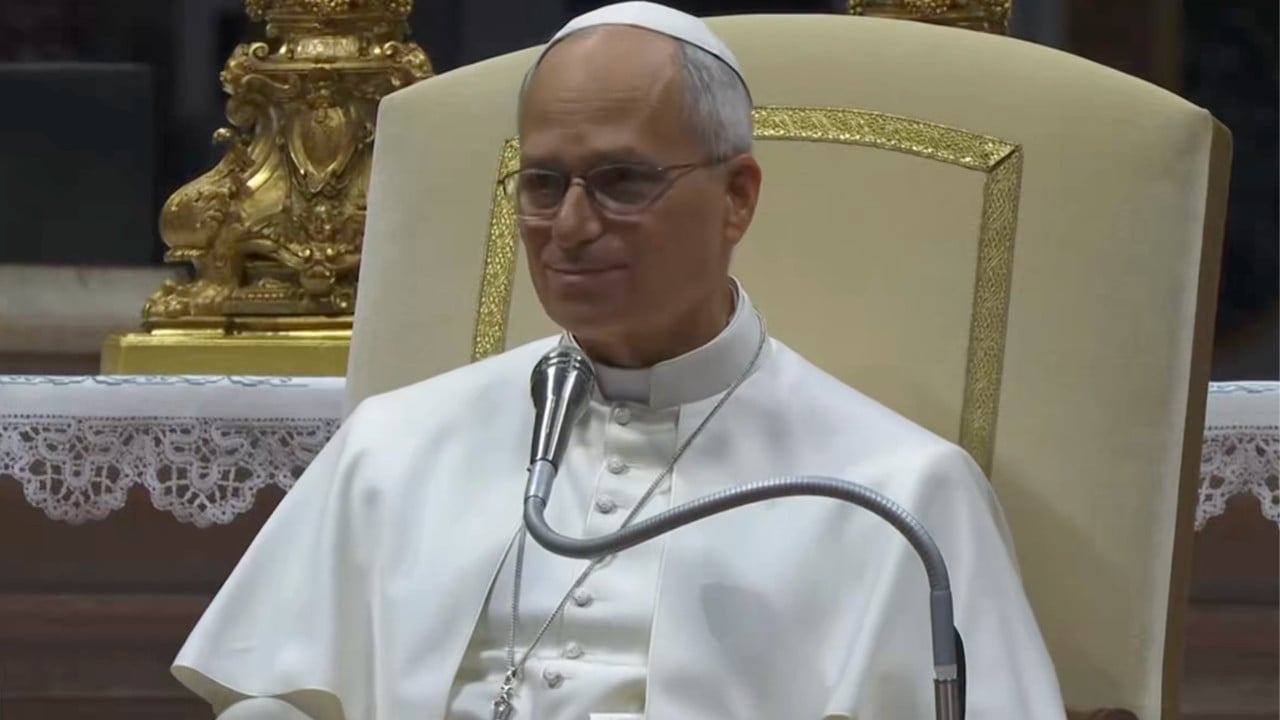
A quick glance at Leo XIV’s August 12 audience on the liturgical year suggests it was a run-of-the-mill catechetical lesson.
But a closer look reveals that his address on the Second Vatican Council’s document Sacrosanctum Concilium is cloaked in decades-old modernist talking points.
Looking at the meat of Leo’s address, it becomes clear that his emphasis on the Eucharist, the Resurrection, the Blessed Virgin Mary and the saints, along with his citations of Dom Prosper Guéranger and Pope Pius XII, are nothing more than a thin Catholic veneer.
While Leo quoted Pius XII’s Mediator Dei to explain how Christ remains living in His Church, it was only the prelude to introducing synodal concepts.
“In this assembly, the Christian community makes visible its communion with the Lord and bears witness to its belonging to Christ,” he remarked, saying nothing about the sacrificial nature of the liturgy.
“The liturgical assembly is in fact fulfilled through the active participation of brothers and sisters,” he added, failing to note that the Mass is a propitiatory act offered by the priest alone and is in no way dependent on the “active participation” of the laity in attendance.
The Dispatch
While it is laudable that Leo noted that a “solely virtual presence” is insufficient, his address was saturated with the synodalese that has become the norm under the two most recent postconciliar papal claimants. For instance, according to Leo, the liturgical year is “not a static representation of past events, but an encounter with Christ himself.” Our “active participation” can “help us to enter ever more deeply into the reality of belonging to Christ.”
Leo further depicted the Church’s prayer life as a ceaselessly-evolving reality. “The liturgical year should thus be understood as a constant renewal of the work of salvation which Christ accomplishes in history,” he said.
Tragically, Catholics have grown so accustomed to this nonsensical and nondescript garbage that they forget that typical language pertaining to the Sacred Liturgy revolves around adoration, sacrifice, propitiation, grace, worship, and the Holy Sacrifice of the Mass. The abandoning of this sort of terminology has been one of the hallmarks of the wicked liturgical revolution set into motion at the Second Vatican Council.
Enjoying this article? Support Integrity’s writers today!
In his other recent catechesis on Sacrosanctum Concilium, Leo endlessly repeated words and phrases such as “renewal,” “progress,” adapting to circumstances, and the Church’s need to “grow” and “develop,” while schizophrenically insisting upon fidelity to tradition.
What Leo is doing is constantly trying to square a circle by using traditional references through the linguistic framework of the Council and its aftermath. Traditionalists would do well not to fall for his efforts and allusions to Guéranger and Pius XII, and recall that the controlling vocabulary he is using remains that of renewal, participation, assembly, and encounter — the sort of language that has been used to justify liturgical experimentation and other abominations for more than half a century.