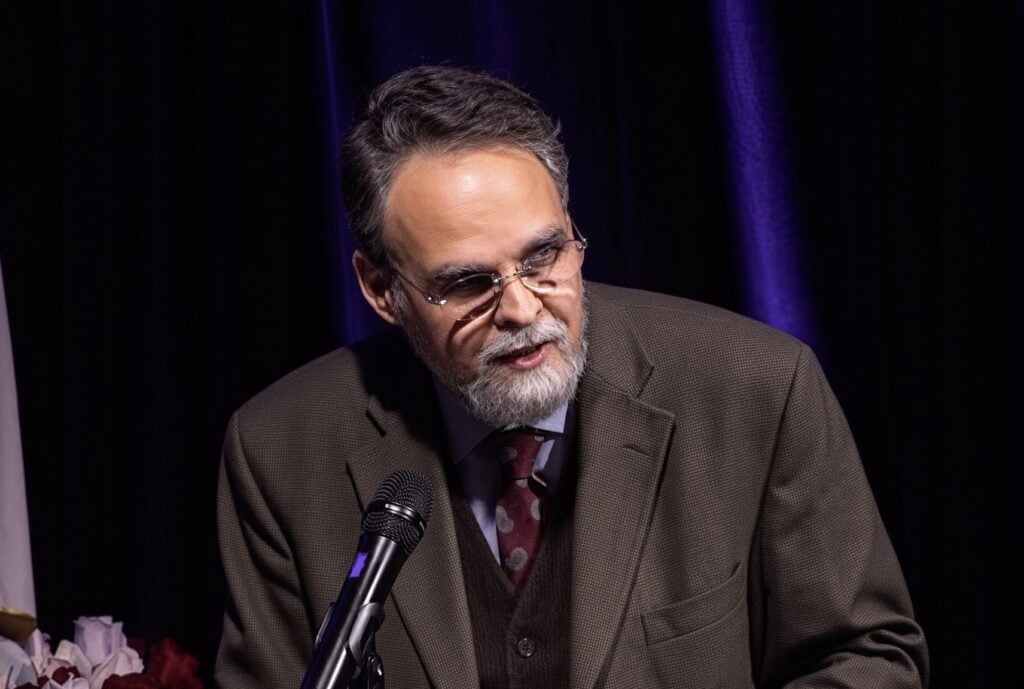

One of the most enlightening books I have ever read on Catholicism and the United States is Professor Robert Kraynak’s Christian Faith and Modern Democracy (2001).
Professor Kraynak has taught at Colgate University for decades, having been hired there in 1978. His biography on the school’s website identifies him as a Professor of Political Science and the Founding Director of the Kraynak Institute for the Study of Freedom & Western Traditions.
I first came across Christian Faith and Modern Democracy in the early 2010s while I was teaching political science at several community colleges in West Michigan. I was young and still trying to find answers to questions I had on political philosophy, Catholic social teaching, and Vatican II. Unwittingly, I more or less adopted the neo-Americanist and New Natural Law positions thanks to having attended several events organized by the libertarian Acton Institute. I was also reading books by George Weigel, Michael Novak, and Princeton Professor Robert George without knowing they were actually liberals.
Around this time I joined the Society of Catholic Social Scientists (SCSS). The group was founded in 1992 by Franciscan University professor Stephen Krason. I eventually attended — and even spoke at — two SCSS events, one at Holy Cross College in South Bend and another in Steubenville, Ohio.
As the years went by, I started buying books written by Traditional Catholics on religious liberty, democracy, human rights, and similar topics. My beliefs slowly changed and I no longer felt I fit within the SCSS’s general paradigm. One book that aided me in that journey was Christian Faith and Modern Democracy.
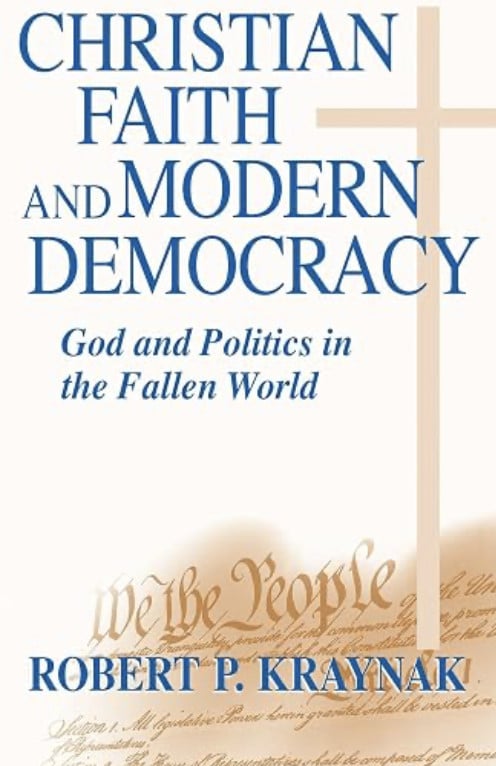
The SCSS hosted a symposium on the book just several years later. I suspect they did that because it challenged many of the arguments supported by establishment conservative Catholic intellectuals.
Kraynak’s main thesis — which I agree with him on — is that “Christianity has been transformed into a religion that sounds more like the ‘gospel of democracy’ than the ‘gospel of Christ,’ or more like Kantian liberalism (with its emphasis on rights, dignity, consent and progress toward perpetual peace) than the natural law of St. Thomas Aquinas (with its emphasis on virtue, character formation, the common good and the inherent limitations of the temporal realm).”
Fortunately, the SCSS published the symposium’s lectures, including Kraynak’s response to his critics, in its 2004 Catholic Social Science Review. I encourage Integrity readers to purchase a copy.
I had the pleasure of interviewing Professor Kraynak for Magnificat Media in 2017. Sadly, the audio of our conversation has been lost. My hope is that he would be willing to come on the Integrity Magazine podcast to discuss his views on political theory as I have a great interest in the subject and was accepted to Catholic University of America for PhD. work in the field before I became a journalist.
I mention all this not to suggest that I agree with everything the good professor has said and done, but to note that his book is a worthy addition to any American Catholic’s library — most especially because it throws cold water on many of the more popular arguments currently being made about the Founding and the Catholic faith. Michael Knowles, who has been pushing the ludicrous idea that the Constitution was “designed” to promote Catholic, would do well to familiarize himself with it.
What would St. Thomas think of the Founding?
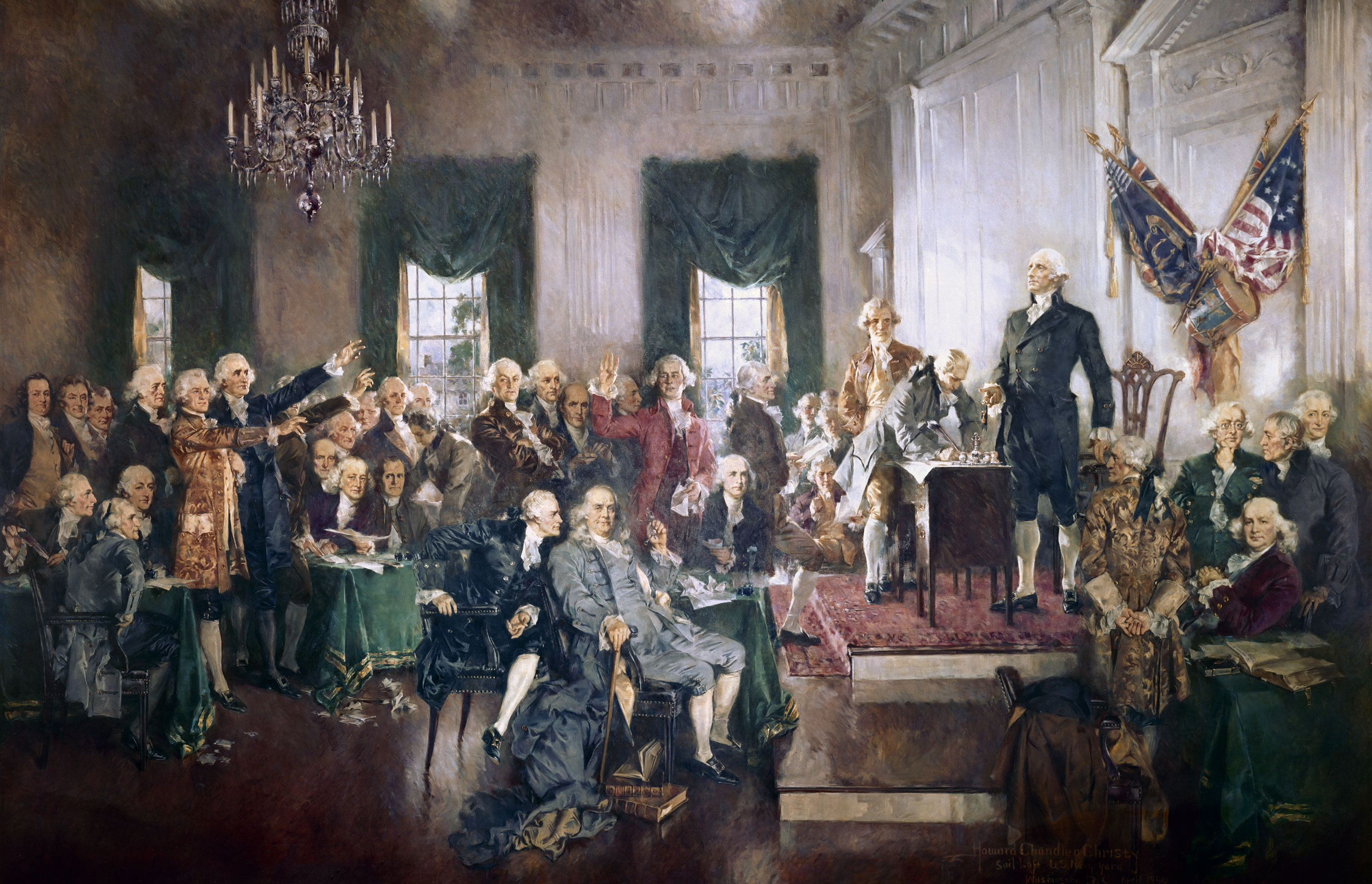
In his many writings, Kraynack has pointed out that “the American political tradition is a complex and somewhat disparate order that has evolved gradually over four centuries from a variety of sources.” Those “sources” are “Puritanism, English common law, classical republicanism, gentleman statesmanship, God-given natural rights, and the Madisonian constitutional republic.”
“What has Catholicism to do with these six sources of the American political tradition and with developments in that tradition since the colonial and founding periods?” he asks. “Not a great deal, as far as I can tell. Of the six elements mentioned above, only English common law could be said to have a direct Catholic connection.”
This is undoubtedly true. Yet he adds that it has been obfuscated by certain intellectuals.
“Catholic revisionists of the twentieth century have exaggerated the similarities between Catholicism and the Anglo-American natural rights tradition.” Catholic “natural law is not primarily about natural rights and government by consent of the people; but about the natural ends of man as a rational creature and the use of prudence to apply these ends to politics.”
“In this light,” he adds, “political freedom is a good only insofar as it promotes virtue, meaning rational and spiritual perfection. Freedom is therefore a means to higher ends — a conditional good that deserves some recognition but is not an inherent right.”
The Dispatch
“The conditionality of freedom,” he continues, “is the reason why St. Thomas Aquinas was not, in principle, in favor of natural rights or human rights. For him, the common good, understood not only as the ‘unity in peace’ of society but also as the shaping and molding of character for rational and spiritual perfection, takes precedence over natural rights and leads Aquinas to advocate constitutional monarchy over liberal democracy and a corporate common good over natural rights.”
This is in opposition to what Knowles and other Catholic influencers have been saying on the supposed inspiration that St. Thomas had on the Founding. In remarks at the Heritage Foundation and at a CatholicVote event earlier this year, Knowles claimed that the Founders established a “mixed regime” that was “closely in accord” with what St. Thomas had called for. But as myself and Integrity editor American Reform have shown on a recent podcast, this is a misreading of St. Thomas’ writings on the subject.
Presumably, Kraynak would cry foul over Knowles’ claims as well seeing how he has previously pointed out that “Catholicism shares the Declaration’s affirmation of natural law … but Catholic natural law is traditionally derived from St. Thomas Aquinas who has a different version of natural law than the Declaration of Independence and John Locke.”
“The Thomistic-Catholic version of natural law emphasizes the perfection of the rational creature through virtue and favors constitutional monarchy, while the Lockean-American version emphasizes inalienable natural rights and favors constitutional democracy or republicanism,” he explains.
Kraynak drives home this important distinction by noting the simple fact that “Christianity places duties to God and to neighbor before claims of rights and cannot accept the proposition that a right to pursue happiness as one sees fit takes precedence over duties to God and man.”
He also recalls that “the Bible uses the language of divine law rather than the language of rights to express morality and justice: It gives us the Ten Commandments rather than the Ten Bill of Rights.”
Is ‘personalism’ the answer?
In response to his numerous SCSS critics, Kraynak admirably refused to budge, and even advanced a strong counter-attack. He noted that their emphasis on rights is a double-edged sword and that their “personalist” alternative is inherently unstable.
“Their remedy is to teach the correct argument base on the Christian idea of the ‘human person,’ or ‘Christian personalism,’ which promotes ‘personalist’ democracy — a Christian version of democracy based on the dignity of the human person made in the image of God, who is also the possessor of inviolable human rights,” he said.
“My main criticism of Christian personalism, however, is that it contains a contradiction at the heart of its conception of freedom that makes personalism untenable as a political philosophy and puts contemporary Christians in a perpetual state of war with themselves, defending and then denouncing the culture of rights and losing their self-confidence in battles with secularists over the proper use of rights,” he argued.
Kraynak thus maintains that “the equation of Catholic personalism with the respect for human rights thereby turns Catholicism into another version of liberalism — a mirror of the prevailing culture rather than the authoritative judge of the prevailing culture.”
Modernity as a ‘blip’ on the screen of history
“At its best,” Kraynak concludes, “the Declaration of Independence is a partial or incomplete version of Catholic natural law based on Thomistic principles.” It “asserts a right to pursue happiness, but does not provide sufficiently for the higher goods of temporal and eternal happiness.”
“At its worst, the Declaration of Independence is opposed to Catholic natural law when ‘the pursuit of happiness’ as a fundamental right loses all connection with rational or spiritual perfection and promotes a radical egalitarianism and expressive individualism that denies the legitimate hierarchies of church, family, and society.”
As such, “the relation between Catholicism and the Declaration of Independence should be seen therefore as more of a prudent alliance than a principled harmony.”
“Very few,” he correctly observes, “seem disturbed by my conclusion that the modern democratic age may be nothing more than a temporary blip in the long history of civilization, with no special significance for salvation history.”
If you would like to read more of Professor Kraynak’s writings, his aforementioned book as well as a 2009 essay titled “Catholicism and the Declaration of Independence: An American Dilemma about Natural Rights” are a great starting point.