With Francis and Leo XIV, the postconciliar religion’s obsession with replacing Jesus Christ with all things “Man” has reached a fever pitch — especially under the latter, who is unashamedly elevating “human dignity” to an idolatrous level.
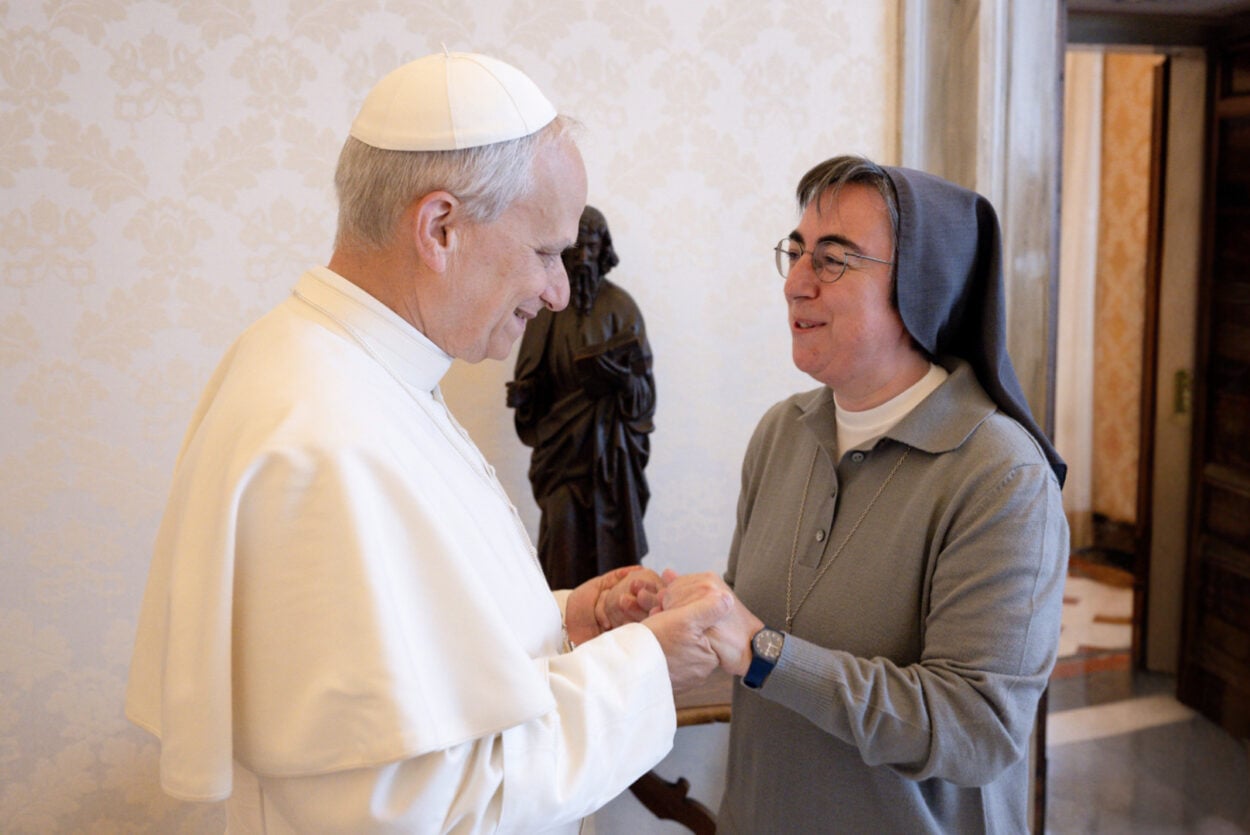
Leo’s appointment of Sr. Alessandra Smerilli, F.M.A. as Prefect of the Dicastery for Promoting Integral Human Development marks the latest stage in the implementation of his agenda.
Smerilli’s hiring is yet another sign that Leo intends to preserve and consolidate one of the defining characteristics of the Francis era: the transformation of the Roman Curia from an instrument principally concerned with the salvation of souls into an institution preoccupied with the temporal concerns of migration, ecology, economics, sustainable development, and global governance.
The appointment is also significant not simply because Sr. Smerilli is a woman — that is problematic and telling in itself — but because of what she represents. She is an economist by trade and a prominent advocate of the economic and social vision associated with the heretical “Economy of Francesco” initiative, which claims to implement the social vision of St. Francis of Assisi and Francis Bergoglio.
If religion is to be understood as the bond between a creed (a system of absolute truths and doctrines to be believed by the intellect), a cult (a system of public and private worship, rituals, and sacrifice performed by the will), and a code (a system of moral laws and duties governing human behavior and conduct), then it is safe to say that “integral humanism” falls somewhere between the creed and the code of the new synodal religion of Antichrist.
The appointment therefore warrants a critical examination as the latest stage in a theological and institutional revolution whose origins stretch back decades before the Second Vatican Council.
The continuation of the Francis program
After the 2025 conclave, many Catholics hoped that Leo XIV would correct the excesses of his immediate predecessor. The first year of his reign has spectacularly disappointed them. To say that Prevost is Bergoglio on steroids is no mere hyperbole.
In his first public interview, Leo stated that he intended to continue the policy of appointing women to positions of authority within the Vatican. The Smerilli promotion is a concrete example of his continuation of Francis’ approach to female leadership.
Sr. Smerilli’s elevation follows Leo’s naming of Sr. Simona Brambilla to a senior curial office and the appointment of Maria Montserrat Alvarado to lead the Vatican communications office. This makes Smerilli the third woman to head a Vatican dicastery under the new order established by Praedicate Evangelium.
These moves are part of a larger modernist strategy to manufacture bureaucratic parity between the sexes. They do not reflect Catholic ecclesiology but instead rest upon secular egalitarian assumptions.
The real goal of Integral Human Development
The root of the problem lies in the organization Smerilli is set to oversee.
The Dicastery for Promoting Integral Human Development was created by Francis in 2016 with the motu proprio Humanam Progressionem, and formally came into operation on January 1, 2017. It absorbed four previously existing pontifical councils: the Pontifical Council for Justice and Peace, Cor Unum, the Pontifical Council for the Pastoral Care of Migrants and Itinerant People, and the Pontifical Council for Health Care Workers.
One would be forgiven for double-checking whether these were not, in fact, departments of the United Nations.
The dicastery was conceived from the beginning as a super-ministry dealing with secular issues such as social policy, migration, healthcare, environmental questions, humanitarian work, and international development. Its official mandate encompasses all the aspects of the Vatican II religion’s “mission” — justice, peace, migration, healthcare, ecology, human trafficking, humanitarian crises, and care for creation.
One cannot avoid asking a simple question: when Our Lord commissioned the Apostles, did He command them to promote “integral human development”? Surely Catholics are to engage in corporal works of mercy, but the Great Commission was for the Apostles to “teach ye all nations; baptizing them in the name of the Father, and of the Son, and of the Holy Ghost: teaching them to observe all things whatsoever I have commanded you.” (Matthew 28:19–20). Likewise, in Mark 16:15, Our Lord explicitly instructs them to “Preach the gospel to every creature.”
The Synodal Church will have none of Christ’s “outdated” commands. There is a new king of the castle, and his name is Man.
The Dispatch
The language of integral human development subtly but decisively shifts the emphasis from spiritual growth and real temporal happiness to the “flourishing” of persons by way of empowerment, accompaniment, and dialogue. But how can a man truly “flourish” or “develop” in the truest sense of the word unless he has the Catholic faith? Simply put, he can’t.
An old accusation made by Archbishop Marcel Lefebvre has become impossible to dismiss: “We may no longer speak of Our Lord Jesus Christ … we may speak of God, of the rights of man, of a certain philanthropy, but we may no longer speak of the rights of Our Lord Jesus Christ, of the reign of Our Lord Jesus Christ.” (Collected Works, Vol. 3).
Paul VI and the birth of a new vocabulary
The expression “integral human development” entered Catholic vocabulary principally through Paul VI’s 1967 encyclical Populorum Progressio, a document which declared in its opening paragraph: “The progressive development of peoples is an object of deep interest and concern to the Church.”
Prevost is thus merely continuing and consolidating this man-centered anti-religion.
Elsewhere in Paul’s Masonic document one finds the famous formula: “The development we speak of here cannot be restricted to economic growth alone. To be authentic, it must be complete: integral, that is, it has to promote the good of every man and of the whole man.” (Paragraph 14).
The phrase itself reflects the influence of the one-time orthodox Catholic philosopher Jacques Maritain’s concept of “integral humanism.”
Maritain and Montini
No account of postconciliar Catholicism can avoid the figure of Jacques Maritain (1882–1973). The French philosopher converted to Catholicism in 1906 and became one of the most influential Catholic intellectuals of the twentieth century.
His 1936 work Integral Humanism became foundational for Christian Democracy and for the Modernist campaign of Catholic accommodation to liberal society.
Maritain sought a middle way between secular liberalism and confessional Christendom. He argued that the medieval synthesis belonged to a previous historical era and that the future belonged to a pluralistic political order inspired by Christian values but no longer formally Catholic.
What Maritain was effectively arguing for was the abandonment of the Social Kingship of Christ and surrender to the contemporary age. This stood in direct contradiction to Pope Pius IX’s condemnation in the Syllabus of Errors of the proposition that “the Roman Pontiff can and ought to reconcile himself to and agree with progress, liberalism and modern civilization.”
Giovanni Battista Montini, the future Paul VI, developed a close friendship with Maritain during his years in Rome and Paris. Maritain and his wife, Raïssa, frequently visited Montini, and Montini greatly admired him. Maritain also had a decades-long friendship with radical Jewish-American community organizer Saul Alinsky.
Jean Guitton would remark that “Paul VI and Maritain belonged spiritually to the same world.”
Maritain can therefore be counted among the principal architects of the postconciliar mentality through his language of dialogue, his emphasis upon the dignity of man, his positive reassessment of democracy, his rehabilitation of religious liberty, and his promotion of a movement away from confessional states.
All of these themes appear repeatedly both in Maritain’s work and in the documents of Vatican II. As Maritain famously wrote in Integral Humanism: “The new Christendom will be secular.”
The lasting harm of Maritain’s ideas
Anthropocentrism has increasingly become the dominant tone of postconciliar Catholic discourse, to the point where it has surpassed Christ-centred dogma as the guiding principle of the Novus Ordo religion.
The words of Paul VI at the close of Vatican II remain perhaps the clearest expression of this transformation. On December 7, 1965, he declared: “We, more than anyone else, have the cult of man.”
These words became one of the founding declarations of the religion that would eventually evolve into a war machine against the Catholic religion, of which Prevost is the high priest today.
Sr. Alessandra Smerilli’s appointment should be seen not as an isolated personnel decision but as a symbol of Leo XIV’s deliberate and chosen continuity — not only with Francis, but with the “cult of man” promulgated at Vatican II and enforced by the subsequent heads of the Conciliar Church.