
A priest can sexually abuse a child and then use a diagnosis of pedophilia to argue that he deserves less punishment. Church courts have accepted this argument.
Australia’s government conducted an inquiry into institutional child sexual abuse, known as the Royal Commission, and documented its results in a 2017 report that found abusive priests have had dismissals overturned because they were diagnosed with pedophilia. 1 Disciplinary figures disclosed by the Vatican in May 2014 confirm that approximately 2,572 out of 3,420 or 75 percent of priests sanctioned for child abuse cases up until that point received penalties short of laicization. 2
The Royal Commission subsequently asked the Vatican to amend the canons (c. 1341, c. 1321–1324) that protect pedophile priests. The Vatican refused and the same system remains in place with its 2021 revisions. 3 These canons, which have been successfully used by guilty pedophiles to avoid laicization, were established with the promulgation of the 1983 Code of Canon Law under John Paul II. 4
How the defense works
The key word is “imputability.” In plain English, it means how responsible a person is for an offense. Church law distinguishes between establishing what a priest did and deciding how fully responsible he was for doing it.
A common defense tactic will use this distinction in order to argue that psychological disorder reduces a priest’s ability to control himself in certain situations around young children and/or minors. If the court accepts that argument, his responsibility can be reduced, bringing a lighter punishment than laicization. The abuse remains established in fact but the offender may remain a priest and even return to public ministry per the Code of Canon Law. Below is the key excerpt taken from Code 1324:
The perpetrator of a violation is not exempted from penalty, but the penalty prescribed in the law or precept must be diminished, or a penance substituted in its place, if the offense was committed by:
1° one who had only an imperfect use of reason;
2° one who was lacking the use of reason because of culpable drunkenness or other mental disturbance of a similar kind, without prejudice to the provision of Can. 1326 § 1 n. 4;
3° one who acted in the heat of passion which, while serious, nevertheless did not precede or hinder all mental deliberation and consent of the will, provided that the passion itself had not been deliberately stimulated or nourished … (emphasis added).
Canon 1324 thusly not only permits but requires a reduced penalty such as a simple penance like prayer or fasting for priests who acted “in the heat of passion” or who suffered from a “mental disturbance of a similar kind,” under which pedophilia can be classified.
This arrangement creates a dangerous circular argument. Abuse is used to help support a diagnosis of attraction to children. The diagnosis is then used to support reduced responsibility for repeatedly acting on the attraction. Reduced responsibility can then justify lesser punishment for the abuser. Evidence of danger to children becomes part of the argument against dismissal.
In 1995, a 1,060-page commentary titled The Canon Law: Letter & Spirit was published. It was issued by the Canon Law Society of Great Britain and Ireland. It said the following about cases pertaining to child abuse under Canon 1395 §2:
When the facts of a particular case are examined carefully, it may well emerge that the cleric did indeed commit a sexual offense, or a number of them, with a minor; as such, he may be liable to punishment by the criminal law of the State; nevertheless, because of the influence of paedophilia, he may not be liable, by reason of at least diminished imputability, to any canonical penalty, or perhaps to only a mild penalty, to a formal warning or reproof, or to a penal remedy (emphasis added). 5
Similarly, a 2019 commentary titled Canon Law of Evidence in Penal Cases argues that the practice of decreasing penalties for pedophiles and other gravely disordered individuals should continue:
The presence of a proven grave psychic personality disorder in a person diminishes the imputability of the offender. ‘The older presumptions that any sexual act is a matter of the will have generally given way to evidence to the contrary. This evidence has shown that in situations involving a disorder, the person has a seriously diminished ability to control his or her actions. [This person] experiences a much higher and more intense level of compulsion for sex than one who is not afflicted with a disorder … The fact of the higher level of compulsion must be considered by ecclesiastical superiors as they deal with pedophile clergy. Because of the reduced ability for self-control, it would seem that this [disorder] would diminish imputability for a canonical crime.’ 6
The 1983 Code lowered the bar
Under Canon 2200 of the 1917 Code of Canon Law, an outward violation of the law created a presumption of deliberate wrongdoing. That presumption stood until contrary evidence proved otherwise. 7
The 1983 Code, however, changed the wording. Responsibility was presumed unless it appeared otherwise. A 2025 study by canon lawyer James Clark explained that a well-founded doubt can defeat this newer presumption. Responsibility must then be established through evidence. 8
But according to The New Commentary on the Code of Canon Law, the changes ushered in by the 1983 Code directly enhanced “the penal rights of alleged offenders” (Beal, Coriden and Green, p. 1541):
The current burden of proof is less stringent than in the former code, which required that the presumption of criminal intent be overturned by moral certitude, i.e., beyond reasonable doubt. The present code states simply that the presumption of imputability is verified unless the contrary is otherwise evident. Hence any evidence posing reasonable questions about such imputability suffices to overturn the presumption … This legal change reflects the present code’s somewhat more pastoral thrust, since it enhances the penal rights of alleged offenders. 9
In previous centuries, Church discipline imposed severe consequences. Canon 71 of the regional Council of Elvira, traditionally dated to 306, denied communion even at death to men who sexually abused boys. 10 On August 30, 1568, St. Pope Pius V issued Horrendum illud scelus. This broader law against sodomy stripped offending clerics of offices and privileges and required their removal from clerical rank, while handing them to secular authorities, who were empowered to enact capital punishment. 11
The ‘spirit’ of Vatican II protects pedophiles
Below is an excerpt from The Canon Law Letter & Spirit (1995, pg. 770) quoting and then commenting on Canon 1341 and explaining how “Vatican II itself introduced a new outlook and a new spirit into the penal law of the Church.”
The Dispatch
Can. 1341: ‘The Ordinary is to start a judicial or an administrative procedure for the imposition or the declaration of penalties only when he perceives that neither by fraternal correction nor reproof, nor by any method of pastoral care, can the scandal be sufficiently repaired, justice restored and the offender reformed.‘
This opening canon voices an essential element in the philosophy of the Church concerning the application of penalties — a philosophy given its initial thrust by Pope Pius XII, 1 and subsequently endorsed by Vatican II which itself introduced a new outlook and a new spirit into the penal law of the Church. This canon stresses two major principles of the revised penal law: restraint in the use of penalties, and discretion in their application. In a situation where a person has behaved in a reprehensible fashion, the law urges caution: penalties are to be imposed only as a last resort. When the Ordinary is made aware of such behaviour, he is to seek to redress the situation by fraternal correction or by a more formal reproof, or by some other means of pastoral care. He is obliged to explore every reasonable measure whereby, without having recourse to penal action, a satisfactory pastoral resolution may be found. To ignore this obligation would in many cases be to run the risk of achieving none of the three objectives listed in the closing words of this canon.
Should all other efforts to repair scandal, restore justice and reform the offender fail to produce the desired effect, then and only then may the Ordinary institute a formal procedure (judicial or administrative) for the imposition or declaration of the appropriate penalty. It is also to be noted that, should a formal judicial penal procedure be selected — as indeed, on occasion, it may have to be — the outcome will no longer be within the control of the Ordinary: it automatically transfers to the (normally) collegiate tribunal entrusted with the case. (see Can. 1425 §1 2°, §2) (emphasis added).
1 Cf. Pope Pius XII allocutions 5.XII.1954 and 5.II.1955: AAS 47(1955) 60–71, 72–85: The Pope Speaks II 1955 17ff. (Canon Law Letter & Spirit, 1995 c. 1341, pg. 770)
Canon 1341 was eventually revised in 2021 under Pope Francis. It retains the earlier code’s framework but more explicitly requires the competent Church authority to begin penal proceedings when pastoral measures, including fraternal correction, warnings, and reproof, cannot sufficiently restore justice, reform the offender, and repair scandal. 12
Tracing the psychological argument
One connection runs through Washington, D.C. In 1985, Thomas Doyle, then a canon lawyer at the Vatican embassy, prepared an abuse manual with psychiatrist Michael Peterson and lawyer Ray Mouton. It included clinical writing about pedophilia. 13
Both The Canon Law Letter & Spirit (1995) and Canon Law Evidence of Penal Cases (2019) reference Tom Doyle’s work to support decreasing responsibility and punishment for guilty child abusers who are pedophiles. Doyle has notably since changed his position and claims this was prior to Canon Law Evidence of Penal Cases (2019) continuing to rely on his past work. In a statement published in October 2023, Doyle now rejects these theories himself:
For many years, I have totally disagreed with the canon that says those with mental disorders are not culpable or fully culpable. I believe that should apply to those who have active psychiatric disorders that truly impede their will. Pedophilia is a paraphilia. I now know that pedophiles, no matter how compelled they are, can make a choice.
For the record, and something you probably don’t know, I am a recovering alcoholic with almost 31 years of sobriety. I am also a licensed addictions therapist. Through all that, I learned a lot and, among other things, that the Vatican curia guys know very little about addictions, mental illness, psychiatric disorders, personality disorders, etc.
Although this whole issue was decided in 2002 for the United States with the zero-tolerance policy … [it] could well go that way for the whole Church if Francis gets his way. Under no circumstances should a priest who has sexually violated someone be allowed to minister and, contrary to the opinions of some, they should be laicized. 14
Examples of guilty child abusers benefitting from the 1983 Code
In Cameroon, Fr. Hilary Ngome Enang was accused of raping a thirteen-year-old girl in August 2018. The newly-installed Bishop Michael Bibi forwarded the case to the Vatican’s Congregation for the Doctrine of the Faith. In August 2022, the Vatican ruled that Ngome was to receive fourteen months of penance. He was also required to live at the diocesan cathedral and have restrictions placed on witnessing marriages, hearing confessions, and holding Church office, though he could still participate in public liturgies. Bibi noted in a public letter to the Diocese of Buea in August 2023 that the Vatican had determined that “proof of [the guilt of the cleric] has been verified from the judicial confession made by the accused himself and the confirmation by the victim.” Instead of Ngome being dismissed from religious life for his crime, Bibi explained that according to Canons 1322-1326 his punishment had been completed and he was “rightfully due the full restoration of his faculties.” 15
Help purify the Church: Become a supporter of Integrity today!
Belgian priest Luk Delft confessed in 2001 to assaulting two boys previously. Child pornography was discovered on his computer in 2009, according to CNN. 17 Other reporting found that a Belgian court convicted Delft in 2012 of child abuse and possession of child pornography. The conviction resulted in a ten-year ban on contact with children from the Salesian Order, though not a dismissal from the clerical state. One year later, in 2013, he was sent by the Salesians to the Central African Republic to work for the Catholic non-profit Caritas, later becoming its national director. 18 Catholic News Service reported in November 2019 that a therapist had warned Michel Roy, former secretary-general of Caritas Internationalis, about Delft in 2017. According to CNN reporter Nicole Winfield, in 2019 “the Vatican’s Caritas charity admitted that it knew for two years of pedophilia concerns” about him “but Caritas only removed Delft after CNN began investigating.” Delft was eventually dismissed from the priesthood but not until September 9, 2021.
In Ireland, Fr. Patrick Maguire confessed to assaulting dozens of minors between January 1972 and June 1980. “In 1997, he admitted to having abused about 70 young boys in a number of countries and he abused at least one young girl as well,” a report published on the Bishop Accountability website reads. That same report found that in September 2000, the Dublin Metropolitan Tribunal decided that Maguire should be dismissed from the clerical state. However, in June 2002, “the Roman Rota tribunal decided that, rather than be dismissed from the clerical state, Fr. Maguire should be suspended from the priesthood for nine years.” 16 The 2017 Australian Royal Commission report identified a diagnosis of pedophilia was the reason his laicization was overturned.
Irish priest Fr. Tony Walsh admitted abusing boys during the 1980s. Church officials decided to dismiss him in 1993 but in June 1994 the Vatican substituted a punishment of ten years in a monastery. The 2017 Australian Royal Commission report links that reversal to a diagnosis of pedophilia as well. Walsh’s defense ensured he remained a priest until John Paul II dismissed him in January 1996. 17
Diagnosis, treatment, and restoration to ministry
Protections don’t just apply to pedophilic clergy. They can apply to any diagnosed sexual disorder, including ephebophilia, which is an attraction to adolescents roughly between the ages of 15 and 19.
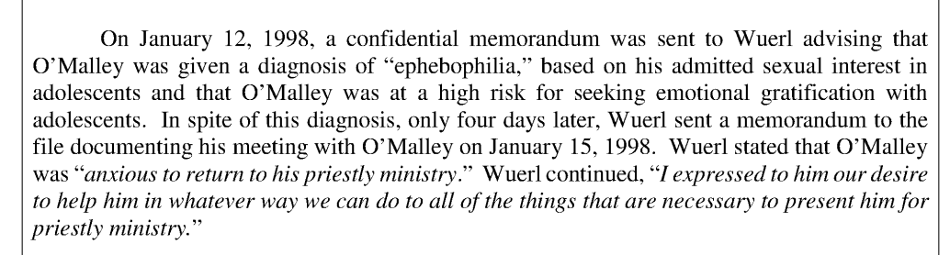
Pittsburgh priest Fr. William O’Malley’s case illustrates how diagnosis and treatment of ephebophilia can be used as a pathway to restored ministry rather than laicization or punishment for predatory behavior.
The 2018 Pennsylvania Grand Jury Report noted that O’Malley had been repeatedly accused of inappropriate conduct with minor males in the 1970s and 1990s. In the report, O’Malley was quoted as having acknowledged that one particular alleged incident of him committing child abuse “probably happened.” The report indicated that then-Bishop Donald Wuerl granted him a leave of absence for psychological treatment. After learning on January 12, 1998 that O’Malley had been diagnosed with ephebophilia, and that he remained at high risk of seeking emotional gratification with adolescents, Wuerl expressed support for bringing him back into ministry on advice from a psychiatrist who was working with O’Malley. Wuerl met with O’Malley on January 15, 1998 and told him he wanted to help him “in whatever way we can to do all things that are necessary to present [you] for priestly ministry.” Following residential treatment, O’Malley was appointed by Wuerl as a diocesan tribunal consultant in November 1998. 22
Leo XIV is responsible for changing Canon Law
The 2017 Australian Royal Commission inquiry recommended making a pedophilia diagnosis irrelevant to prosecution and punishment for child sexual abuse. The Vatican’s revised 2021 penal law ignored this advice and still allows for reduced punishment instead, making dismissal from the priesthood highly unlikely, which is at variance with previous Church disciplinary norms.
To end the abuse crisis, Leo XIV should require dismissal from the priesthood for every priest found responsible for sexually abusing a child after a fair process, with permanent exclusion from ministry and Church administration rather than rehabilitation. A report to law enforcement should also accompany removal. Protection of children must take precedence over preserving an offender’s priesthood.
- Royal Commission into Institutional Responses to Child Sexual Abuse, Final Report, vol. 16, Religious Institutions, book 2 (December 15, 2017), printed pp. 716–717, especially Recommendation 16.13. The discussion reports the Irish Murphy Commission’s findings and Doyle’s evidence. Final report. ↩︎
- Dan Kedmey, “Vatican Reveals It Punished Thousands of Priests for Sex Abuse,” Time, May 6, 2014. Vatican figures for the preceding decade; calculation: 2,572 ÷ (848 + 2,572) = 75.2%. These totals do not identify individual grounds for mitigation. Report. ↩︎
- Holy See, “Observations of the Holy See to the Recommendations of the Royal Commission,” enclosure to Letter N. 484.110, February 26, 2020, pp. 3–4, responses to Recommendations 16.11 and 16.13. Holy See response. ↩︎
- “Vat. II which itself introduced a new outlook and a new spirit into the penal law of the Church,” “In a situation where a person has behaved in a reprehensible fashion, the law urges caution: penalties are to be imposed only as a last resort.” (Canon Law Letter & Spirit, 1995, pg. 770 regarding c. 1341). Also: Canon Law Society of Great Britain and Ireland, The Canon Law: Letter & Spirit: A Practical Guide to the Code of Canon Law, ed. Gerard Sheehy et al. (1995), p. 770, commentary on the original canon 1341; passage reproduced in Michael Hichborn, “Legal Loophole in Canon Law Protects Pedophiles,” Lepanto Institute, January 24, 2022, archived by BishopAccountability.org, January 26, 2022. Reproduced commentary. ↩︎
- Canon Law Society of Great Britain and Ireland, The Canon Law: Letter & Spirit: A Practical Guide to the Code of Canon Law, ed. Gerard Sheehy et al. (1995), p. 805; passage reproduced in Commission of Investigation, Report into the Catholic Archdiocese of Dublin (Murphy Report, 2009), chapter 4, §4.59, pp. 71–72. Reproduced commentary in the Murphy Report. ↩︎
- Peter O. Akpoghiran, Canon Law of Evidence in Penal Cases: A Commentary on Canons 1526–1586 of the Code of Canon Law (CreateSpace Independent Publishing Platform, 2019), p. 154; ISBN 9781543113846. The page reference and quotation were supplied by the author; “33” is the book’s own note marker. Bibliographic record. ↩︎
- Codex Iuris Canonici (1917), c. 2200 §§1–2. Latin text; English explanation in the article. Canon 2200. ↩︎
- James Clark, The Presumption of Imputability and the Presumption of Innocence: Two Presumptions in Conflict? (doctoral thesis, 2025), pp. 121–122; Code of Canon Law, original c. 1321 §3, now c. 1321 §4. Clark discusses both the drafting history and the distinction between rebutting the presumption and proving its contrary. Thesis. ↩︎
- John P. Beal, James A. Coriden, and Thomas J. Green, eds., New Commentary on the Code of Canon Law (Paulist Press, 2000), p. 1541; passage reproduced in Matthew David, “Cameroonian Rapist Priest Rehabilitated,” October 16, 2023, archived October 19. Reproduced commentary. ↩︎
- Council of Elvira, canon 71, traditionally dated to c. 306; English translation in “81 Canons of the Synod of Elvira.” The exact date of this regional council is disputed. Canon 71. ↩︎
- St. Pius V, Horrendum illud scelus, August 30, 1568, §§2–3; English translation reproduced by RK Documenten, citing Bullarium Romanum, vol. 4, part III, p. 33. Constitution. ↩︎
- Code of Canon Law, c. 1341, as revised in 2021; compare the original and revised texts in the Holy See’s official synoptic comparison of Book VI. Current canon 1341. 1983 and 2021 comparison. ↩︎
- Thomas Doyle, “A Short History of The Manual,” account of the 1985 project by Doyle, Michael Peterson, and F. Ray Mouton. Doyle identifieshis Washington appointment and the inclusion of clinical literature. Doyle’s account. ↩︎
- Thomas Doyle, statement reproduced in Matthew David, “Cameroonian Rapist Priest Rehabilitated,” Church Militant, October 16, 2023, archived by BishopAccountability.org, October 19, 2023. Doyle rejects the sweeping claim that pedophiles cannot choose otherwise. Published statement. ↩︎
- Michael Miabesue Bibi, “Restoration of the Faculties of Fr. Hilary Ngome for the Full Exercise of Ministry,” Diocese of Buea, DB/B-BOL-329/2023/7, August 15, 2023, pp. 2–3; Matthew David, “Cameroonian Rapist Priest Rehabilitated,” October 16, 2023, archived October 19. The published report supplies the rape allegation, age, and offense date; Bibi’s letter records the Church’s findings and decisions. Published report. ↩︎
- Murphy Report (2009), chapter 4, §§4.79–4.80, p. 76; chapter 16, §§16.62–16.65, pp. 235–236, for Patrick Maguire’s offense dates, criminal sentence, and canonical proceedings. Chapter 16. Chapter 4. ↩︎
- Commission of Investigation, Report into the Catholic Archdiocese of Dublin (Murphy Report, 2009), chapter 19, §§19.79, 19.86–19.89, 19.94, and 19.102–19.103; portions released December 2010. “Fr. Jovito” is Tony Walsh. Chapter 19. ↩︎