
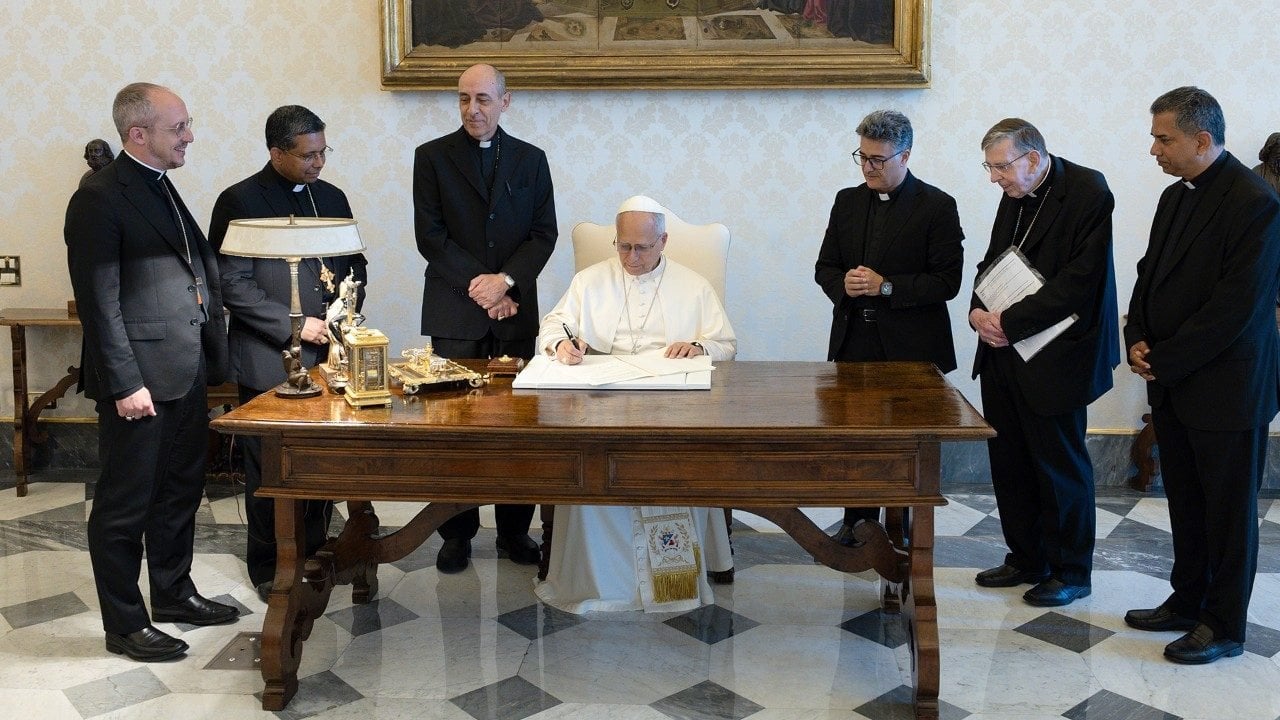
On Wednesday, the Vatican published a note bearing the name A Journey of Hope to mark the 60th anniversary of Nostra Aetate. Issued jointly by three Roman dicasteries, the document reflects on decades of “interreligious dialogue and fraternity” in light of that revolutionary Vatican II declaration.
Strictly speaking, A Journey of Hope is not a magisterial text, but it does witness to the mind of Leo XIV, who personally approved it and ordered its publication. Formal authorship belongs to three dicastery prefects: Cardinal Víctor Manuel Fernández of the Dicastery for the Doctrine of the Faith, Kurt Koch of the Dicastery for the Promotion of Christian Unity, and George Jacob Koovakad of the Dicastery of Interreligious Dialogue.
All three cardinals explained the document’s meaning in separate interviews with Vatican News. In his exclusive interview, Fernandez argued “Every religion — and all religions — stands for peace,” linking this claim to paragraph 223 of Leo XIV’s first encyclical, Magnificas Humanitas. 1 Koch, for his part, argued that the new document “means that it is impossible to be a disciple of Jesus Christ and, at the same time, an antisemite,” noting that “every Pope since the Second Vatican Council has reaffirmed this with great conviction.”
Antisemitism is a major theme of the note itself. While never explicitly defining it, the document confirms Nostra Aetate was born from “the aftermath of the Second World War,” more specifically as having emerged “initially … as a response to the tragic consequences of antisemitism, which culminated in the Shoah.” 2 3
Tracing itself to paragraph four of Nostra Aetate, the document expresses solidarity with the Jewish people and “the shared struggle against antisemitism,” again, while not stating clearly what that term means. 4 At the same time, the note clarifies its own understanding of antisemitism as “advancing beyond” a 1928 ruling of the Holy Office which narrowly defines the term as hatred of the Jewish people, which all Catholics must condemn.
Another notable emphasis the document notes is the link between Nostra Aetate and Dignitatis Humanae. Without the “right to religious freedom” having been asserted by Dignitatis Humanae, it rightly notes, “no respectful relationship with other religions [sic] can be sincere or feasible.” 5
“To achieve this goal [of interreligious dialogue],” it continues, “a genuine shift in mindset is necessary: abandoning the logic of defensiveness, hostility, or conquest in order to adopt an attitude that is open, benevolent, and courageous.” 6
Join the Counter-Revolution: Become a supporter of Integrity today!
The document conspicuously sources its arguments — which total ninety-five citations— almost exclusively from the Second Vatican Council and onward, citing only two pre-conciliar texts, one of which is Protestant theologian Karl Barth. 7 The other ninety-three citations reference the Council and subsequent conciliar magisterium, while essentially adopting the specious arguments made by Jules Isaac, a French-born Jew who sought and was granted an audience with John XXIII before Vatican II. Isaac is famous for his 1966 work, translated into English, entitled “Teaching of Contempt” in which he seeks to revolutionize Catholic tradition on the Jewish people and prove that the Church was responsible for persecuting Jews during World War II.
When analyzing the document in totality, one cannot help but agree with the A Journey of Hope when they state that Vatican II’s Nostra Aetate “marked a profound change in the Church’s understanding and expression of her relationship with followers of other religions.” 8 Indeed, Vatican II did scandalously 9 affirm that the Conciliar Church “rejects nothing that is true and holy in these religions.” 10
Catholics denounce ‘A Journey of Hope’
The Dispatch
On social media many Catholics voiced criticism of the document. Anthony Abbate of the Avoiding Babylon podcast saw it as “The Pope … telling us the Great commission is over.” David Reilly of The Backlash observed in the same vein, “It appears as though the Post-Conciliar Vatican is ditching Matthew 28:19,” a reference to the duty of the Church to “teach” all nations the Catholic religion — including the Jewish people.
Editor-in-Chief of Integrity Magazine Stephen Kokx saw in A Journey of Hope, “One of the most insidious documents to be published by the Vatican in recent memory.”
Father Federico Palma, a priest of the Roman Catholic Institute, incisively remarked that the document “proves that the religion that emerged from [Vatican II] is essentially different from the Catholic Religion.”
At the same time, defenders of Vatican II championed the orthodox portions of the document, notable among them being X user Pope Respecter, who recalled that Nostra Aetate said dialogue must be “grounded in doctrinal clarity.” Though an ardent defender of Nostra Aetate, Dr. E. Michael Jones, who has previously admitted, “the [conciliar] Church is crippled by a misinterpretation of Nostra Aetate,” seemed to chafe at the note and reiterated his false belief that the Conciliar Church “can’t condemn what it can’t or won’t define,” a reference to its failure to define what antisemitism actually is.
In an X exchange with XboxLiveRepublican, even Jewish convert Gideon Lazar conceded, “I definitely agree all the recent documents (starting with Nostra Aetate itself) are badly written.”
What emerges from this range of reactions is a document that, ultimately, only pleases the partisans of Vatican II and furthers the conciliar revolution and its capitulation to Jewish propaganda. And, despite the note rejecting the claim that it seeks “founding a great world religion in which all beliefs are leveled,” 11 the entire document suggests that is precisely what it seeks to accomplish. As such, it is fulfilling what Pope Saint Pius X’s warned about in his 1910 encyclical Notre Charge Apostolique:
Accordingly [ecumenists] ask all those who want to change today’s society in the direction of Democracy, not to oppose each other on account of the philosophical or religious convictions which may separate them, but to march hand in hand, not renouncing their convictions, but trying to provide on the ground of practical realities, the proof of the excellence of their personal convictions. [They think] Perhaps a union will be effected on this ground of emulation between souls holding different religious or philosophical convictions … an inter-denominational association that is to work for the reform of civilization, an undertaking which is above all religious in character; [but] there is no true civilization without a moral civilization, and no true moral civilization without the true religion: it is a proven truth, a historical fact. 12
- Leo XIV, Magnificas Humanitas, (May 15, 2026), para. 223: “[T]hose who use the name of God to legitimize terrorism, violence or war betray His true nature, for to fight in the name of religion means attacking religion itself.” ↩︎
- A Journey of Hope, (September 16, 2026), no. 4. ↩︎
- Cf. Reflection on the 50th Anniversary of Nostra Aetate, (December 10, 2015), no. 40. — “It is easy to understand that the so–called ‘mission to the Jews’ is a very delicate and sensitive matter for Jews because, in their eyes, it involves the very existence of the Jewish people … In concrete terms this means that the Catholic Church neither conducts nor supports any specific institutional mission work directed towards Jews. While there is a principled rejection of an institutional Jewish mission, Christians are nonetheless called to bear witness to their faith in Jesus Christ also to Jews, although they should do so in a humble and sensitive manner, acknowledging that Jews are bearers of God’s Word, and particularly in view of the great tragedy of the Shoah.” ↩︎
- AJH., no. 14. ↩︎
- Ibid., no. 2. ↩︎
- Ibid., no. 54. ↩︎
- Citations are as follows: [6] Barth, Church Dogmatics (1956); [25] Holy Office Decree (1928). ↩︎
- Ibid., no. 1. ↩︎
- John Daly, The Principal Heresies and Other Errors of Vatican II. — “Putting aside the scandalous reference to life, conduct and precepts, let us concentrate on the statement that the Church has ‘a high regard’ for the ‘doctrines’ of false religions, not only those doctrines which, fortuitously, may be true, but even those which ‘differ … from her own teaching.’ Now since the teaching of the Catholic Church is true, it is a logical necessity that any doctrine which differs from it must be false. The Fathers of Vatican II, therefore, have firmly declared that the Church ‘has a high regard’ for false doctrines. Of course, this is perfectly true of the Conciliar Sect; but the attitude of the Catholic Church towards false doctrines has always been the same as that of her Divine founder: unrestrained loathing.” ↩︎
- AJH, no. 1. ↩︎
- AJF, no. 53. ↩︎
- Pope St. Pius X, Notre Charge Apostolique, (August 25, 1910). ↩︎