
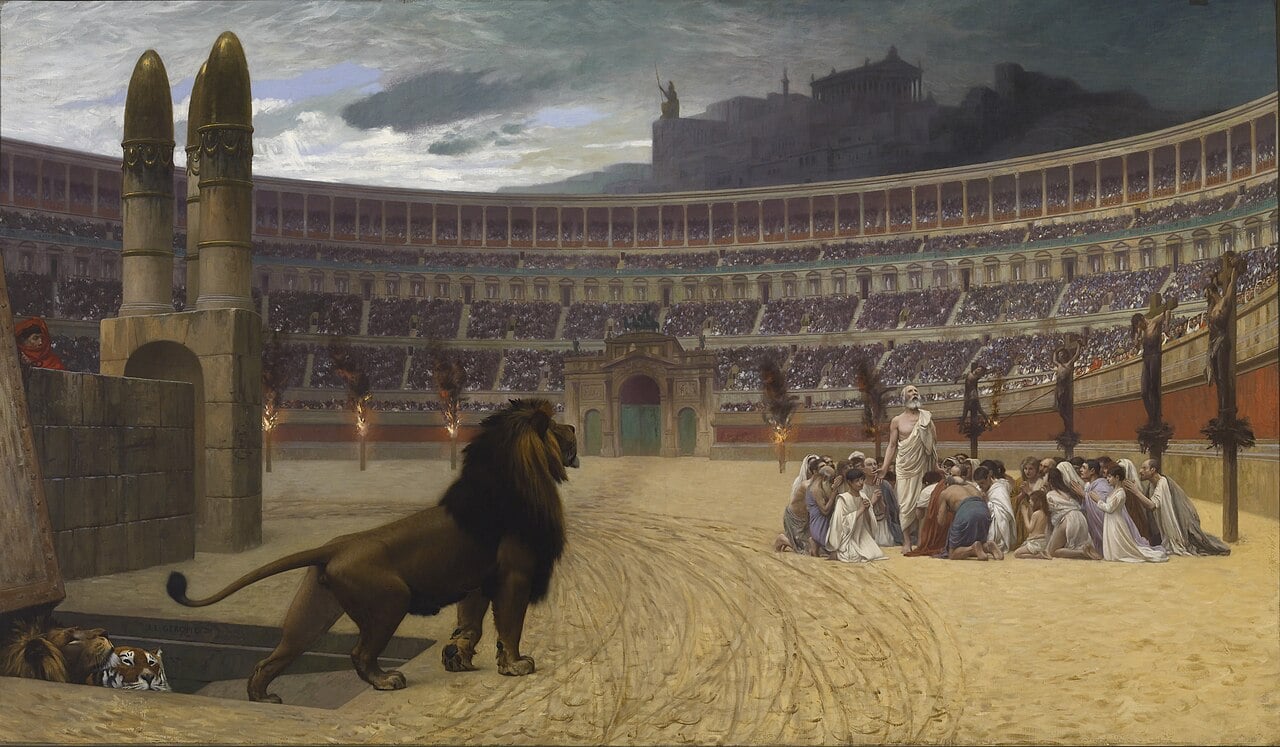
There is an unmistakable pattern in Scripture, Church history, and our present day: the reality of a tiny, though faithful remnant living amid a larger mass of persons outside the kingdom of God.
Our Lord Himself speaks of this. After sharing the parable of the widow and the unjust judge, He asks, “When the Son of Man comes, will he find faith on the earth?” The correct answer seems to be: “Not much.” This is to be expected, as the millennia that preceded the end of days is replete with examples of a small number of souls testifying to the truth.
Early on in the Biblical narrative, we see that only eight souls were saved on Noah’s Ark. Later, we learn that Joshua and Caleb, along with those who were twenty years old and younger, were allowed to enter the Promised Land. For the rest of the Israelites, their bones bleached in the desert.
Further along, only Shadrach, Meshach, and Abednego refused to bow to Nebuchadnezzar’s golden idol. Jeremiah himself called Judah to repentance for at least twenty-three years, and very few listened (Jer. 25:3). Jeremiah well understood David’s lament: “They have all gone astray, they are all alike corrupt; there is none that does good, no, not one” (Ps. 14:3).
Again, Christ said that many were called but few were chosen (Mt. 22:15). He also taught that few would find the straight and narrow path that leads to eternal life (Mt. 7:14).
Stand for the faith: Become a monthly donor at Integrity today!
The vast majority of the saints throughout history agreed with this assessment. St. Louis Marie de Montfort said: “The number of the elect is so small — so small — that, were we to know how small it is, we would faint away with grief: one here and there, scattered up and down the world.”
Apparently, Bishop Robert Barron didn’t get the memo. In 2014, he contributed a cheery forward for Hans von Balthasar’s Dare We Hope That All Men Be Saved?
“The most striking and original contribution that Balthasar makes to this discussion, I believe, is his critique of Thomas Aquinas’s view — shared widely in the classical tradition — that part of the joy of heaven is to witness the sufferings of the damned,” Barron wrote.
Some examples offered by Barron’s predecessors in the episcopate throughout Church history are worth recalling.
St. Jerome once said that “the world groaned and woke to find itself Arian,” indicating that the vast majority of bishops had bought into the heresy and were sending themselves to eternal damnation. Of the more than fifteen Catholic bishops in England in 1535, only John Fisher opposed Henry VIII. Curiously enough, of the more than 270 active members of the USCCB, how many besides Joseph Strickland articulated firm and consistent opposition to Bergoglio’s many heresies?
The Dispatch
Simply put, courage in the hierarchy during the Church’s history is almost as rare as the Northern White Rhino — only two of which are left on the planet. And yet we are to reasonably hope that “all men” are saved?
Catholics do not abide by Church teaching
Some might argue that because there is between 1.1 and 1.4 billion self-identified Catholics in the world that it is absurd to speak of a tiny, faithful remnant. This is to forget the facts on the ground.
When you look at studies on Catholic’s beliefs and practices on contraception, abortion, in-vitro fertilization, same-sex marriage, and cohabitation, the faithful remnant comes into view as large percentages of laity do not support nor abide by Church teaching on these topics.
Add to that the number of mortal sins that are not being confessed (e.g., not fulfilling the Sunday obligation, gossiping, impurity, sins against marital chastity, etc.) and the “little flock” gets even smaller.
At present, 840 Catholics leave the Church for every 100 who join. There isn’t much hope for a turn-around right now, especially as more ordinaries are cracking down on the Latin Mass.
Remaining humble and faithful to Christ
Many are called but few are chosen. Many Catholics start off on the path to heaven but are later ensnared by the lust of the flesh, the lust of the eyes, and the pride of life. Our Lady told Jacinta Marto at Fatima in 1917 that more souls go to hell because of sins of the flesh than for any other reason.
As bleak as things look at the moment, the Desert Fathers can give us hope amid the storm. St. Anthony provides a signpost for earnest souls who want to belong to the tiny, faithful remnant: “I saw the snares that the enemy spreads out over the world and said groaning, ‘Who can escape from these?’ Then I heard a voice saying to me, ‘Humility.’”
It is no coincidence that the righteous remnant mentioned in Zephaniah 3:12 — which St. Jerome and St. Augustine foresaw — was described as “a people humble and lowly.” If humility is the mother of all virtues, as many spiritual luminaries have asserted, then it must be considered foundational for us in these times.
The great spiritual director, Fr. Gabriel of St. Mary Magdalen (1893-1953), who wrote Divine Intimacy, opined that although charity is greater than humility, it is built on the foundation of humility. In other words, there is no progress in the spiritual life without humility just as there is no building a house without a sturdy foundation. May we heed these words as God continues to purify each and every one of us during this time of great tribulation.