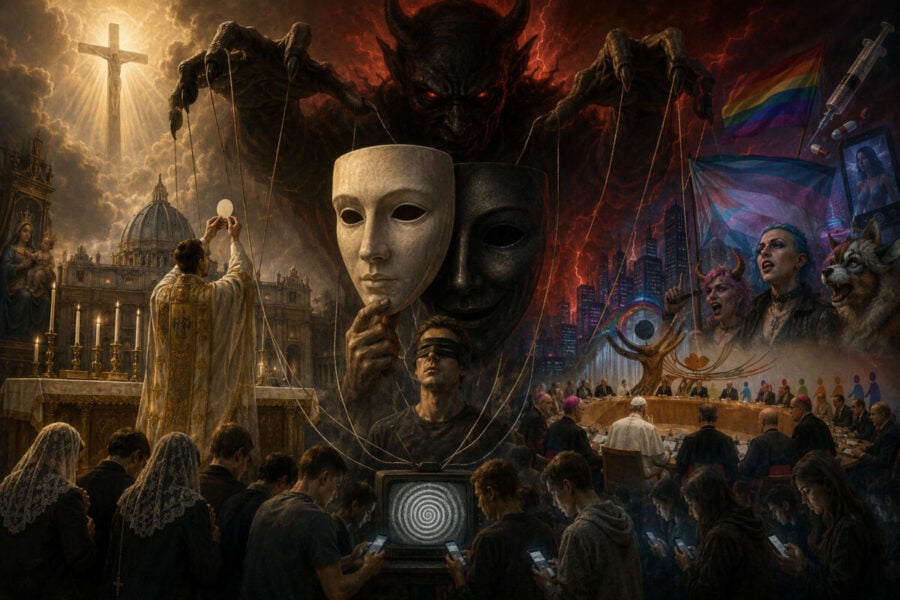
Satan is attacking the very fabric of reality on a grand scale in what could rightly be called a planetary act of sorcery.
Deception, inversion, and perversion have always been the tools of his trade, but in the spiritual wasteland of twenty-first century humanity, nearly every aspect of civilization has become conducive to the greatest mass deception in salvation history. From mass media to social media, from entertainment to pharmaceuticals, from designer narcotics to the collapse of morality, from post-Christian neo-pagan spirituality to forms of sexual degeneracy that would make pagan antiquity blush, modern man is immersed in a civilization of unreality.
The distinguishing mark of this age is inversion. Evil presents itself as good, disorder as freedom, rebellion as virtue, and corruption as enlightenment. Meanwhile, goodness is treated as extremism, purity as repression, truth as hatred, and tradition as some kind of pathology. Isaiah’s warning echoes over our age with terrifying precision: “Woe unto them that call evil good, and good evil: that put darkness for light, and light for darkness.” What was once obvious to ordinary men now requires courage merely to affirm.
In few instances is this satanic insanity more starkly evident than in so-called gender ideology and its adjacent practices. Humanity is waging a full-frontal assault on God through the sheer madness we see today — from people insisting on preferred pronouns that do not align with their biological sex, to blue-haired psychos who not only identify as genders they are not but who also invent entirely new gender categories and even claim to be other species.
This inversion is systematic, coordinated, and spiritual in character. Like sorcery, it works through manipulation of perception. Sorcery does not create reality; it distorts man’s perception of reality. It clouds judgment, weakens discernment, and substitutes illusion for truth. The modern world operates in precisely this way. Language itself has become unstable and definitions shift constantly. Objective truths are dissolved into subjective feelings, and the modern man no longer asks what something is, but how he feels about it.
In former ages, man sought conformity with reality. Today, reality is expected to conform to man’s desires.
Read more: The Synodal Church’s teaching on proselytism contradicts the Gospel
This spirit of inversion permeates every layer of modern civilization. Governments normalize vice while criminalizing dissent. Entertainment glorifies ugliness, blasphemy, and degeneracy under the banner of artistic freedom. Pharmaceutical dependency numbs populations spiritually and psychologically. Technology saturates human consciousness with endless distraction, destroying contemplation and interior silence. Social media creates a counterfeit world where image replaces substance and vanity replaces wisdom. Modernity does not merely distract man from God but conditions him to forget that transcendence exists at all.
As catastrophic as the collapse of secular civilization has been, an even greater tragedy lies within what still calls itself the Catholic Church.
For nearly two thousand years, Catholicism understood itself as the one true religion established by Jesus Christ outside of which there was no salvation. Its mission was not dialogue with the world, but conversion of the world. It spoke with clarity and guarded doctrine because doctrine concerns eternal salvation and maintained sacred liturgy because worship forms belief.
Then came the post-conciliar revolution.
What occurred after the Second Vatican Council was presented as a “renewal”, but the practical reality experienced by millions of Catholics resembled not renewal, but transformation. The liturgy was dismantled and replaced with something anthropocentric and desacralized, ecumenism blurred distinctions between truth and error, religious liberty contradicted prior magisterial teaching regarding the social kingship of Christ, and collegiality weakened the understanding of authority.
Most devastating of all was the psychological operation carried out upon the faithful: Catholics were instructed to believe that the religion now emerging from the post-conciliar structures was identical to the religion of their ancestors, despite dramatic differences in worship, emphasis, language, and theology.
The Dispatch
This is where the deeper inversion emerges.
Now a man may look at the profound discontinuity and raise his concerns and still be told there is continuity. He may compare the pre-conciliar Mass with the new liturgy and be instructed that both express the same theology equally well. He may compare pre-conciliar condemnations of religious indifferentism with modern ecumenical practices and be assured that nothing essential has changed. In other words, he is expected to deny the evidence before his eyes for the sake of institutional conformity.
That is not unlike the broader civilizational demand placed upon modern man: to reject objective reality in favor of officially sanctioned narratives, propaganda, and indoctrination.
The modern secular world insists that identity is fluid, self-defined, and detached from objective nature. The post-conciliar religious world similarly insists that Catholic identity can remain intact even when doctrine, liturgy, and ecclesial orientation appear fundamentally altered. In both cases, continuity is asserted where rupture is clearly evident. The individual is conditioned not to trust reason, tradition, memory, or inherited categories, but institutional messaging.
This is why the crisis of the Church cannot be understood merely as bad leadership or unfortunate pastoral decisions, but as metaphysical in scope. It concerns the corruption of categories themselves. The ancient distinction between sacred and profane has collapsed and the distinction between Catholic and non-Catholic has been blurred. The distinction between preserving tradition and reinventing religion has become obscured.
The result is spiritual disorientation on a massive scale.
A Catholic from 1920 transported into many modern parishes would scarcely recognize what he encountered. The architecture resembles Protestant minimalism, the music resembles popular entertainment, the sermons often avoid sin, judgment, sacrifice, or hell, and the liturgy emphasizes community over transcendence. Sacred silence has disappeared beneath constant activity and noise, yet despite these profound changes, the faithful are expected to believe that nothing essential has changed.
Again, the mechanism resembles sorcery: not the destruction of reality, but the manipulation of perception.
The devil has always preferred counterfeit over annihilation. A counterfeit religion is more useful than open atheism because it preserves external appearances while corrupting the substance. It allows souls to believe they possess the faith while gradually severing them from the doctrinal, sacramental, and spiritual foundations that sustained Catholic civilization for centuries.
This explains the strange paralysis visible among many modern Catholics. They sense contradiction but suppress it. They witness collapse yet repeat slogans about renewal. Churches empty, vocations disappear, doctrine dissolves into ambiguity, and moral confusion spreads everywhere, but the wicked heresiarchs insists that this represents a flowering of the Holy Spirit.
Meanwhile, fidelity to historic Catholic teaching is labelled as rigidity, extremism, or disobedience. Such conditions could only emerge in an age deeply conditioned by spiritual deception, or then sorcery and Black Magick.
The modern world prides itself on being rational and enlightened, yet it increasingly resembles a civilization under barbaric, dark, and primal enchantment — restless, irrational, emotionally manipulated, detached from reality, and hostile to truth. The Synodal Church makes similar claims and unsurprisingly finds itself in exactly the same state. Men no longer know what they are, what they are for, or whom they should worship.
It is therefore of absolute importance that, just as one should not pander to the delusions of those who demand that we deny reality by recognizing their preferred pronouns or imagined twisted identities, Catholics must resist at all costs any recognition or legitimization of the Synodal Church as Catholic.
To do so would be a betrayal of Jesus Christ and the Roman Catholic Church and would make you a participant in the Great Deception.