
There are anniversaries that invite the Catholic commentariat to reveal, without quite meaning to, the entire operating system behind its public posture.
May 8, 2026 was one of those.
One year after Robert Francis Prevost emerged on the balcony as Leo XIV, many of the same traditionalist and conservative voices who built careers explaining the Francis crisis suddenly found the smelling salts.
Relax. Count your blessings. Stop worrying so much. Live your Catholic life. Pray. Do not get pulled into ragebait. Welcome to papal history. There have been worse popes. There have been corrupt popes. There have been murderous popes. There have been decadent popes. Therefore, apparently, a pope who continues the conciliar revolution in a quieter voice deserves a generous round of grateful silence.
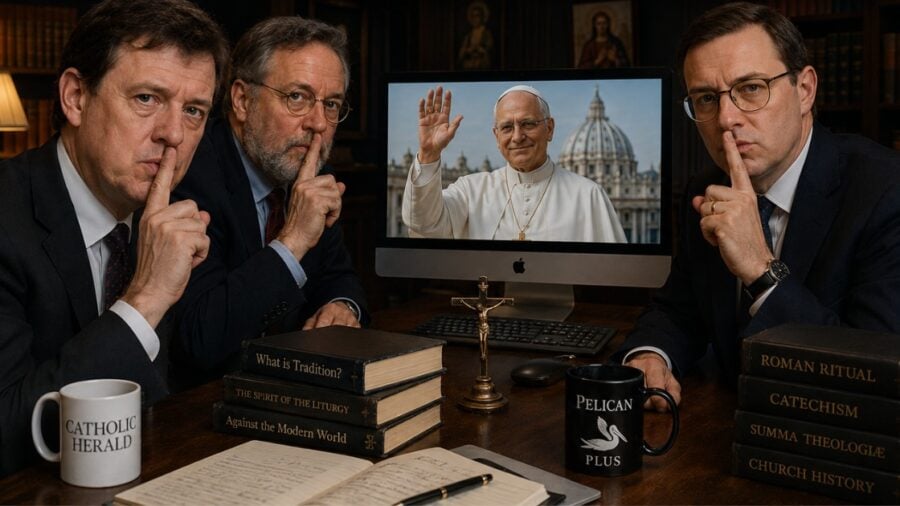
Call it the Zip It Policy.
It is the new doctrine of Trad Inc, or at least the new public etiquette. Francis could be criticized because Francis was loud, Argentine, theatrical, and aesthetically unbearable. Leo must be endured more delicately because he wears the clothes, speaks softly, likes canon law, and does not publicly sneer at Latin every forty-eight hours. The substance may continue. The machinery may remain intact. The synodal organs may keep humming. The homosexualist pressure groups may receive Vatican oxygen. The Latin Mass may remain juridically restricted. The SSPX may be treated as a menace while the German bishops play chicken with Rome. But as long as the papal voice drops an octave and the mozzetta returns, we are instructed to lower our own voices too.
That is the story behind the Kwasniewski post and the Damian Thompson tweets. They are worth examining because they capture the psychology of a movement that can recognize the disease but cannot bring itself to diagnose the patient.
Kwasniewski’s soft landing
Peter Kwasniewski’s anniversary post begins with a concession that ought to detonate the rest of the paragraph. Leo, he says, has maintained and will maintain continuity with his immediate predecessors in some areas, while doing his own thing in others. He adds that we were never going to get anything other than a “very Vatican II” pope because we remain “deeply in the mire of the postconciliar period.”
That part is true enough. Then comes the turn.
We should “count the blessings we have.” Leo will “not be perfect.” He will do things that delight us and things that anger us. Welcome to papal history. Layfolk should live the Catholic life, hold fast to traditional doctrine, give novelties a wide berth, cling to the patrimony of the saints, especially in the sacred liturgy, and pray for “the Vicar of Christ, the Successor of St. Peter, the Bishop of Rome.”
This is the strange new equilibrium: admit the pope is “very Vatican II,” admit he will maintain continuity with the postconciliar line, then immediately sacralize the arrangement by piling up the papal titles.
A Catholic can certainly pray for a claimant to the papal office. A Catholic can pray for his conversion, his correction, his protection from evil counsel, his public return to the integral faith. But the traditionalist habit of saying, in effect, “Yes, he will continue the revolution, but remember, he is the Vicar of Christ,” is precisely the mechanism by which the revolution survives.
Because once that premise is granted, every novelty becomes a trial of obedience rather than a reason to question the system producing it.
The layman is told to “give novelties a wide berth,” but the office producing, tolerating, protecting, or laundering those novelties remains beyond serious examination. Avoid the poison. Revere the dispenser. Keep your family away from the doctrinal spill, but do not ask why the pipes are still connected to Rome.
This is managed contradiction.
Thompson’s relaxant
Damian Thompson’s contribution was less devotional and more sedative.
He quoted George Weigel: “Everyone needs to relax a little bit and perhaps worry a bit less about what the Pope said yesterday morning.” Thompson agreed, adding that anyone as worried as he was under Francis needed to refresh his memory about the “almost daily outrages from Santa Marta.”
There it is, the whole argument in miniature.
The crisis is measured by outrage frequency. If the pope is not detonating a new scandal every morning before breakfast, the crisis has improved. If he is less improvisational than Francis, less slapstick, less chaotic, less addicted to headline-grabbing pastoral grenades, then we are supposed to breathe easier.
But Catholic doctrine does not become safer because the operator uses a silencer.
Leo’s first formal address to the cardinals explicitly called for continuing the “precious legacy” of Francis, renewing commitment to the path followed since Vatican II, and highlighting Evangelii Gaudium themes including synodality, the sensus fidei, care for the rejected, and dialogue with the contemporary world.
His first Urbi et Orbi blessing also thanked Francis, spoke of building bridges through dialogue and encounter, and called for a Church “open to welcoming” those in need of its charity, presence, dialogue, and love. Again, the tone was smoother than Francis, but the vocabulary was familiar.
So yes, Leo may generate fewer daily explosions and restore decorum while preserving the architecture. That makes him more dangerous in one obvious sense: he gives conservative Catholics enough aesthetic relief to stop asking doctrinal questions.
‘Nothing Francis did can compare…’
Thompson’s other tweet is even more revealing. Responding to the claim that Francis was minor compared with other bad eras of papal history, he wrote that nothing Francis did can compare to the “homicidal orgiastic madness” of certain popes at the end of the first millennium. Francis, he said, was merely the worst pope for centuries.
This is the classic historical distraction.
Yes, there have been grotesque men in Roman history. Yes, there have been corrupt clerics, simoniacs, nepotists, cowards, libertines, and scoundrels. Nobody serious denies this. The Church survived them because personal wickedness, however revolting, does not necessarily amount to a public doctrinal revolution imposed through official organs.
The question after Vatican II has never been whether a pope can be personally sinful. The question is whether the Roman apparatus can promulgate, protect, normalize, and export a new religion while Catholics are told that recognizing the contradiction is extremism.
A Borgia scandalized the Church by vice. The postconciliar claimants scandalize by making ambiguity a method of governance, liturgical rupture a permanent settlement, and moral exceptions a pastoral art form. The old bad popes sinned like men. The new crisis teaches like an institution.
That is the difference Trad Inc. keeps dodging.
When Thompson drags out the corpses of medieval papal corruption, he is changing the subject from doctrine to decadence. A pope’s private depravity can wound the Church terribly. A public doctrinal machine can misform generations while looking respectable in white.
Rorate finds a sunrise in the fog
The more sophisticated version of the same argument appeared at Rorate Caeli. In a first-anniversary analysis, Serre Verweij argued that Leo may represent “a return to orthodoxy,” that he has made conciliatory moves toward supporters of the Tridentine Mass, that his appointments “lean conservative,” and that he has “restored dignity to the papal office.”
The article goes further. It says Leo has drained synodality of its revolutionary meaning, that Fiducia Supplicans has been reinterpreted against the Germans rather than conservatives, and that “Traditionis Custodes is dead.” It concludes that Leo had a “good,” perhaps “very good,” first year.
Traditionis Custodes is “dead” only in the way many dead things in the postconciliar Church continue to twitch, bite, and issue diocesan memoranda. If the old Mass remains something to be dispensed, managed, tolerated, relocated, negotiated, and politically leveraged, the revolution has merely shifted from open attack to licensing.
The same goes for Fiducia Supplicans. A “reinterpretation” that leaves the document standing is containment.
The Register’s own first-year analysis by Edward Pentin conceded that Leo has shown “fundamental continuity” with Francis, has largely reaffirmed Francis on marriage and family, has maintained support for synodality, has resisted repealing Fiducia Supplicans, and has left the larger Traditional Latin Mass debate unresolved.
That is the part the Zip It Policy cannot digest. The case for Leo as restoration depends on treating symbols as substance and delays as decisions.
The progressive side understands the game
The funniest part is that progressive Catholics often understand Leo more clearly than the conservative optimists do.
Where Peter Is, the gaslighting website of popesplaining windbag Mike Lewis, celebrated Leo’s first year by noting that he has shown broad alignment with Francis on war, immigration, the death penalty, care for creation, and social justice. It also pointed to Leo’s admiration for Francis, his intention from the loggia to continue the synodal Church, and his repeated favorable references to his predecessor.
Progressives look at Leo and see continuity with Francis.
Traditionalist managers look at Leo and see a secret restoration.
The Vatican’s own texts look rather more like the progressive reading. Leo’s official first address to the cardinals invoked Vatican II, Evangelii Gaudium, synodality, dialogue, the sensus fidei, and Francis’s legacy.
The Synodal report everyone is supposed to process calmly
While the anniversary commentariat was telling people to relax, the Synod machine supplied a useful test case.
The Dispatch
Study Group 9’s final report, released through the synodal process, included testimonies from men in same-sex civil “marriages” and raised questions about homosexuality, doctrine, pastoral practice, and even whether one can speak of “marriage” in relation to persons with same-sex attractions. The official report argues for moving beyond a model that applies “general and abstract principles” to concrete situations and calls for a “circularity” between theory and praxis, thought and experience.
One of the official annexed testimonies says, in the first person, that homosexuality is not a perversion, disorder, or cross, but a “gift from God,” and describes a same-sex “marriage” as happy and healthy.
The Register reported that the Study Group 9 report included testimonies from “married” gay men, questioned whether same-sex relations are sinful, and drew serious criticism for its treatment of Courage International. It also reported that the study group included figures such as Cardinal Carlos Castillo Mattasoglio, Father Maurizio Chiodi, and Father Carlo Casalone, all names carrying serious doctrinal baggage in moral theology debates.
This is the world in which Kwasniewski tells us to count blessings and Thompson tells us to relax.
The Synod apparatus did not vanish under Leo. The categories did not vanish. The method did not vanish. The progressive activists did not vanish. The report even says the process will continue through dioceses and episcopal conferences toward the 2028 Ecclesial Assembly.
A quieter pope presiding over a functioning synodal machine is still presiding over a functioning synodal machine.
The German Bishops and the SSPX, paired for convenience
Another absurdity in the anniversary discourse is the habit of pairing the German bishops and the SSPX as matching “fringes.”
Thompson predicted Leo may act decisively against the German bishops and the SSPX, upsetting “both fringes” to bring peace to the Church. CatholicCulture made a similar move, describing the SSPX and German bishops as “wayward sons” and saying Leo wants both to cancel their plans.
This framing is morally grotesque.
The German bishops are pushing the sexual revolution through ecclesiastical channels. Their project involves blessings, synodality, lay governance, doctrinal pressure, and the normalization of relationships Catholic moral theology has always condemned. The SSPX, whatever one thinks of its canonical situation, exists because Archbishop Lefebvre saw the conciliar collapse coming and refused to hand the traditional priesthood over to the men dismantling it.
Only in the managerial Catholic mind do these become equal and opposite extremisms.
The National Catholic Register’s “Challenge of Tradition” piece framed Leo as caught between two stubborn sides, with the SSPX preparing episcopal consecrations and the German bishops daring Rome over same-sex blessings. It also stated that excommunication would be “necessary” for Leo to demonstrate authority if the SSPX proceeds without a papal mandate.
There is the tell.
Authority must be demonstrated against traditionalists. Against Germans, it must be processed, dialogued, interpreted, and folded into the next phase of ecclesial discernment.
The German revolutionaries are sons to be accompanied. The traditionalists are subjects to be disciplined.
The ‘Zip It’ Policy
The Zip It Policy has several articles of faith.
First, aesthetic improvement counts as doctrinal progress. If the pope wears the right vestments, lives in the right apartment, and speaks in a lower temperature, the crisis must be improving.
Second, ambiguity becomes prudence. If Leo declines to settle major doctrinal and liturgical questions, this is interpreted as patience, strategy, listening, or canonical sobriety.
Third, any criticism from the right is “ragebait.” This word now does enormous work. It allows the respectable commentator to avoid the substance of the critique by pathologizing the critic’s emotional state.
Fourth, history is used as anesthesia. Benedict IX was worse. The Borgias were worse. The pornocracy was worse. The Arians were worse. Therefore, shut up about the synodal laundering of sodomy, the permanent Vatican II settlement, or the continued legal captivity of the Roman Rite.
Fifth, prayer replaces judgment. We are told to pray for the pope, which of course Catholics should do. But prayer is presented as a substitute for public clarity, as though the duty to beg God for mercy cancels the duty to identify wolves.
This is why the anniversary posts matter. They show the terms of the new compromise. Under Francis, Trad Inc. could be angry because the regime was embarrassing. Under Leo, Trad Inc. prefers to be relieved because the regime learned manners.
Quiet revolution, same direction
Vatican News marked Leo’s first year by reporting that he had made over 400 appeals for peace, with the word “peace” appearing more than 400 times in his first-year addresses. The official account praised his theme of “unarmed and disarming” reconciliation and his repeated warnings against war, weapons, and the “lords of war.”
Leo’s pontificate has a recognizable public theology. It is peace, dialogue, unity, synodality, social questions, migration, ecology, anti-war appeals, and carefully modulated continuity with Francis. Some of those themes can be stated in orthodox ways. Some are not evil in themselves. But together, inside the postconciliar framework, they form the familiar replacement grammar: less conversion, more encounter; less condemnation of error, more dialogue with the world; less militant confession of Christ the King, more therapeutic unity.
Catholic World Report’s anniversary essay called unity the “master theme” of Leo’s first year, tracing it from his first address to his homily, Dilexi Te, Vatican II catechesis, and trip to Algeria.
Unity with what? Unity in what? Unity ordered to which doctrine, which worship, which moral law, which confession of Christ?
The postconciliar mind rarely answers that question directly. It prefers the word itself. Unity. Peace. Dialogue. Listening. Synodality. The words become icons. Catholics are expected to bow before them and stop asking what they contain.
The real scandal of the anniversary
The real scandal of the Leo anniversary was not that Kwasniewski urged people to pray. Catholics should pray. The scandal was not that Thompson remembered how uniquely exhausting Francis was. Everyone remembers.
The scandal was the managed descent from critique into compliance.
A year into Leo, the traditionalist public square is already being trained to accept the new arrangement. The men who once told Catholics to see the crisis now tell them to see the blessings, and warn against “ragebait.”
This is how revolutions stabilize. First comes the iconoclast. Then comes the consolidator. The iconoclast shocks the faithful so badly that when the consolidator arrives with smoother manners, half the opposition mistakes sedation for healing.
Francis broke windows. Leo closes the curtains.
Trad Inc. calls that restoration.
What Catholics should actually say
A Catholic response to Leo’s first year should be sober, direct, and unmoved by anniversary theater.
The central question is whether the postconciliar claim to authority can be squared with the Catholic faith as previously taught, worshipped, defended, and handed down. Whether a “very Vatican II” pope maintaining continuity with his immediate predecessors can be treated as the visible principle of unity in the same sense Catholics meant before the revolution. Whether Catholics are obliged to spend their lives filtering papal output for usable fragments while giving “a wide berth” to the novelties issuing from the same system.
That question cannot be answered by pointing to Benedict IX, saying “pray more,” or by declaring the Latin Mass persecution over while the legal architecture remains.
It cannot be answered by saying Leo is not Francis. Nobody said he was. The question is whether Leo is the correction of Francis, or the consolidation of Francis under quieter management.
So far, the official record points toward consolidation.
Conclusion: The finger over the lips
The first anniversary of Leo XIV gave us a useful grace. It showed us who wants clarity and who wants quiet.
Kwasniewski’s post says to count blessings, hold tradition, avoid novelties, and pray for the Vicar of Christ. Thompson says to relax and remember that Francis was worse. Rorate says Traditionis Custodes is dead, Fiducia is being reinterpreted, and Leo may be giving us a very good pontificate. The broader conservative ecosystem says Leo must discipline both German bishops and the SSPX to restore unity.
Meanwhile, the Vatican tells us Leo continues Francis’s legacy, Vatican II’s path, synodality, dialogue, and the social priorities of the postconciliar Church. The Synod machine publishes homosexual testimonies under the language of discernment. Fiducia Supplicans remains. The old Mass remains a managed exception. The Germans push forward. The SSPX is cast as the matching danger. Peace and unity become the master words.
Trad Inc. looks at all of this, raises one finger to its lips, and whispers the new rule.
Zip it.
But Catholics who still have the old instincts should answer differently.
No. We have zipped it long enough.