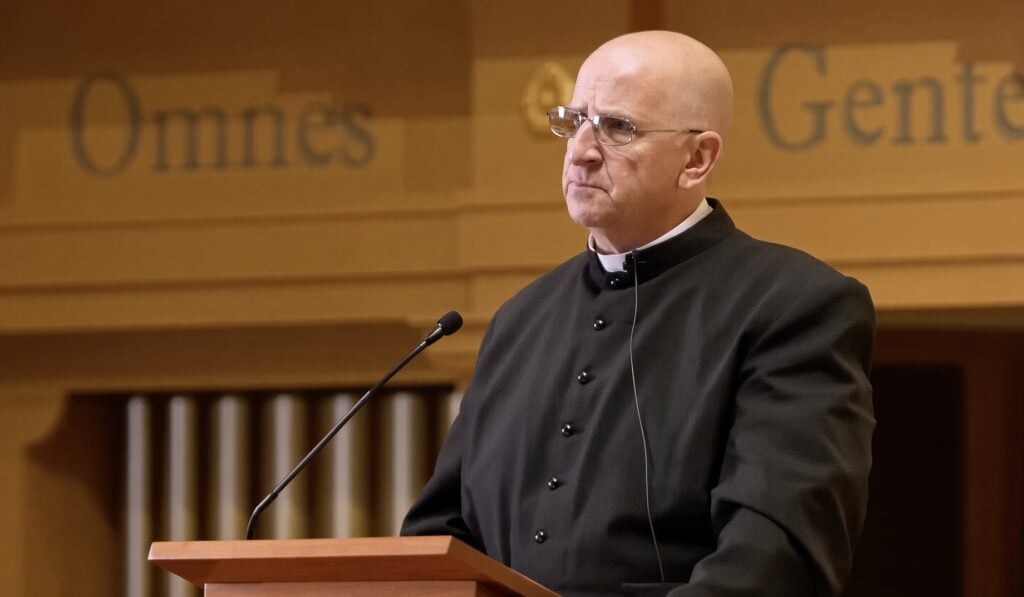
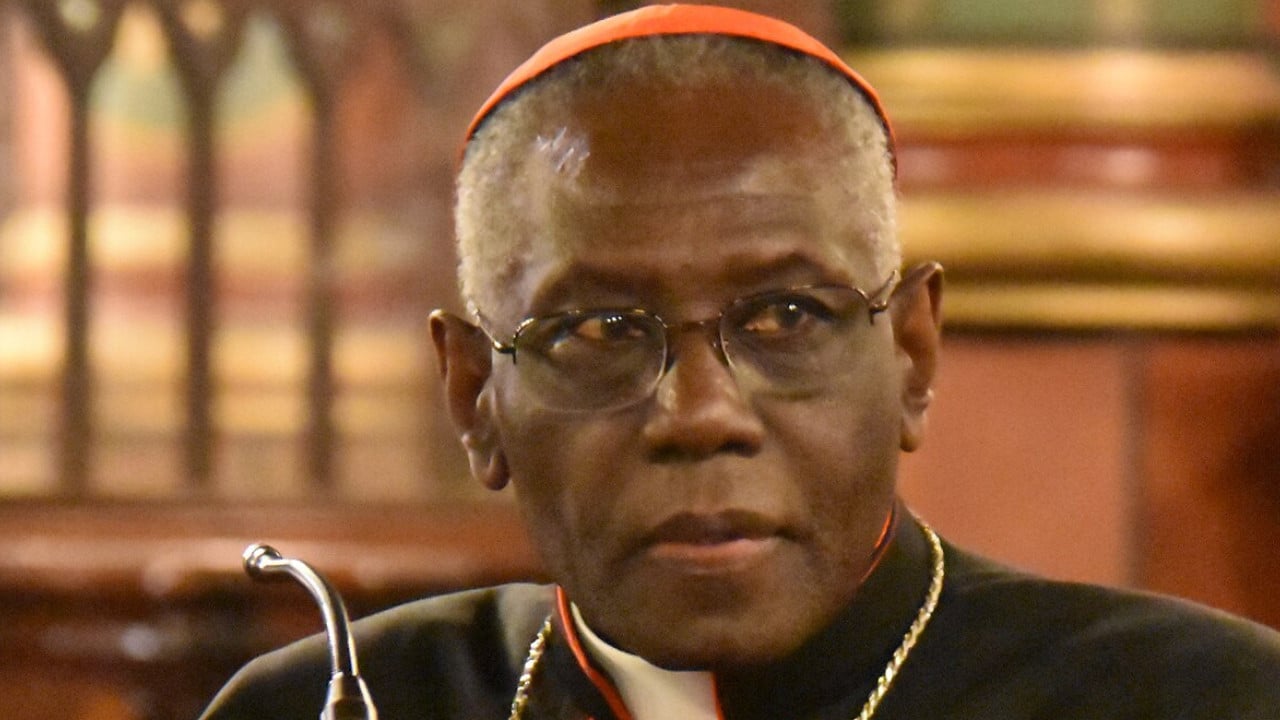
Cardinal Robert Sarah’s address to the European Parliament on July 15 has been widely praised within conservative and neo-trad circles in the Synodal Church.
It was lauded primarily as a profound meditation on the moral and spiritual crisis confronting Western Civilization, with His Excellency warning about the “apocalyptic beasts” of “gender ideology and “Islamic fundamentalism.”
Sarah rooted his address in what he repeatedly described as a “crisis of the logos” — a crisis in which words no longer correspond to reality and language becomes an instrument of ideological power rather than a vehicle of truth. One cannot fault the Cardinal on this observation.
A philosophical error
The former Prefect of the Congregation for Divine Worship opened with a deceptively simple question: “Can we still understand one another?” He observed that terms such as human rights, family, gender, freedom and health no longer carry a common meaning between Europe and Africa.
Instead, he argued, these words have become ambiguous political instruments, used not to illuminate reality but to conceal it. Euphemisms such as sexual and reproductive health, he noted, often signify abortion, while gender equality increasingly refers to the deconstruction of the natural distinction between man and woman. Such ambiguity, he warned, undermines genuine dialogue between nations.
Cardinal Sarah argued that Europe’s deepest crisis is not political but philosophical. When reason is detached from God and objective truth, law ceases to protect the human person and instead becomes an instrument of power. Benedict XVI’s Regensburg Address, his lecture at the Collège des Bernardins and his speech before the German Bundestag formed the intellectual framework of Sarah’s analysis.
Read more: Conservative Catholic complaints about the crisis in the Church ignore its root cause
The Cardinal then argued that Europe increasingly promotes an anthropological vision founded on radical autonomy rather than on the truth of human nature, imposing this vision internationally through legislation, trade agreements, and development assistance.
Equally troubling, he argued, is the growing insistence that African nations adopt initiatives promoting comprehensive sexuality education and categories such as sexual orientation and gender identity as conditions of international cooperation.
The threat of Islam
One of the address’s most reported moments came when Cardinal Sarah reaffirmed a statement that he made during the Synod on the Family in 2015. Without retracting a single word, he declared:
“Gender ideology and Islamic fundamentalism represent, each in its own way, two ‘apocalyptic beasts’, threatening to destroy not only the family, but man himself, image of God.”
Sarah recognized that these two forces arise from very different origins, but argued that both ultimately seek to remake the human person by rejecting the truth about human nature. One attempts to reconstruct man through radical secular autonomy; the other through religious extremism. Both, he maintained, threaten religious freedom, undermine the family, and deny the dignity of the human person created in the image of God.
The West and the Church
Throughout his lecture, Sarah returned repeatedly to Africa’s right to cultural and religious self-determination. He rejected the notion that Christianity is a foreign import to the continent, reminding his audience that Africa gave the universal Church some of her greatest Fathers, including Tertullian, Cyprian, Athanasius and St Augustine.
Sarah also suggested that the crisis within the Church in Europe and the crisis of Western Civilization are inseparable.
Europe, he also argued, has forgotten its Christian foundations. Africa, by contrast, continues to offer a vibrant witness of faith, family life and openness to life itself. Rather than treating Africa as a perpetual pupil, Europe should be prepared to receive from the continent the witness of a living Christianity that it has itself begun to lose.
Neglecting the elephant in the room
Cardinal Sarah can indeed be praised for touching on many truths in his speech. Ultimately, however, his attempt to diagnose the afflictions of the West, Africa, and the Catholic Church failed to mention their most glaring enemy.
The Dispatch
No serious discussion of the ills of the 21st century would be complete without a sober but charitable look at not only the theological disagreements between Judaism and Christianity, but the broader threat of Jewish influence on the Catholic Church and Christian civilization.
Synodal prelates such as Sarah don’t address these issues due to the obvious restrictions that the postconciliar “Church’s” only dogmatic council, Vatican II, places on them. In other words, what Sarah correctly identified in his speech is low hanging fruit, as he didn’t recognize the Jewish influence that played a significant role in shaping the reforms of the Second Vatican Council, particularly the declaration Nostra Aetate, but also how Jewish organizations pressured Church authorities to alter the Good Friday prayer in the Roman liturgy and to remove language that explicitly prayed for the conversion of the Jewish people.
Following what transpired in Germany during the Second World War, Church leaders became reluctant to proclaim traditional Catholic teaching concerning Judaism out of a false sense of guilt or fear of being accused of “antisemitism.”
Enjoying Integrity? Donate Today!
The elevation of so-called reconciliation after the Second World War was put above truth, and resulted in a weakening of Catholic doctrine regarding the unique role of Christ and the Church. Consequently, Catholic-Jewish dialogue and interreligious cooperation promoted religious indifferentism by implying that Judaism and Christianity are equally valid paths to God. This opened the door for the full-blown denial of Christ as the only way to salvation that currently is promoted by high-ranking figures such as Cardinal Kurt Koch and Bishop Robert Barron.
What Sarah should have said
Beyond theology, it would have been a golden opportunity for the conservative Sarah to have shone a light on the disproportionate influence within modern political, financial, and cultural institutions that Jewish groups exercise.
The prominence of particular Jewish individuals and/or families in banking and finance is concerning evidence of how Jewish interests exert significant influence over the global economy. Similarly, Jewish founders and executives have historically occupied influential positions within major media and entertainment industries, allowing them to shape popular culture in ways that undermine traditional Catholic and civilizational morality.
Sarah’s address would have carried far more weight if it also included a look at how Jewish intellectuals have played an influential role in the spread of secular liberalism, relativism, and other ideologies that challenge Christianity’s traditional place in society. It is not difficult to note the Jewish ancestry of several prominent Marxist and communist revolutionaries who were disproportionately involved in movements historically hostile to Christianity and the Catholic Church.
Of course, many Jews opposed communism, but an analysis of the decay of modern civilization is one-sided if the broader historical pattern linking Jewish intellectual life with revolutionary political movements is ignored.
Sarah wants to lay Europe’s immigration woes solely at the feet of Islam, and indeed it has to shoulder a large part of the blame, but he fails, or refuses to acknowledge, that Jewish organizations have supported large-scale Muslim immigration into traditionally Christian nations as part of a broader commitment to multiculturalism and opposition to European nationalism. Mass immigration contributes to the weakening of Europe’s historic Christian identity and social cohesion, and Jewish organizations have been influential in promoting multiculturalism, cosmopolitanism, and internationalism at the expense of traditional national cultures rooted in Christianity.
Jewish forces are working to de-Christianize the West
As is the habit of postconciliar prelates, Sarah beautifully recognizes that issues such as abortion and gender confusion is wreaking havoc, but again fails to mention Jewish influence on the promotion of socially liberal causes, including support for abortion rights, same-sex marriage, and broader secular understandings of morality. This has all been admitted to, most recently by American influencer Batya Ungar-Sargon, who has confessed that Jews have been at the forefront of every liberal cause over the past century.
To that end, Jewish activists, academics, lawyers, and public figures have participated in advancing legal and cultural changes that conflict with Catholic moral teaching that led to a wider cultural movement away from Christian values. Good example of this are Advocates for Trans Equality (A4TE) (founded by Mara Keisling, Jewish); The Transgender Legal Defense & Education Fund (TLDEF) (founded by Jillian Weiss and Michael Silverman, both Jews); Gay, Lesbian and Straight Education Network (GLSEN) (directed by Eliza Byard, a Jew); and Trans Student Educational Resources (TSER) (founded by Eli Ehrlich, a Jew). One could almost say there is a pattern here.
Indeed, American commentator Dennis Prager has admitted that “every ‘ism’ was founded and/or led disproportionately by Jews. You name it, Marxism, humanism, socialism, environmentalism, feminism, Jews. It’s the Jews.”
Sarah would have put too much of a target on his own back if he used the occasion to connect the dots and show that there has historically been cooperation between Jewish interests and other groups perceived as hostile to the Catholic Church, particularly Freemasonry, but it would have been a historic public witness to the truth of where things stand presently.
A thorough dissection of the moral and spiritual crisis confronting Western Civilization would have also noted how Jewish advocacy organizations possess considerable political influence, particularly through lobbying, media engagement, and relationships with multiple governments. This influence extends to shaping public policy, discouraging criticism of Judaism or Israel, and even affects aspects of Church life.
A comment on a recent X post by rabid Zionist Laura Loomer summed up the problem succinctly. Loomer repeated the often-abused Scripture verse: “Whoever blesses Israel will be blessed, and whoever curses Israel will be cursed.” Kangmin Lee, apparently a YouTube personality, answered with much more accuracy than Cardinal Sarah: “America has been blessing Israel for over 70 years now. We’ve gotten feminism, transgenderism, sodomy, abortion, mass immigration, pornography, child mutilation, pointless wars, and families being torn apart. How are we being blessed?”
If it is true that to learn who rules over you, you need to find out who you are not allowed to criticize, then not only is Sarah’s speech, but the whole situation in the Synodal hierarchy at the moment, indeed very telling.