Although Christ said “the poor you have always with you” (Matthew 26:11), Leo XIV appears determined to challenge that teaching.
This past Saturday, he once again called for eliminating the causes of poverty, presenting his vision of a socialist dystopia on earth at the latest “Lunch with the Pope.”
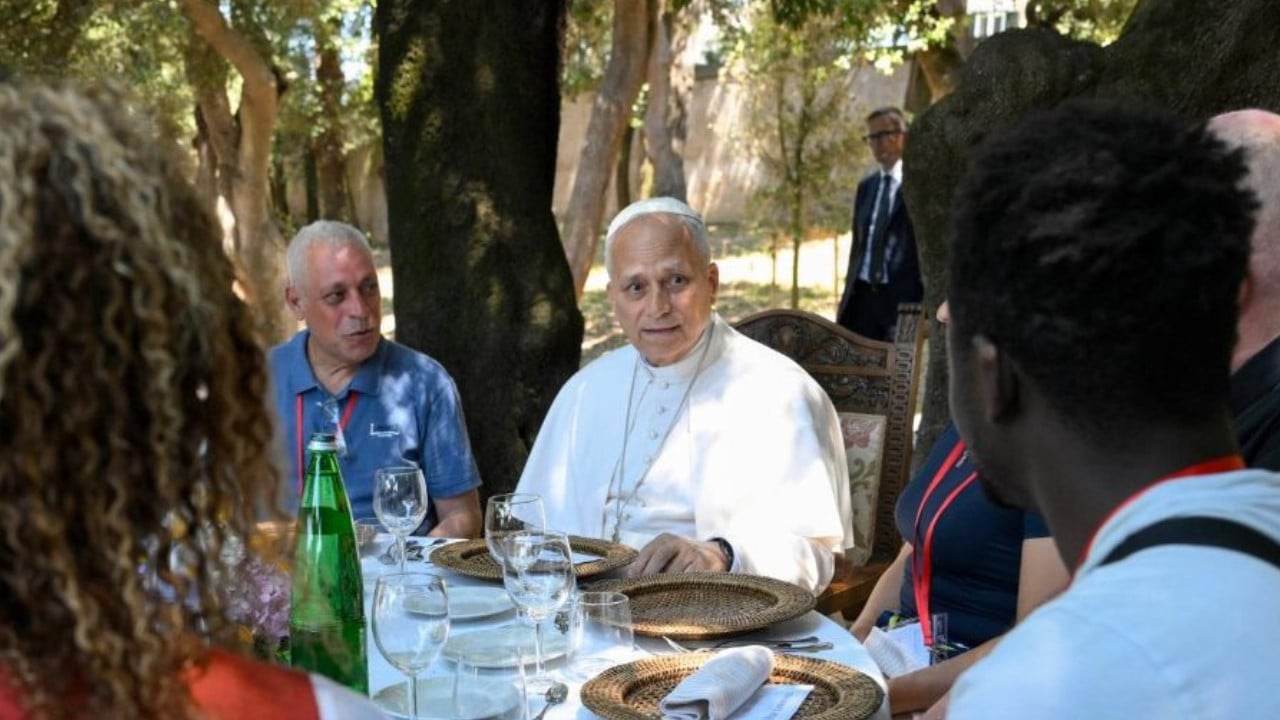
Leo joined approximately 200 poor and socially vulnerable people for a special meal on July 11 at Borgo Laudato si‘ in the Pontifical Gardens of Castel Gandolfo. The head chef at the complex’s restaurant, Art Smith, is an active homosexual from Chicago who is in a “same-sex marriage.”
During his brief remarks, Leo told his audience, “I came without a prepared speech, but I did come with hunger — hunger for justice, hunger for genuine charity, hunger for a Church that truly knows how to open its doors, to welcome and receive everyone; where there is love for all and no one is an enemy, where all of us know how to live reconciliation, forgiveness, and peace.”
Aside from being a continuation of his obsession with social justice issues, Leo’s comments are blatantly hypocritical. Supporters of the newly “excommunicated” SSPX would surely balk at his claim of being a church “that truly knows how to open its doors, to welcome and receive everyone; where there is love for all and no one is an enemy.”
While pontiffs have long supported charitable initiatives, the highly publicized “Lunch with the Pope” gained prominence under the arch-heretic and died-in-the-wool communist Jorge Bergoglio, who frequently hosted the meals as a symbolic expressions of the Church’s “commitment to the marginalized.” Leo XIV is simply following in the footsteps of his late role model.
Leo’s remarks reflected the familiar themes that have come to dominate almost all Vatican addresses in recent years: justice, inclusion, reconciliation, peace, dialogue, and a war on poverty. Although worthy aspirations, these concerns completely displace explicit attention to the Church’s supernatural mission. This imbalance, which has become a defining characteristic of the Synodal religion, is impossible to ignore.
A dogma-less humanitarianism
The infiltrated Church faces perhaps the gravest doctrinal crisis since the Protestant Reformation, if not of all time.
Across large parts of the world, bishops openly question settled Catholic teaching on sexual morality, marriage, the uniqueness of the Catholic faith, the ordination of women, and the permanence of divine revelation. Liturgical abuses remain widespread and catechetical collapse has left generations of Catholics with little — or a perverted — formation in the faith. Many dioceses continue to experience declining Mass attendance, shrinking vocations, and widespread religious indifference.
Against this backdrop we find a man dressed in the white papal vestments who is using the decimation of the Catholic religion as an opportunity to promote a substanceless, virtue-signalling religion of social justice sans Jesus Christ and Catholic dogma.
The Church ‘we want to be’
At the luncheon, Leo described his desire for “a Church of justice, peace, and love” and spoke of building a society where the causes of poverty and injustice are overcome.
These goals are entirely consistent with Catholic social teaching but the Church is not primarily a humanitarian organization or an international development agency. Her first mission is the salvation of souls through the proclamation of the Gospel, the administration of the sacraments, and the preservation of the faith entrusted to the apostles.
Catholic social teaching itself rests upon doctrinal foundations. Charity cannot be detached from truth or be separated from conversion. Peace ultimately comes through reconciliation with God before it can fully exist among men. When Leo says “this is the Church we want to be” — referring to a Church dedicated to justice, peace, and overcoming social inequalities — he seems to forget that Jesus Christ already decided what type of Church He wanted His Church to be.
The Dispatch
Leo persistently and intentionally neglects real catechesis, refuses to confront public dissent from Catholic teaching, and fails to insist that bishops faithfully transmit the deposit of faith. These omissions exacerbate the Church’s greatest crisis, which is not economic inequality, but spiritual disorientation. Moreover, his clearly secular humanist quasi-religion of social justice puts him once again at odds with preconciliar popes.
Far from treating social justice as the Church’s primary mission, the preconciliar popes consistently insisted that temporal works must always remain subordinate to the supernatural end of the Church: the salvation of souls and the sanctification of mankind. Their social encyclicals repeatedly affirm the importance of justice, charity, and concern for the poor, while warning against reducing Christianity to merely humanitarian or political action.
Distorting Catholic social teaching
Pope Leo XIII’s landmark encyclical Rerum Novarum (1891), often regarded as the foundation of modern Catholic social teaching, placed earthly concerns firmly within an eternal perspective.
After discussing the rights of workers and the duties of employers, Leo reminds readers that “the true worth and nobility of man lie in his moral qualities, that is, in virtue; that virtue is the common inheritance of all alike, high and low, rich and poor; and that virtue, and virtue alone, wherever found, will be followed by the rewards of everlasting happiness” (Rerum Novarum, §24). He also insisted that “the things of earth cannot be understood or valued rightly without taking into consideration the life to come, the life that will know no death” (Rerum Novarum, §21).
Join the Counter-Revolution: Donate to Integrity Magazine
Pope St. Pius X likewise rejected the idea that Catholic action could become merely social or political activism. In Il Fermo Proposito (1905), he declared, “Civilization is no longer to be invented, nor is the new city to be built in the clouds. It has been and it is. It is Christian civilisation. It is the Catholic city.” He explained that the task of Catholics is “to restore it on its natural and divine foundations against the ever-recurring attacks of unhealthy Utopia, revolt and impiety.” For Pius X, authentic social renewal was inseparable from restoring all things in Christ rather than pursuing purely temporal reforms.
Pope Pius XI continued this emphasis throughout his pontificate. Although Quadragesimo Anno (1931) developed Catholic social doctrine in response to modern economic problems, it never presented social reform as an end in itself. Instead, the encyclical repeatedly teaches that every aspect of social life must be ordered toward man’s supernatural destiny.
This same principle becomes even clearer in Divini Redemptoris (1937), where Pius XI condemns atheistic communism precisely because it attempts to establish an earthly paradise while denying man’s eternal vocation. He writes that communism “strips human personality of all its dignity and removes all restraint on the impulses of blind instinct.” Such systems fail because they ignore that humanity’s ultimate end is not temporal prosperity but eternal communion with God.
Perhaps the strongest warning against reducing Christianity to activism came from Pope Pius XII. Addressing the Marian Sodalities of Barcelona on December 7 1947, he cautioned Catholics against what he described as “the heresy of action.” He warned that “two errors must be avoided,” the first being “the danger of excessive preoccupation with exterior activity.” Pius XII’s warning remains one of the clearest papal condemnations of activism that loses sight of sanctification.
Leo’s public addresses on the other hand continue to display this recurring imbalance. His speeches not only emphasize social concerns, but social concerns completely replace full authentic Catholic doctrine.
The Gospel must come first
The Church has fed the hungry for two thousand years because she first believed she possessed the Bread of Life; she built hospitals because she proclaimed the Great Physician’s message of aiding the sick; she defended human dignity because she taught that every person is created in the image of God and is called to eternal life.
But the synodal imposter is determined not to proclaim revealed truth with clarity and conviction, and even its “charitable witness” has taken on a distinctively antichrist character.
It’s Integral Human Development office, for instance, is not only run by a leftist female nun, it’s primary goal is to direct societal flourishing while leaving out the one thing that is guaranteed to bring about civilizational growth: Jesus Christ.
Promoting humanitarian issues is something many institutions can do, but only the Church offers the saving truth of Jesus Christ, faithfully handed down through Scripture and Tradition. The fact that Leo habitually inverts this on a daily basis only confirms his full adherence to the Vatican II religion of man.