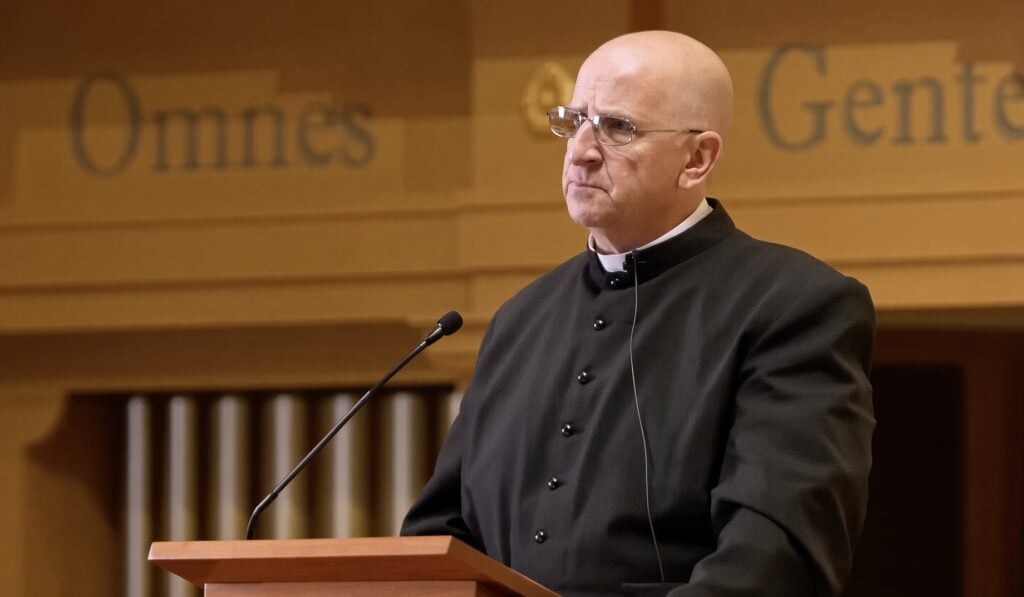
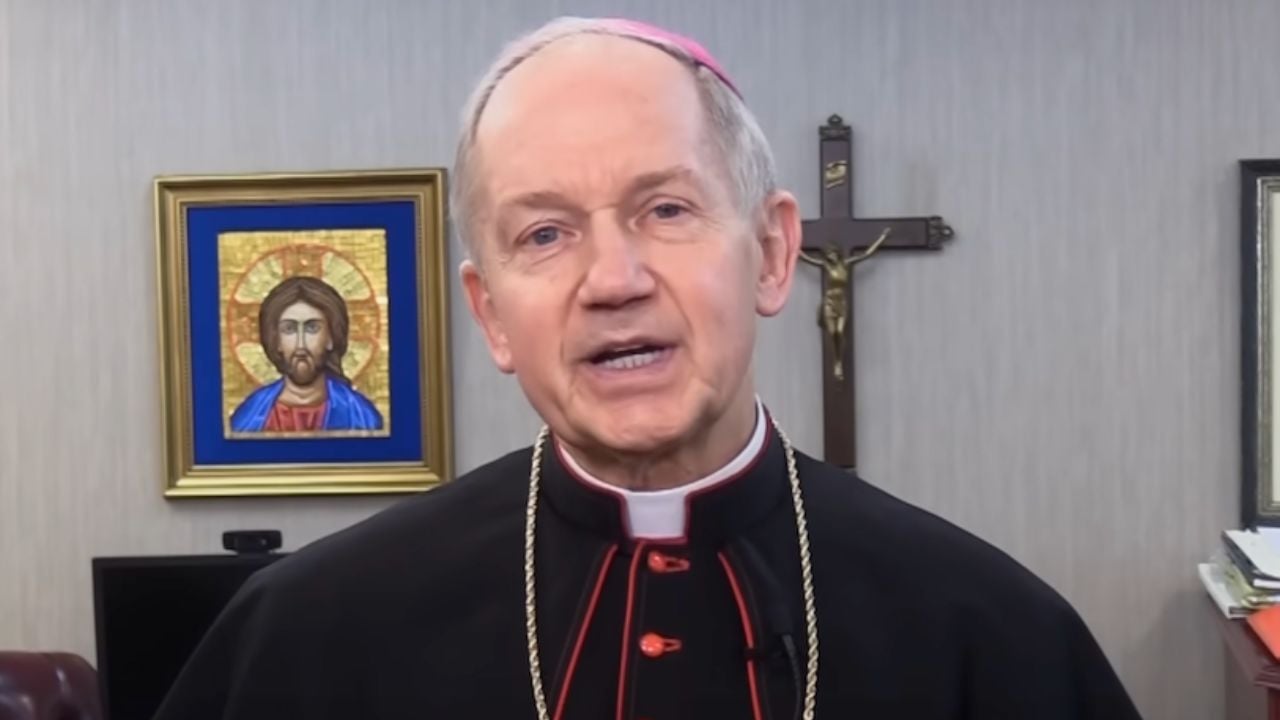
A recent video address by Bishop Thomas Paprocki once again revealed that detecting irony is not a strong suit of the decomposing modernist mind.
In his remarks concerning the Society of St. Pius X (SSPX), Paprocki presented the recent episcopal consecrations as evidence that the Society has become “basically another Protestant sect.”
Paprocki further insisted that the Society’s rejection of the Second Vatican Council constitutes a rejection of Catholic unity and papal authority.
While these remarks reflect the official postconciliar position of apostate Rome, they also reveal a fundamental assumption that deserves critical examination.
The Vatican II religion
Paprocki wants the issue of the SSPX to be about Catholic unity, while the real question is whether Catholic unity can legitimately be demanded around teachings and practices that consistently depart from the Church’s perennial magisterium.
Bishop Paprocki states that “the main problem with the SSPX is their rejection of the doctrinal teachings of the Second Vatican Council and their defiance of papal authority.”
This formulation assumes precisely what is under dispute.
The Society does not argue that Catholics may reject authentic Catholic doctrine. Rather, it argues that conciliar and postconciliar teachings cannot be reconciled with prior magisterial ones and therefore they cannot demand unconditional assent in the same manner as dogmatic definitions.
The Society’s own statement, quoted by Bishop Paprocki, illustrates this point. It declares that “modern errors represent a dreadful threat to the whole of the Catholic order, and that their penetration into the life of the Church, under the influence of the Second Vatican Council and the post-conciliar reforms, has provoked a crisis of exceptional gravity.”
Whether one accepts this judgment or not, it is clearly a theological argument concerning continuity with tradition rather than a simple rejection of authority.
But Paprocki likely knows that to address the theological argument would expose the fact that the Novus Ordo religion is indeed a new (and false) religion, and therefore he must take cheap shots at what have effectively become a very convenient strawman in this ongoing drama.
Perhaps the strongest rhetorical claim made by Bishop Paprocki is his assertion that “by disobeying the Pope and rejecting the teachings of the Second Vatican Council, the Society of St. Pius X is now basically another Protestant sect that thinks that they are right and the pope is wrong.”
Oh boy, the irony. This comparison is difficult to sustain historically.
The defining characteristic of Protestantism was not merely disagreement with particular churchmen. It consisted in rejecting Sacred Tradition, denying the authority of the historic priesthood, abandoning the sacrificial understanding of the Mass, rejecting papal primacy altogether, and embracing private judgment as the ultimate rule of faith.
The SSPX rejects none of these principles. It professes the traditional doctrines on the Real Presence, apostolic succession, Marian dogmas, the true nature of the Mass, and the authority of Sacred Tradition. Indeed, its criticism is precisely that the postconciliar Church has weakened or obscured these very teachings.
Protestant influence at Vatican II
Ironically, many of the characteristics traditionally associated with Protestantism have been identified in aspects of the postconciliar reforms themselves.
The widespread abandonment of Latin, the replacement of Gregorian chant by contemporary music, celebration of Mass facing the congregation, simplification of the ceremonial, increased emphasis upon Scripture divorced from traditional liturgical expression, the promotion of collegiality at the expense of the papacy, subtle campaigning for married priests as well as female “priests,” and frequent ecumenical worship services all resemble practices historically associated with Protestant communities far more than they resemble the Roman rite as celebrated for centuries before the Council.
This was noted by Integrity co-founder Stephen Kokx on X where he highlighted the undue influence of non-Catholics at Vatican II on the liturgy and other documents.
The Dispatch
Equally significant is Bishop Paprocki’s appeal to unity.
He quotes Leo XIV’s desire for “a united Church, a sign of unity and communion,” arguing that Christians should return to the “Mother Church.” No faithful Catholic would dispute the desirability of unity, but Catholic tradition has always maintained that authentic unity is unity in truth.
The Conciliar Church lacks unity
It must also be observed that within the postconciliar church there is no unity, as it is busy drowning in an ocean of ambiguous theological relativity. It therefore has no unifying principle of objective truth. Expressions of synodal “Catholicism” literally differs from parish to parish, diocese to diocese, and continent to continent.
Brazilian priest Father João Silveira drew attention to this on social media. “Does anyone in their right mind actually believe that there is unity in the Church? The disunity is obvious, first and foremost in the way people pray, and then in what they believe,” he said on X.
Naturally, this forces one to conclude what Father did not say in his post: that the mark of “oneness” is totally absent from the post-Vatican II Church.
If unity requires acceptance of teachings or pastoral practices that are not only inconsistent with, but flat-out in opposition to earlier magisterial teaching, then unity is impossible. Such unity will be nothing more than institutional conformity at the expensive cost of ecclesial fidelity. This is exactly the problem regarding religious liberty, ecumenism, collegiality, and aspects of the liturgical reform.
A break with Tradition
An example of discontinuity that has occurred since the Council is between the teachings of Dignitatis Humanae and earlier papal encyclicals such as Quanta Cura. Another is modern ecumenical initiatives — including interreligious prayer services and declarations — with magisterial insistences prior to Vatican II that announced the Catholic Church alone possesses revealed truth.
These contradictions can ultimately never be reconciled. Nevertheless, dismissing those who point them out as being in rupture as mere “Protestants” oversimplifies a complex doctrinal discussion and is clear evidence of a strategy of obfuscating the real issue to protect a dark agenda.
An additional irony appeared in a recent USCCB article discussing Paul VI’s confrontation with Archbishop Marcel Lefebvre in the 1970s. The article records Paul VI telling Lefebvre: “The position you have taken is that of an antipope.” Likewise, Paul remarked, “If this were so, I would have to resign and invite you to take my place and lead the church.”
Bringing up this statement by Paul VI as if it is some clever “gotcha” moment is riddled with even more ironies. Every single pope since — and including — Paul VI has made himself guilty of one or more crimes against the faith that easily constitutes the loss of office. As Traditionalists have consistently maintained, the postconciliar hierarchy has introduced theological heterodoxy, novel liturgical reforms, and pastoral innovations that stand in contrast with the Church’s previous teachings. In other words, they have all helped install a new religion within the structures of the Catholic Church.
One could thus argue that almost all the postconciliar popes were either antipopes, false popes or no popes at all.
Read more: Trad Inc. is worried more Catholics are concluding Vatican II created a new religion
The USCCB would do itself a huge favor by waking up to the fact that of all the postconciliar popes are the biggest enemies of Catholicism. To bring up a quote by the “pope” who set the destruction officially in motion when wanting to discuss orthodoxy, obedience, and faithful adherence to the faith is laughable and insulting to Catholics.
There can be no unity around disunity
Ultimately, Bishop Paprocki, the USCCB, and the rest of the synodal hierarchy frames the controversy primarily as one of obedience, while Traditionalist Catholics see it, rightly, as one of continuity with Tradition. If Vatican II and the subsequent reforms represent genuine organic development entirely consistent with previous magisterial teaching, then Paprocki’s criticism would be correct.
Sadly, it doesn’t. His appeals to obedience cannot resolve a matter which at its heart is about a standoff between the one true Catholic religion and the false Synodal religion of the usurpers in Rome.
Enjoying Integrity? Donate Today!
The deepest irony of Bishop Paprocki’s address is his repeated invocation of Protestantism. Not only because Protestants rejected Catholic tradition in favor of innovation, but more so because the Synodal Church and its imposter religion has drifted so far from Christianity that even those in some Protestant circles raise their eyebrows at its heretical nature.
The central question is not whether Catholics should seek unity, but whether that unity is grounded primarily in institutional conformity or in fidelity to the Church’s perennial tradition and truth. Genuine unity can never be separated from doctrinal continuity with the faith handed down through the centuries.
The answer to that question exists, although many still fear to articulate it and to follow it to its logical conclusion — that Traditional Catholics of all convictions, including the SSPX, should realize and accept that the Synodal Church is not the Catholic Church, stop seeking communion with it, and decisively reject it.