
The Society of Saint Pius X (SSPX) has raised serious concerns with, and has seriously challenged, Leo XIV’s latest ecumenical initiative, warning that renewed efforts toward Catholic-Lutheran “unity” are being pursued at the expense of confronting doctrinal errors condemned by the Church nearly five centuries ago.
In a report published on October 7, the SSPX questioned the theological foundations of Leo’s proposal to commemorate the 500th anniversary of the Augsburg Confession in 2030. “But what unity could be built on errors to which the Church had officially responded as early as 1530?” the Society asked in its essay.
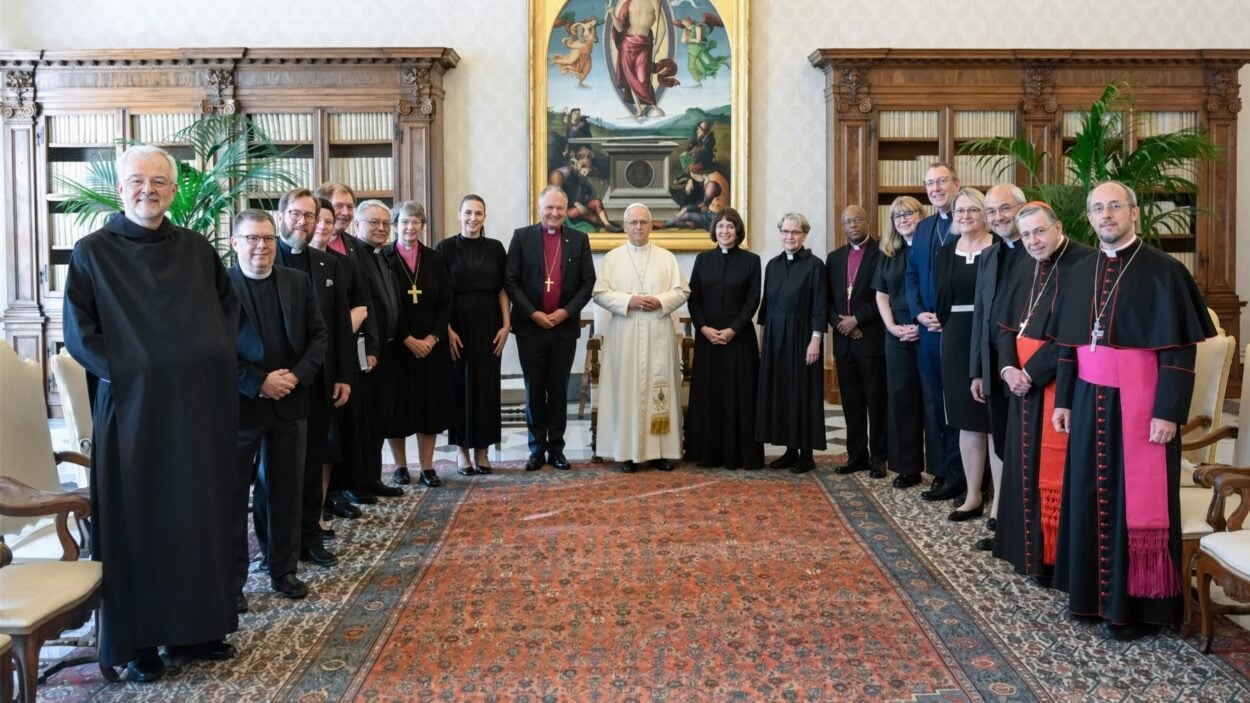
The criticism came after Leo XIV’s October 1 audience with representatives of the Lutheran World Federation, which included women so-called clergy, at the Vatican. During the meeting, Leo expressed hope that the anniversary would become a “profound ecumenical experience” that brings “new energy and new joy” to the pursuit of “full and visible unity.”
The origins of the Augsburg Confession
The controversy concerns a document presented to Emperor Charles V at the Diet of Augsburg in Germany on June 25, 1530 during the early decades of the Protestant Revolution. Thirteen years earlier, apostate monk Martin Luther had published his Ninety-Five Theses, launching the religious revolt that fractured Western Christendom. Despite being excommunicated by Pope Leo X in 1521, Luther gained influential supporters among German princes.
Seeking to restore religious peace within the Holy Roman Empire, Charles V convened the Diet of Augsburg, permitting Lutheran representatives to present a statement of their beliefs, which was principally drafted by Philip Melanchthon, who was one of Luther’s supporter.
In its report on the matter, the SSPX acknowledged that the document was originally intended to promote reconciliation, noting that “the Augsburg Confession of 1530 sought to avoid a definitive break is historically accurate.” But the Society also emphasized that the Confession already contained “doctrinal divergences fundamentally incompatible with Catholic teaching that was “noted as such by the Church.” Catholic theologians subsequently produced the Confutatio Pontificia, identifying both acceptable teachings and errors requiring correction in the Confession.
Justification and the Sacrifice of the Mass
One of the central disagreements the Church has with the Lutheran understanding of justification is that it places faith alone at the center of salvation.
The Dispatch
“Article IV states that people are justified ‘freely through faith in Christ,’ when they believe their sins are forgiven because of him,” the SSPX noted in its essay. “Article VI adds that good works should certainly be performed, but they should not be relied upon ‘to merit justification before God.”
“In other words,” the Society remarks, “justification is here attributed to faith alone, without works performed under the influence of grace having any meritorious value. It is on this point that Catholic doctrine differs from the Lutheran conception: grace is primary and absolutely necessary, but man, moved by it, truly cooperates in his salvation, and his works performed in a state of grace possess genuine supernatural merit.”
The Augsburg Confession also challenged Catholic teaching on the nature of the Church, as well as the authority of the Pope, religious vows, and the Holy Sacrifice of the Mass. Particularly heterodox was its rejection of the Mass as a propitiatory sacrifice offered for the living and the dead.
“The Augsburg Confession rejects the teaching that Christ’s sacrifice instituted the Mass as an offering ‘for daily sins, venial and mortal,'” the SSPX recalls. “It invokes the Epistle to the Hebrews to affirm that ‘the sacrifice of Christ, accomplished once, has atoned for the sins of all’ and that ‘there is no need for any other sacrifice for sins.”
All of these disagreements were subsequently addressed by the Council of Trent, which solemnly reaffirmed Catholic teaching against Protestant novelties. For this reason, the SSPX contends that the Augsburg Confession cannot be regarded as an expression of shared Christian belief preceding later theological divisions.
A continuing ecumenical program
Leo XIV’s treasonous courtship with this heretical and schismatic sect follows decades of Catholic–Lutheran dialogue, with the most prominent marker on that timeline being the 1999 Joint Declaration on the Doctrine of Justification, which claimed a consensus on fundamental aspects of justification.
During this most recent meeting, Leo called for renewed attention to the faith of the early Church and the Church Fathers as a foundation for reconciliation. But as the SSPX warned in its statement, appealing to early Christianity cannot become a means of disregarding later dogmatic definitions. The Society rightly argues that the teachings solemnly defended against Protestantism were authoritative clarifications of truths belonging to the Catholic faith.
Support Integrity’s independent reporting: Become a donor today!
The SSPX also invoked Pope Pius XI’s 1928 encyclical Mortalium Animos. That document rejected attempts to construct Christian unity independently of full adherence to Catholic doctrine. Again, the Society’s criticism has highlighted the extent to which the post-conciliar Church is willing to sear its own conscience in pursuit of an anti-Catholic, ecumenical project plainly at variance with pre-Vatican II teachings.
The ecumenical approach pursued by Leo erroneously seeks to forge agreement on doctrines that Catholics and Protestants hold in common. But the traditional Catholic position — as defended by the SSPX in its statement — holds that the Church already possesses that perfect unity which was established by Jesus Christ, and which those who are separated must return by professing the Catholic faith and renouncing their errors.