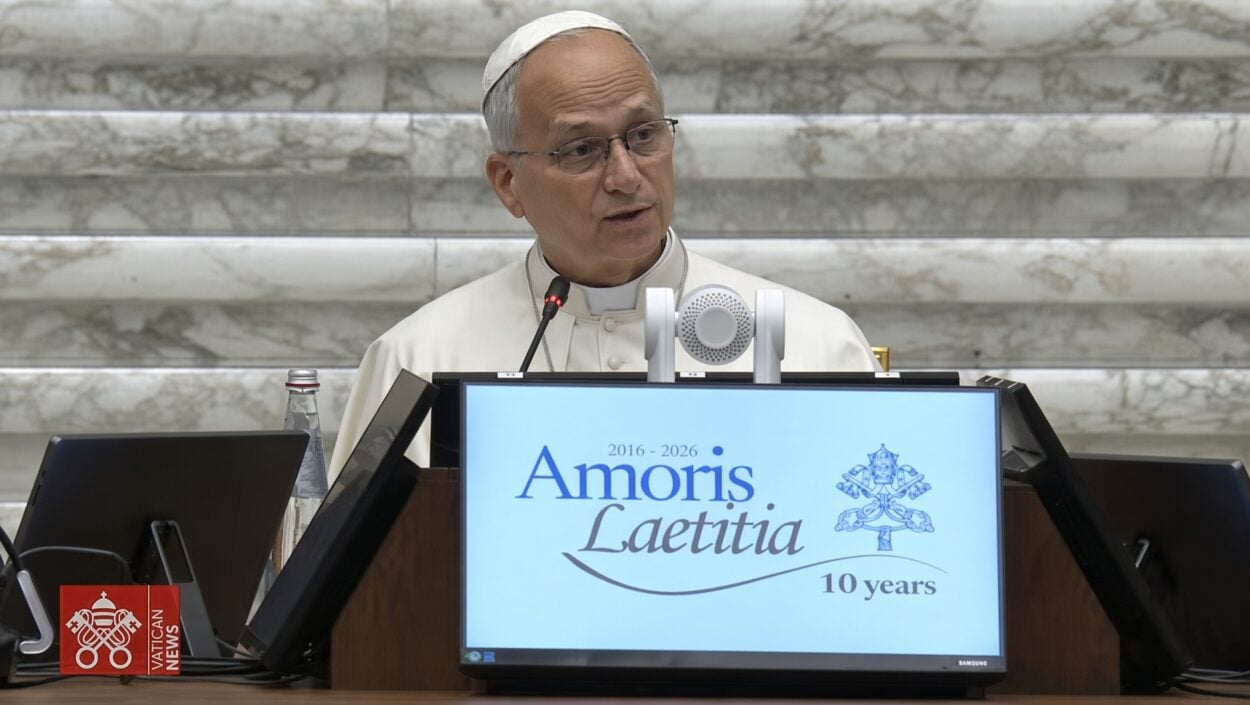
Despite Amoris Laetitia infamously contradicting Catholic teaching, Leo XIV chose to convene a Vatican gathering celebrating its tenth anniversary rather than reverse that noxious Francis-era document.
Leo opened the gathering this week with an unapologetic endorsement of the pastoral direction established by his predecessor, making no attempt to address the doctrinal disputes surrounding Amoris Laetitia. The only reasonable conclusion is that he embraces its teachings without reservation.
Leo’s opening address sets alarming tone
The meeting began on October 7 and will run through October 14. It brings together bishops, married couples, theologians, and facilitators under the pretext of assessing the document’s implementation and its implications for future “pastoral practice.” The event makes clear that the gathering is not intended to revise but to redouble the deeply problematic exhortation.
In his opening address, Leo described Amoris Laetitia as an important stage in the Church’s development along a trajectory stretching from the Second Vatican Council through John Paul II to Francis. Unsurprisingly, it was riddled with troubling and often ominous passages.
For instance, Leo asked, “what are the lived experiences of families teaching us — an experience from which we have not yet fully learned?” He subsequently declared that the Holy Spirit “often speaks through the very situations that challenge us.”
“Our task, therefore, is not only to interpret these realities but to let them question us and motivate our pastoral responsibility,” he maintained.
Leo then slipped into the old Modernist error that the Church must somehow adapt to the zeitgeist, insisting on the need to “continue the Church’s discernment in the face of profound changes.” The traditional Catholic understanding of the family was likewise recast in language reminiscent of Masonic ideals, reducing it to a cog in the greater machinery of a supposed universal fraternity. “The family remains key to an approach that holds together the local and the global, guided by the search for a universal fraternity in Christ that the Gospel calls us to build with everyone,” Leo declared. Elsewhere, he insinuated that Christ has somehow revealed new truths capable of accommodating the profound moral failures of contemporary society rather than condemning them.
Support Integrity’s independent reporting: Become a donor today!
One of Leo’s most alarming statements, however, came near the end of the address when he told the prelates and guests: “Listening to one another … can awaken the pastoral creativity we need in the face of new questions.”
The Dispatch
Catholics should be extremely concerned when men who have betrayed the teachings of Christ’s Church propose wading into the murky waters of modern sensibilities and relativism to become “creative” with God’s eternal laws in the face of “new questions.”
All these statements suggest that the guiding principle of this gathering, and of the post-conciliar Church more broadly, is the notion that contemporary human experience can redefine, reinterpret and reshape the application of the Church’s moral teaching — teachings these men evidently regard as too stifling. Indeed, Leo’s statement that “we all know the gap between the good we desire and what we are able to live” sounded like a preemptive justification for, or excuse of, moral collapse.
The unresolved crisis of Amoris Laetitia
Published in April 2016 following the controversial family synods of 2014 and 2015, Amoris Laetitia addressed marriage, family life and pastoral care. Its most disputed provisions appeared in Chapter VIII, particularly paragraph 305 and footnote 351, which suggested that with “discernment” sacraments might be administered to people living in objectively sinful unions.
This represented a departure from the Church’s previous teaching and discipline, under which divorced and civilly remarried Catholics — adulterers, in other words— who continue living as husband and wife are to be excluded from Holy Communion.
In September 2016, Cardinals Raymond Burke, Walter Brandmüller, Carlo Caffarra, and Joachim Meisner submitted five dubia or “doubts” seeking clarification of the exhortation’s compatibility with established moral teaching. Their questions concerned admission to the sacraments, intrinsically evil acts, absolute moral prohibitions and the relationship between conscience and divine law.
However, Francis never provided formal answers to those original five questions and the controversy only intensified when Francis endorsed guidelines issued by bishops in Buenos Aires allowing, under certain circumstances, sacraments for divorced and remarried Catholics who had not committed to living in continence. That interpretation was subsequently incorporated into the Acta Apostolicae Sedis as authentic magisterium.
A gathering shaped by dissidents
The theological orientation at Leo’s meeting was apparent from the identities of its most prominent participants. Among the influential progressive figures invited as Leo’s 22 personal guests include Cardinals Robert McElroy, Joseph Tobin, José Cobo Cano, Jean-Claude Hollerich, Víctor Manuel Fernández, Luis Antonio Tagle, and Gérald Lacroix.
The program also featured Dominican Sister Helen Alford, president of the Pontifical Academy of Social Sciences, who has defended Amoris Laetitia as being consistent with earlier Church teaching. Alford emphasized the “law of gradualness,” arguing that individuals may advance toward moral perfection through successive stages while remaining subject to objective moral requirements.
These opening proceedings leave little room for doubt: Rome appears determined to double down by consolidating the legacy of Amoris Laetitia, with no apparent intention of resolving the doctrinal controversies that have surrounded it for the past decade.