
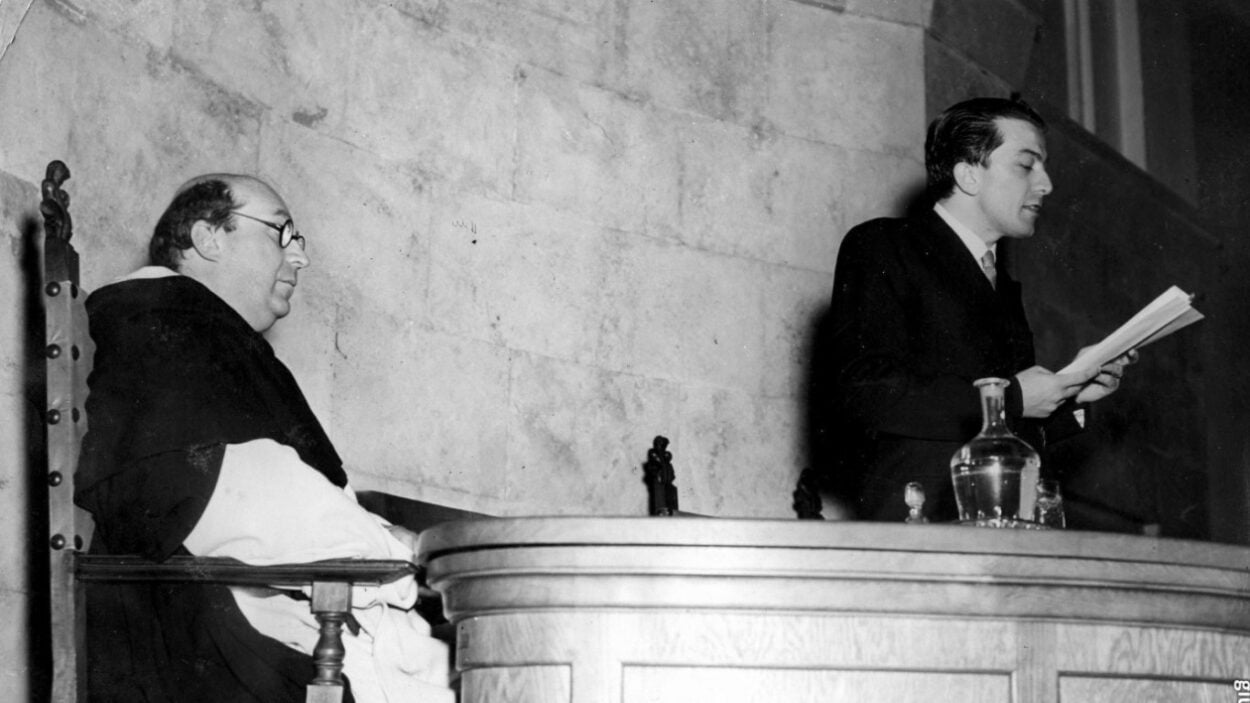
Editor’s Note: This essay is Part IV of a series critically reviewing the efforts of Fr. Félix Morlion (1904-1987). Part I discussed his involvement with the US Deep State; Part II discussed his efforts with Pro Deo University in Rome; Part III focused on his influence at Vatican II; Part IV speculates on his connection with the assassination plot against John Paul II.
As we have seen in the previous installment of this series, Fr. Félix Morlion’s indirect — albeit little known — role in the Second Vatican Council was disastrous for traditionalists. Yet Morlion was not content with simply facilitating changes to Catholic attitudes and teaching. At the end of his career, there is even reason to believe he may have played a role in the assassination attempt of Pope John Paul II in 1981.
To this day, the question of who or what entity ordered the killing of John Paul II remains a mystery. What is certain is that Mehmet Ali Agca, the “lone gunman” who was arrested in St. Peter’s Square, was part of a conspiracy. Agca was sentenced to life imprisonment within a few weeks of the attempt. Initially, Agca claimed to have acted alone. Then, his connections to the Grey Wolves, a Turkish militia organized by the CIA for use against Turkish leftists for Operation Gladio, began to surface in global media outlets. 1
Operation Gladio is not widely known in the United States, but it is a staple of discourse in Italy and Turkey, the two nations most affected by it. As Cold War tensions deepened, the Central Intelligence Agency established stay-behind paramilitaries with access to large stockpiles of arms for use if the Soviet Union invaded Western Europe or Turkey. These organizations answered to a shadow chain of command embedded in the political structures of almost every Western country, such as the P2 Masonic Lodge in Italy or the “deep state” of interlocking military and political elites in Turkey. Operation Gladio, the term for the Italian compartment of this program, is the name by which this program is typically called. 2
Eventually, these stay-behind organizations were repurposed to conduct internal subversion campaigns against their host countries in accordance with a “strategy of tension” whereby the secret services of the United States fomented violent conflict within Allied nations for the ultimate purpose of strengthening their ties to NATO. The tension strategy was critical to NATO control of Italy, which had a large communist party. During the Years of Lead from the 1960s to the 1980s, operatives associated with the P2 Lodge, American special forces, and the Mafia conducted numerous false flag attacks against Italian civilians, such as the Piazza Fontana bombing in Milan, which killed 17 and wounded 88. Other operations included the Bologna Massacre at the central railway station of Bologna, which killed 85 and wounded more than 200 and the Piazza delle Loggia bombing in Brescia, which killed 8 and wounded more than 100. Little known to most, Catholics being no exception, the effect of the violence was to strengthen the grip of pro-American elites over the Italian political process. In most cases, American control over the Italian judicial system via the P2 Lodge ensured that communist organizations were held responsible for these crimes, only for later investigators to determine that the evidence actually indicated the involvement of NATO secret services.
Support independent Traditional Catholic journalism: Become a monthly donor for just $10 today!
The Dispatch
In Turkey, the subcontractor for Operation Gladio was the Grey Wolves organization, a neo-Nazi paramilitary founded by Colonel Alparslan Turkes, a Turkish army officer who conducted several courses of training in irregular warfare at Fort Bragg in the late 1940s and who returned to Turkey to found his militia. 3 Named after the mythical she-wolf Asena, who led the Turkic peoples west out of the Altai Mountains in western China, the animating ideology of the Grey Wolves was Turanism, a noxious offshoot of National Socialism which held that the manifest destiny of the Turks was to rule over the peoples of Central Asia. 4
Thus, the Grey Wolves were inimical to the Soviet Union. As such they became one of the most effective and violent American proxy organizations. The paramilitary perpetrated an astounding series of massacres, pogroms, murders, and kidnappings against leftist organizations from the 1950s through the 1990s. In this, the Grey Wolves were widely supported by conservative Turks and by powerful entities in the security services and military establishment. 5 The contemporary Nationalist Movement Party, or MHP, the party organization connected to the Grey Wolves, is a part of the ruling Turkish coalition in the Erdoğan government, indicating that its ties to the Turkish elite are far-reaching.
Perhaps to conceal Agca’s indirect connections to the United States 6 — or perhaps in accordance with a larger, darker conspiracy — CIA cutouts in the media like Claire Sterling in Time of the Assassins began to promote the idea that Agca had actually perpetrated the assassination on behalf of the Bulgarian intelligence service, acting on orders from Moscow. 7 Agca was interrogated on multiple occasions by operatives from SISMI, Italy’s military intelligence organization. After a series of visits from high-ranking SISMI operatives connected to the P2 Masonic Lodge, 8 Agca changed his tune. He claimed to have worked for the Bulgarians, and named Sergei Antonov, a probable intelligence asset working undercover with Bulgarian Airlines, along with two other Bulgarians and four other Turks, as accomplices in an international conspiracy to kill John Paul II. 9
The key part of Agca’s testimony concerned his supposed interactions with Antonov, who claimed to have never met Agca and to have had no knowledge of the attack on John Paul. To substantiate his allegation that Antonov had transmitted a kill order to him, Agca purported to describe the interior of Antonov’s apartment, with special reference to a folding door that divided the kitchen from the living room. The case against Antonov collapsed over this critical detail. It turned out that Antonov had removed the folding door months before Agca claimed to have met him. In fact, the folding door belonged to the apartment of one Fr. Felix Morlion, who was then living in the suite one story below the unfortunate Bulgarian. 10
The detail about the folding door in Morlion’s apartment was forgotten amid the antics of the trial, which involved Agca repeatedly claiming to be the Lord Jesus Christ and demanding the release of the Third Secret of Fatima. Agca’s surrealist behavior may have been calculated to distract the public from this damning detail of his testimony, among many other suspicious facts about the trial that indicate connections to Western intelligence agencies, rather than to the Soviet Union.
Morlion’s real role in the assassination attempt against John Paul II may never be known. Perhaps Morlion was a handler for Agca as part of an American-orchestrated false flag attack on John Paul intended to be blamed on the Soviets. This is a nightmarish counterfactual for which there is some evidence in the trial records, in the backgrounds of the co-conspirators, and in the political context of the time. At the very least, Morlion was certainly participating in a plot to manufacture a narrative against the Soviet Union, even though the attempted murder had been perpetrated by other actors. As of 2026, it is still impossible to say what transpired, despite Morlion’s undoubted role as the most important invisible priest of the last century in the Roman Catholic Church.
- R.W. Apple, Jr., ‘Trail of Mehmet Ali Agca: 6 Years of Neofascist Ties,’ New York Times (May 25th, 1981). ↩︎
- The best work on the CIA’s ‘stay-behind’ paramilitary organizations is Daniele Ganser’s NATO’s Secret Armies: Operation Gladio and Terror in Western Europe (Oxford, UK: Routledge, 2004). For Operation Gladio in Italy, see Daniele Ganser’s ‘Beyond Democratic Checks and Balances: The ‘Propaganda Due’ Masonic Lodge and the CIA in Italy’s First Republic,’ in Eric Wilson and Tim Lindsey (eds.), Government of the Shadows: Parapolitics and Criminal Sovereignty (New York, NY: Pluto Press, 2009), pp. 256-76. Daniele Ganswer presents a brief summary in ‘Terrorism in Western Europe: An Approach to NATO’s Secret Stay-Behind Armies,’ Whitehead Journal of Diplomacy and International Relations, Volume 6, Number 1 (Winter/Spring 2005), pp. 69-95. See also Richard Cottrell, Gladio: NATO’s Dagger at the Heart of Europe: The Pentagon-Nazi-Mafia Terror Axis (Palm Desert, CA: Progressive Press, 2012). ↩︎
- Mehtap Soyler, The Turkish Deep State (New York: Routledge, 2015), pp. 107-8. ↩︎
- Nihal Atsız, quoted in Hugh Poulton, Top Hat, Grey Wolf and Crescent: Turkish Nationalism and the Turkish Republic (New York: New York University Press, 1997), p. 135. ↩︎
- Jacob M. Landau, ‘The Nationalist Action Party in Turkey,’ Journal of Contemporary History, Volume 17, Number 4(October 1982), pp. 589-92. ↩︎
- Jeffrey M. Bale’s ‘The Ultranationalist Right in Turkey and the Attempted Assassination of Pope John Paul II,’ Turkish Studies Association Bulletin, Volume 15, Number 1 (March 1991), pp. 1-63, extensively documents Ağca’s right-wing associations. Bale balks at the idea that the CIA might have orchestrated the murder attempt, instead proposing a rationale for why Turanism would have incubated hatred of the pope. ↩︎
- The Time of the Assassins: Anatomy of an Investigation (New York: Holt, Rinehart and Winston, 1985) established in the public mind the idea that the Bulgarians had conducted the assassination attempt on the pope, probably on orders from Moscow. In fact, Sterling herself was an agent of influence on behalf of the Mossad, the CIA, and MI6 for the dissemination of black propaganda. Born Claire Neikind into a Jewish family in New York City, Sterling had cut her teeth in the late 1940s working for the Overseas News Agency, a subsidiary of the Jewish Telegraphic Agency funded by MI6 to shape public perception in the United States in favor of the Second World War. Her first book Our Goal Was Palestine was a puff piece about Jewish refugees produced on behalf of the Zionist movement. In 1979, Sterling attended the Jerusalem Conference chaired by then-Professor Benjamin Netanyahu and attended by the glitterati of the national security states of Israel, Great Britain, and the United States, including Senator Henry Jackson, whose staff incubated future Iraq War planners like Paul Wolfowitz and Richard Perle; historian Paul Johnson; Dr. Edward Telle; journalist George Will; Congressman Jack Kemp. At the Jerusalem Conference, the attendees came up with the ingenious plan to create a narrative that the Soviet Union supported ‘international terrorism’ to shore up support for Israel’s ethnic cleansing of the new Occupied Territories seized during the 1967 Six-Day War. Benjamin Netanyahu’s edited conference proceedings International Terrorism: Challenge and Response: Proceedings of the Jerusalem Conference on International Terrorism (New Brunswick: Transaction Books, 1981) gives an idea of the feverish goings-on. In 1981 Claire Sterling also duly produced The Terror Network (New York: Holt, Rinehart and Winston, 1981) which purported to document Soviet support for international terrorism. Though translated into 22 languages, the book contained no less than 31 references to unnamed intelligence officials, on top of dozens of other citations of sources connected to Western secret services, out of some 458 total citations. Thus Sterling’s work can be regarded as black propaganda serving the interests of her paymasters in various secret services. ↩︎
- Edward S. Herman and Frank Brodhead, The Bulgarian Connection, New York: Sheridan Square, 1986, 102-110, describes the involvement of SISMI in interrogating Ağca. Herman and Brodhead’s book is still the definitive debunking of the ‘Bulgarian connection’ to the assassination attempt. ↩︎
- E.J. Dionne, Jr., Agca Said to Detail Plan of 2nd Gunman,’ New York Times, November 1st, 1984. ↩︎
- Edward S. Herman and Frank Brodhead, The Bulgarian Connection (1986), pp. 111-12. ↩︎