Day by day the Synodal Church is increasingly — and consistently — implementing the religion of the Second Vatican Council.
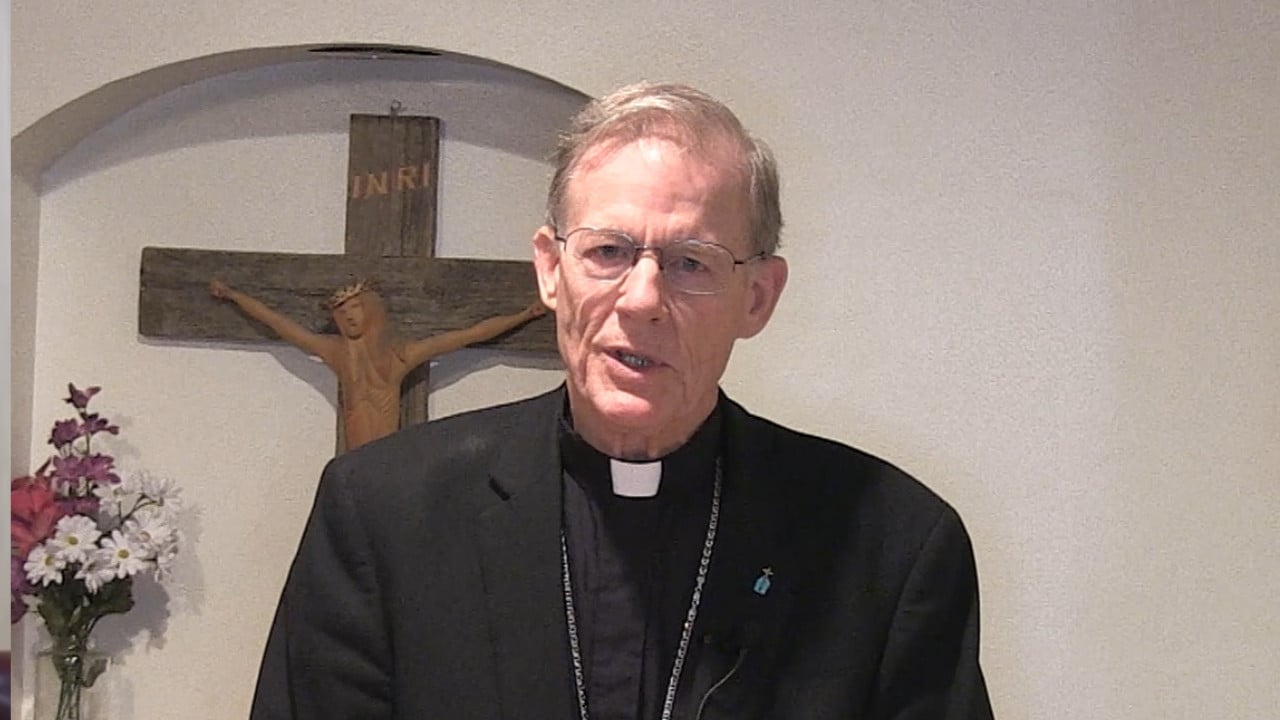
A good example of this is a recent statement issued by Archbishop John C. Wester of Santa Fe, New Mexico entitled Supporting Our Muslim Neighbors’ Right to Worship.
While a minor riot broke out on social media in response to his remarks, Wester’s position is perfectly congruous with Vatican II’s approach to false religions and religious liberty (which has repeatedly been condemned by the Catholic Church).
Dignitatis Humanae supports his stance
In his unfortunate document, Wester not only defended the constitutional right of Muslims to erect a mosque but, in true synodal fashion, reminded the reader that supporting it is “not only a civic duty but a core element of Catholic teaching.”
He then claimed that the “Catholic Church has long affirmed religious liberty as essential to human dignity … every person ‘must be free from coercion’ in matters of faith.”
Wester grounded his argument almost entirely in Dignitatis Humanae, Vatican II’s Declaration on Religious Liberty, which was approved at the Council’s last session in 1965 after dozens of revisions and intense debate.
Among other things, Dignitatis Humanae states that “The human person has a right to religious freedom … no one is to be forced to act in a manner contrary to his own beliefs.”
It also says “religious communities also have the right not to be hindered … in erecting buildings for religious purposes,” while also maintaining that”injury … is done to the human person … if the free exercise of religion is denied in society, provided just public order is observed.”
In his letter, Wester borrows from this by insisting that Muslims have a “God-given right” to establish places of worship and that civil authorities should recognize their immunity from coercion.
Join the Counter-Revolution. Donate to Integrity today.
He also echoes the Council’s document Nostra Aetate, which teaches that “The Church regards with esteem also the Muslims … they adore the one God.”
Pre-Vatican II teaching
While Wester’s statement might be perfectly aligned with Vatican II, it is in direct conflict with the perennial teaching of Holy Mother Church.
In the 1832 document Mirari Vos, Pope Gregory XVI condemned the “absurd” proposition that liberty of conscience ought to be promoted as an unrestricted right.
Blessed Pius IX also rejected in his Syllabus of Errors (1864) the claim that every person possesses an unrestricted right to publicly manifest any religion whatsoever.
The Dispatch
Read more: Pius IX, the Syllabus of Errors & 19th century French Liberal Catholicism
On the subject of Islam, St. Thomas Aquinas carefully distinguished between toleration and approval.
In Summa Theologiae II-II, q.10, a.11, he teaches that unbelievers may sometimes be tolerated by Christian rulers for the sake of avoiding greater evils or preserving peace.
St. John Damascene, writing in the eighth century in De Haeresibus, likewise classified Islam as a heresy. For him, Islam was not another path to God but a Christological error.
This is to say nothing of what the brave men who fought in the Crusades would have thought about a Catholic bishop claiming that Islamists have a right to build temples in Christian lands.
Conciliar clergy and Islam
Others leaders in the synodal church have said things similar to Wester’s comments.
Francis repeatedly emphasized fraternity with Muslims and signed the 2019 Document on Human Fraternity with the Grand Imam of al-Azhar.
His protégé and successor, Leo XIV, has continued that approach. During a visit to the Great Mosque of Algiers in April 2026, he thanked those present by stating that the Great Mosque is “… a place that represents the space that is of God; a divine, sacred space where so many people come to pray in order to find the presence of the Most High, of God, in their lives.”
At the dedication of a mosque and Islamic center in Dearborn Heights, Michigan this summer, Archbishop Edward Weisenburger of Detroit praised it as “a sacred place” and spoke of experiencing a “profound divine presence” upon entering the property.
He went on to make the blasphemous claim that “all churches, all mosques, all synagogues, all places where God reaches out and touches with His finger are sacred.”
What about preaching the Catholic faith?
It is clear that Christ’s Great Commission to “Go therefore and teach all nations…” (Matthew 28:19) and St. Paul’s warning that “There is no other name under heaven given to men whereby we must be saved.” (Acts 4:12) are rejected by the postconciliar church.
If the synodal church were indeed the Catholic Church, it would take seriously the Council of Florence’s decree Cantate Domino (1442), which declared that those outside the Catholic Church cannot attain eternal salvation apart from incorporation into it.
Tragically, Archbishop Wester’s document spoke eloquently about dialogue, dignity, and coexistence, but failed to say anything about the hope of bringing Muslims to know Jesus Christ in the fullness of the Catholic faith.
The postconciliar church — as reflected in Dignitatis Humanae, Nostra Aetate, Archbishop Wester’s statement, and Leo XIV’s remarks in Algeria — has repeatedly shown that it is not the Catholic Church because it shares neither its faith nor its mission.