While it seems trite to mention it every year, it is nonetheless true that only Catholics can claim the very first “Thanksgiving Day” on American soil.
Many Catholics are under the impression that the first Thanksgiving occurred with the founding of St. Augustine, Florida on September 8, 1565, which fittingly coincided with the offering of the Holy Mass. However, certain historians draw attention to the fact that French Huguenots, a Calvinist sect that broke with Rome less than 50 years prior, celebrated the founding of Fort Caroline along the St. John’s River, near modern-day Jacksonville, in 1564.
Fortunately, this dispute is immaterial to the true first Thanksgiving in America.
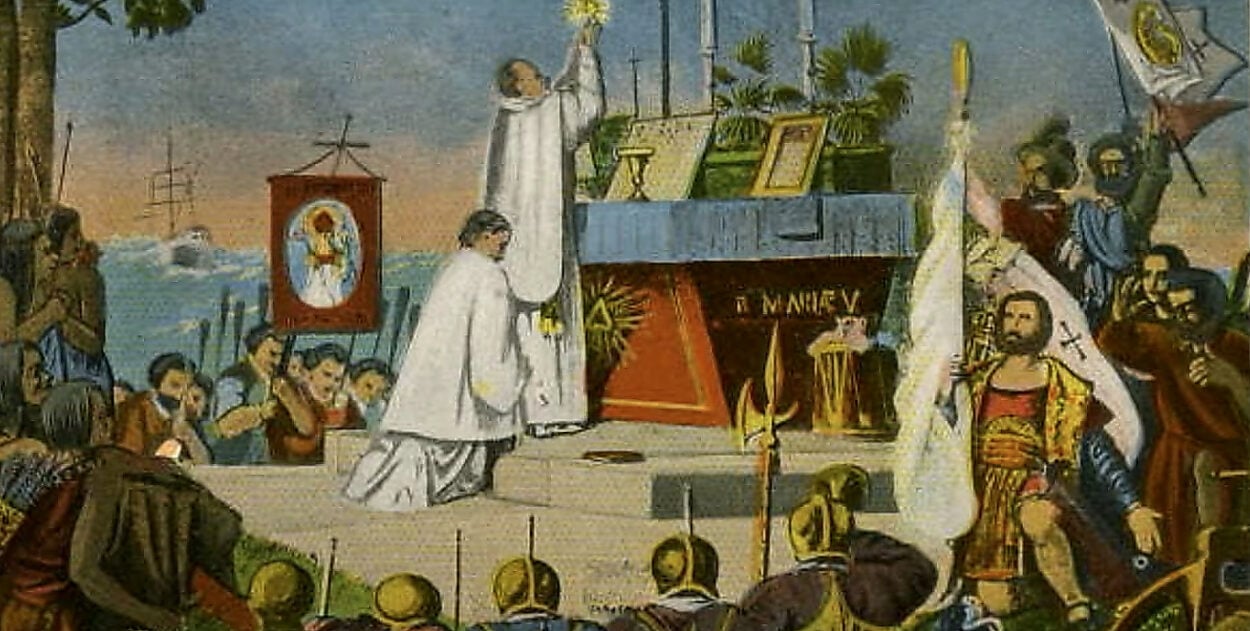
In May 1541, in Palo Duro Canyon, Texas, near present-day Amarillo, Fr. Fray Juan de Padilla proclaimed a day of prayer and feasting to help Spanish explorer Francisco Vasquez de Coronado and his men. This Day of Thanksgiving came 80 years before the famous Plymouth Thanksgiving in Massachusetts, and 23 years before the Huguenots’ supposed “first” at Fort Caroline.
Despite the Catholic patrimony of Thanksgiving, there is a danger in seeing this day as nothing more than a purely civil holiday that has no supernatural dimension, one that is disconnected from the supreme act of Thanksgiving offered at Mass. Indeed, holiday is taken from the Old English hāligdæg, meaning “holy day.”
The “sacrifice” of the turkey is no substitute for the sacrifice of Christ at Mass, although one may be forgiven for thinking as much given how worldly men and modern families celebrate the day.
If we forget this simple fact, our Catholic example to our non-believing families, friends, and neighbors on Thanksgiving is bound to fail.
The American reception of Thanksgiving
The Catholic Encyclopedia notes that the American custom of observing a “Thanksgiving” began in the Plymouth Colony under the authority of Governor William Bradford in 1621. Notably, this colony was settled by a radical group of Protestants called “Separatists.” They were more radical than simple Puritans, who were content to reform the existing Anglican sect. To the Separatists, later known as the Pilgrims, even Protestant England was too “Popish.”
The practice of observing “Thanksgiving” later spread to other New England colonies. President George Washington, on the recommendation of Congress, eventually proclaimed Thursday, November 26, a “day of public thanksgiving and prayer to be observed by acknowledging with grateful hearts the many and signal favors of Almighty God.”
An exchange between Washington and Protestant minister Samuel Langdon (1723–1797) on this topic is worth highlighting.
In July 1789, just several months into Washington’s presidency, Langdon sent him a sermon with a pointed appeal. Perhaps uneasy about Washington’s habitual use of deistic-sounding language about God, Langdon urged him to “let all men know that you are not ashamed to be a disciple of the Lord Jesus Christ.” Understandably busy with the duties of his new office, Washington did not reply to Langdon until late September, the very week Congress asked him to proclaim a national day of thanksgiving.
In his response to Langdon, Washington affirmed no Christian doctrines and did not use the Holy Name of Jesus Christ. Instead, he chose to give thanks to “the great Author of the Universe.” A few days later, on October 3, he issued the Thanksgiving Proclamation, which largely followed the same pattern of omission. True, the proclamation spoke of “Almighty God” and the “Lord and Ruler of Nations,” even asking for pardon of “our national and other transgressions,” but it never named Jesus Christ nor affirmed any distinctly Christian doctrine.
By the middle of the 19th century, the American Republic slowly began to embrace the Day of Thanksgiving. In 1863, President Abraham Lincoln issued a proclamation to set apart the last Thursday of every November as a national holiday known as Thanksgiving Day.
Catholic appraisal of Thanksgiving
The Dispatch
The original Catholic Encyclopedia noted in 1911 that “Catholic recognition of the [Thanksgiving] day by special religious features has only been of comparatively recent date,” as it had not yet received an “official general custom.”
Indeed, as late as the turn of the 20th century, Catholics were slow to adopt the holiday, which, again, in the popular American understanding, traces its origins to the Separatists, a radically anti-Catholic sect of Protestants.
Unsurprisingly, Cardinal James Gibbons (1834–1921) spearheaded the effort for Catholics to adopt the practice of Thanksgiving. Gibbons was among the chief Americanist clergy in the late 19th and early 20th centuries.
In a penetrating essay published in 2014, Dr. Marian T. Horvat of Tradition in Action not only recounts Gibbons’s effort but notes fierce opposition to his plans by none other than Bishop Benjamin J. Keiley of Savannah, Georgia.
It was Cardinal of Baltimore James Gibbons (1834-1921), the great champion of Americanism and religious liberty, who was the first Prelate to make public efforts to integrate Catholics into the Protestant festival,” Horvat writes. “This won him points with the New York Herald, who praised him highly for the act, and with President Cleveland. But, if the Cardinal’s gesture won him admiration from Protestant quarters, it met with strong protest from many fellow Prelates, especially those in the South. Bishop Benjamin J. Keiley of Savannah (GA), complained publicly that Gibbons had ‘out-heroded Herod’ by inducing Catholics to recognize ‘the damnably Puritanical substitute for Christmas.’
These are strong words from Bishop Keiley. They are also probably wholly unknown by most American Catholics.
It took several decades, but Gibbons was ultimately successful, as more Catholics started observing the “Puritanical” Thanksgiving Day along with their non-Catholic neighbors. It seems that this was aided, at least in part, by a number of factors, including the change in culture post-World War but also the influx of various European nationals who immigrated to the United States — for better or worse — at that time. These groups substantially adopted the Anglo-American culture and customs thanks to the deliberate effort to encourage and promote assimilation.
In 1947, Pope Pius XII praised efforts in the United States directed toward giving thanks. In a November 16 radio message to Catholics in America, the Holy Father alluded to President Harry S. Truman’s Thanksgiving Day proclamation, which was issued six days earlier. He praised how there was a “week characterized in your country by the dominant note of thanksgiving to God.” He also noted that “the highest authority of the State” (i.e. President Truman) has “summoned you … to pause in the midst of your varied occupations to render thanks to Almighty God, the Father of Lights from whom is every best and perfect gift (Iac. 1, 17).” Most importantly, Pius XII asked that this gratitude take the form of charity and sacrifice.
Join the Counter-Revolution: Donate to Integrity today!
Two years later, Pius XII again referenced, at least indirectly, Thanksgiving. In an address to members of the U.S. House of Representatives on November 27, 1949, he observed that “the legislative and executive halls of your Capitol” had just heard “the noble accents of a Nation’s prayer of thanksgiving to the living God.”
A supernatural thanksgiving
With this papal approbation in mind, Catholics can and should celebrate Thanksgiving along with our fellow Americans.
But we must not forget the radicalism of the separatist Pilgrims nor the fact that the very first Thanksgiving on America shores was celebrated by Fr. Fray Juan de Padilla in 1541. We also cannot fail to recall that the Holy Sacrifice of the Mass is the ultimate and most pleasing from of thanksgiving that can be offered to God. Lastly, Catholic should not neglect to heed the wisdom of Pope Pius XII.
Catholics should therefore “baptize” this day and spiritualize it, taking care to avoid the secular, consumerist mentality that has sadly come to mark this most holy time of year, just as the holy season of Advent is set to descend upon us.