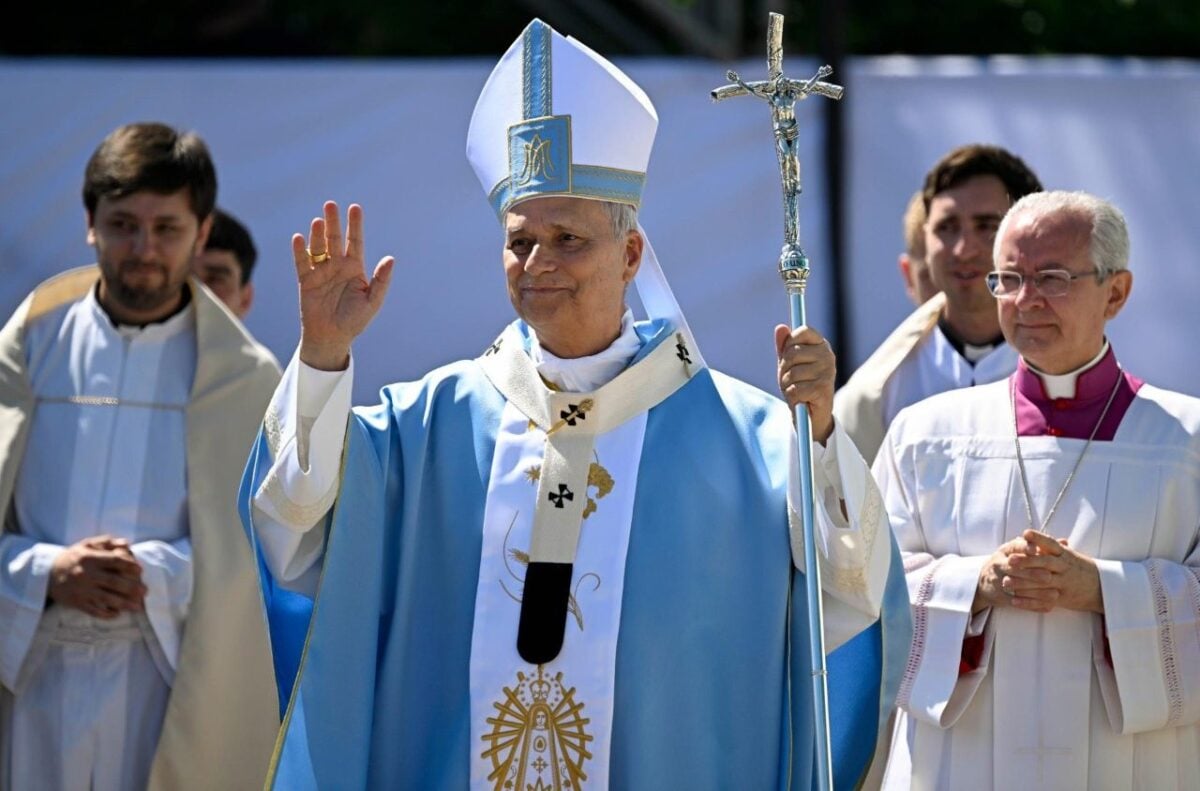
The media frenzy surrounding Leo’s South American visit reached a fever pitch this week when it was widely reported that his Mass in Buenos Aires had drawn a crowd of 2.5 million people.
While apologists for the Conciliar Church will once again, as they did with his recent France visit, proclaim this a victory for Catholicism and a testament to its health, Leo’s theology tells a different story. One cannot help but ask what, exactly, these vast crowds are being fed spiritually.
As usual, Leo’s addresses and homilies were riddled with UN-style globalist platitudes and Catholic-lite nothingburgers. But his November 9 address to the representatives of various Christian sects and “religious traditions” at the Palacio San Martín in Buenos Aires once again laid bare the false religion at the heart of the post-conciliar behemoth. Religious indifferentism, Masonic naturalism, and false ecumenism were the guiding stars of this remarks.
Almost as an exercise in irrelevant box-ticking, Leo did acknowledge Jesus Christ as “true God and true man,” only to proceed with the now-familiar vision of a religion centred on human dignity, fraternity, freedom, and social cooperation. Needless to say, any affirmation of the Catholic Church as the one true Church established by Christ for the salvation of souls was conspicuously absent.
Straight out of the gate, Leo reminded us that the days of seeking the conversion of the lost sheep are apparently over, telling his audience: “Our meeting rests on the pillars of dialogue and friendship […] building new bridges, that is, new paths of cooperation in the society in which we live.”
Click here to support Integrity’s independent Catholic journalism!
Moments later, Leo promoted yet another old error, declaring that he wished “to reaffirm the spiritual ties that unite the Church to the Jewish people […] and our sincere respect for whatever is holy and true in the different religious traditions.” But post-Christian Judaism, far from being the religion of Moses and the ancient Israelites, is a blasphemous rejection of Christ and mired in Talmudism.
In contradiction to Leo XIII’s Immortale Dei, which rejected the notion that civil society should treat religious truth and error as equivalent, Prevost claimed, “religions [sic] were never a cause of division, but rather a meeting point and a source of commitment to society.”
Bordering on blasphemy, Leo then placed all religions on an equal footing, falsely maintaining that, “In the various religions, people pray raising their voices to God … in keeping with our respective traditions, countless languages, songs and gestures converge heavenward, as though gathering before the ineffable mystery of our existence.”
The Dispatch
While his namesake, Leo XIII, condemned the naturalistic principles and moral outlook of Freemasonry in Humanum Genus (1884), Leo XIV essentially promoted its diabolical principles by reducing religion to an instrument for promoting universal human values. “I would like to consider with you today three aspects that emerge from sincere prayer… religions as guardians of human dignity, religions as expressions of our freedom, and religions as places in which to cultivate hope,” he said.
In the same vein, he returned to his familiar obsession with an exaggerated, naturalistic human dignity. “First of all, every religion bears witness to the fact that the human person is defined by need and desire: we are all yearning for life,” he said. “In this way, then, religions safeguard human dignity” and “promote the dignity of every man and woman in the family, in education, in work and in the environment.”
Contradicting the teachings of Pius XI on the Social Kingship of Christ in Quas Primas (1925), Leo also told the representatives of these sects and false religions that their service to humanity was “to build a better future for all, as we await the blessed fulfillment of history.”
Preaching dogma-less humanitarianism
And if any doubt remained as to where Leo’s inspiration comes from, he concluded with a prayer drawn from Francis’ Fratelli Tutti document, asking God to “Move us to create healthier societies and a more dignified world, a world without hunger, poverty, violence and war.” In true Masonic fashion, the prayer also called for the forging of “bonds of unity, common projects and shared dreams.”
Leo left his audience with the expressed hope that “the Almighty [would] bless our enthusiasm for humanity and inspire our commitment to peace: the peace that will be fulfilled forever in the holy name of God.”
Thus, the question of what these vast crowds were being fed spiritually has been answered. Leo and his new humanistic religion are popular with the masses and the world because it makes no demands for repentance, requires no accountability, and promises a temporal paradise from which God has effectively been banished.
Leo’s recurring emphasis on religious convergence, universal fraternity, human dignity, and common spiritual aspirations continues to displace Catholic supernatural revelation, replacing it with a natural religion in which the worship of God gives way to the exaltation of man.