
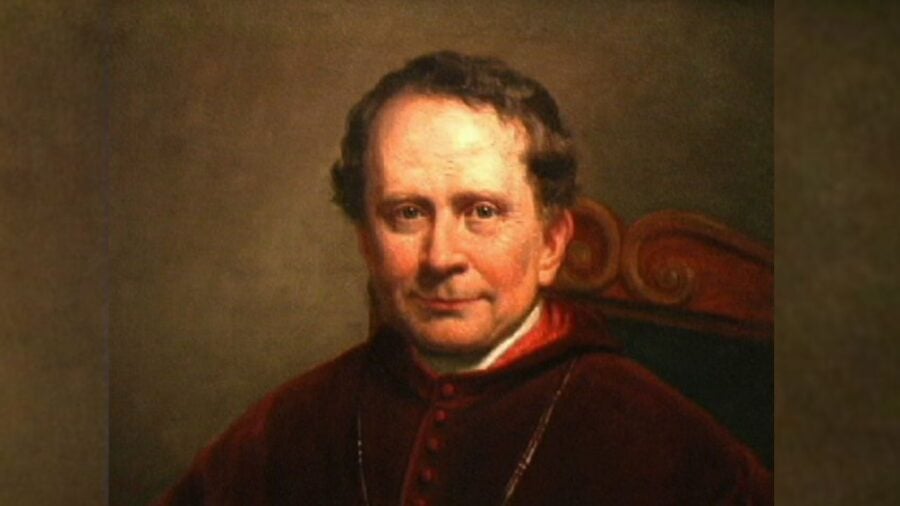
The 1752 Challoner revision of the Douay-Rheims Bible essentially served as the official Catholic Bible used in the United States for nearly a century and a half.
Fr. Richard Challoner was a prominent Catholic clergyman born in England in 1691. He served as Vicar Apostolic of the London District for much of the 18th century.
First published in the United States in 1790, the Challoner edition was mandated for devotional and liturgical use by an informal council of American bishops in 1810. The mandate was upheld at the First Provincial Council of Baltimore in 1829 and again at the First Plenary Council of Baltimore in 1852.
However, many felt a revision of Challoner’s text was necessary to keep up with the changes in the English language. 1 The Archbishop of Baltimore, Francis Patrick Kenrick, took it upon himself to produce this revision, which he published in six volumes between 1849 and 1862. The Kenrick Bible, as it has been called, shows how Americanist and liberal sentiments were on the rise at the time.
The non-Catholic influences on Archbishop Kenrick
A common theme among Americanists of that era was a disdain for the Congregation of the Index and its limits on freedom of the press, as expressed by New York’s Archbishop John Cardinal Farley (1842-1918).
“[T]he exaggerated restrictive policy of the ecclesiastical authorities… through their unreasonably stringent methods of censorship (the Index, for example), only succeed in stifling all initiative on the part of the ablest and best-disposed Catholic scholars,” he alleged.
Kenrick was no exception. In his manual of moral theology, he claimed that the rules of the Index were not binding in America, despite admitting that “several popes have declared them to be obligatory on all the faithful throughout the whole world.” 2
He further argued that, due to the uniquely multi-confessional culture of the United States, it could be “inferred” that the pope tacitly tolerated the reading of condemned books. Of course, no such tacit toleration existed, as if it were ever acceptable to presume upon the pope’s particular permission in defiance of his general decrees. This disregard for the Index influenced Kenrick’s heavily annotated Bible translation.
In the “General Introduction” to his second volume, Kenrick admitted to having violated the rules of the Index, which required that annotations be taken solely from the Fathers or Catholic theologians. Instead, Kenrick used many sources that were, in his own words, “Protestant and Rationalistic.” 3
The Dispatch
Kenrick sought to justify this decision by arguing that he only used such sources when he found their arguments to be helpful for “the vindication of the sacred text” — as if the great Catholic luminaries could not sufficiently vindicate it themselves.
This Protestant influence was not limited to annotations, but also colored Kenrick’s translation of the text itself. His rendering of metanoeo as “repent” instead of the traditional “do penance” provoked controversy, much like his choice to translate baptizo as “immersion.” These decisions appeared as compromises with Protestant interpretations and conveyed a lack of concern for the serious doctrinal issues that they touched upon. 4
It is unclear if these flagrant violations went uncorrected due to the inhibitions that Pope Pius IX suffered when enforcing them, or simply because they did not garner enough attention to attract the Congregation of the Index’s notice. The latter seems likely, given the fact that Kenrick’s Bible failed to gain traction with the general Catholic population and no new editions were published after his death in 1863. 5
The US hierarchy weighs in
At the Second Plenary Council of Baltimore in 1866, the bishops passed over Kenrick’s Bible and instead renewed the mandate for the Challoner Bible. Rev. Martin John Spalding, who succeeded Kenrick as Archbishop of Baltimore and convened the Council, criticized Kenrick’s Bible for its Protestant tendencies and failure to conform to the Index. 6
There were other possible concerns at play in this rejection. Kenrick had devoted the entire introduction to his translation of the book of Genesis to deconstructing the traditional notion of Biblical chronology in favor of a revisionist reading of Genesis 1 that fit with geological deep time. 7 To lend support for his position, Kenrick erroneously claimed that some Church Fathers interpreted the six days of creation as “indefinite spaces of time.” 8
Spalding, meanwhile, seems to have favored the traditional interpretation of Genesis, having published numerous articles critiquing this “day-age” theory while editor of The United States Catholic Magazine and Monthly Review. It is hard to imagine that he would have approved of Kenrick’s notes. In any case, the topic remained controversial among American Bishops even into the 20th century.
What’s more, the 1899 Baltimore edition of the Challoner Bible began with a chronological table tracing the history of the world across roughly 4,000 years from Creation to the birth of Christ. However, in 1914, James Cardinal Gibbons — despite his previous approval of that edition — together with his protégé John Cardinal Farley, promoted a revision that removed it.
Ultimately, the Challoner Bible continued to be promulgated as the standard American Catholic Bible until the mid-20th century, when it was incrementally phased out by alternatives.
- Archdiocese of Baltimore, “Biblical Translations,” May 28, 2007. https://www.archbalt.org/biblical-translations/ ↩︎
- Kenrick, Theologia Moralis (Mechelen, 1861), Vol. II, Tract. XIII, P. I, Ch. V, p. 53, trans. Smith in Notes on the Second Plenary Council of Baltimore (New York, 1874), p. 364. ↩︎
- Kenrick, The Acts of the Apostles the Epistles of St. Paul, the Catholic epistles and the Apocalypse translated from the Latin Vulgate and diligently compared with the Greek text, being a revision of the Rhemish translation (New York, 1851), p. xiii. ↩︎
- Fogarty, American Catholic Biblical Scholarship: A History from the Early Republic to Vatican II (San Francisco, 1989), pp. 16 & 28-29. ↩︎
- Moran, “The Writings of Francis Patrick Kenrick”, Records of the American Catholic Historical Society of Philadelphia, Vol. 41, No. 3 (September 1930), pp. 257-258. ↩︎
- Fogarty, Op. Cit. ↩︎
- Kenrick, The Pentateuch. Translated from the Vulgate, and Diligently Compared with the Original Text, Being a Revised Edition of the Douay Version. With Notes, Critical and Explanatory (Baltimore, 1860), pp. 17-20. ↩︎
- While Church authorities have tolerated the day-age theory as a hypothesis, it is certainly no older than the 18th century. All the Fathers and ecclesiastical writers (even those whom the revisionists often appeal to, like St. Augustine and Origen), whether they understood the days of creation as real or virtual, taught that the Scriptures provide an upper limit for the age of the world, as man came into being together with the universe. In 1862, Francis Kenrick’s own brother, Bishop Peter Kenrick of St. Louis, published his own translation of a French treatise titled Sacred Cosmogony, which debunked the claim that some of the Fathers had admitted long ages in the creation of the world. Unfortunately, while this treatise was strong on Patristics, it was weak on geology, since the author, Abbé Sorignet, inexplicably declined to invoke the Noahic flood for explanatory purposes, and therefore struggled to find a sufficient mechanism to explain the formation of marine fossil beds within the traditional Biblical timescale. ↩︎