
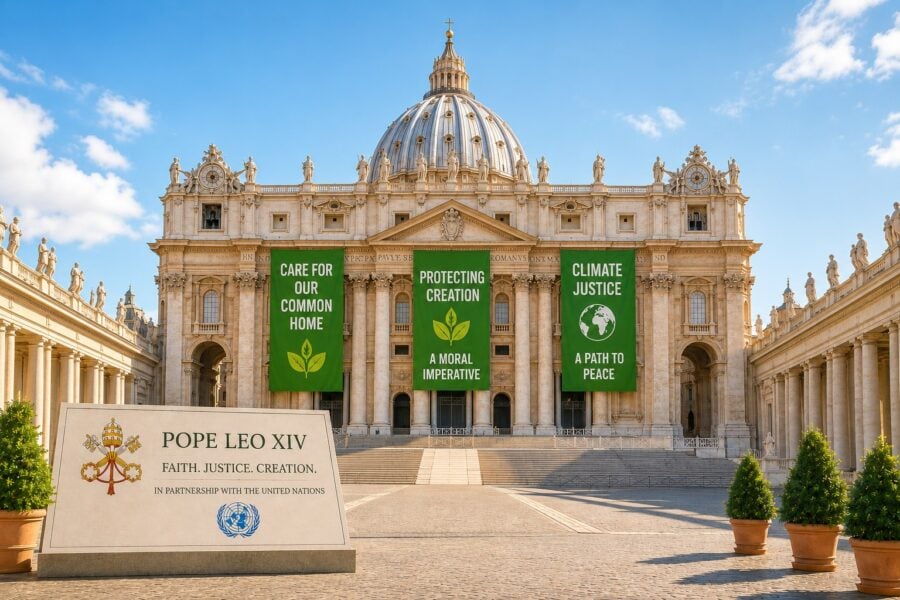
One of the most formidable mechanisms globalist antichrist forces have been using to usher in planetary communism is the climate hoax.
But since truth has become illegal in these sinister times we find ourselves in, acknowledging that fact often earns one the label of a “conspiracy theorist.” That might be changing now as there has been a remarkable development on the topic.
Last month, a group of 44 scientists involved with the Intergovernmental Panel on Climate Change (IPCC), under the leadership of Professor Detlef van Vuuren, effectively conceded in a report that the most catastrophic climate scenarios used by governments, courts, media outlets, and international organizations for years are actually “implausible.”
The IPCC is the United Nations body that assesses the science related to climate change. Its findings confirm that certain assumptions behind temperature changes, exaggerated population growth, and impossible levels of fossil fuel consumption simply do not reflect reality.
The infamous RCP 8.5 scenario, long-used by international institutions, became the cornerstone of climate alarmism, and served as the foundation for thousands of scientific papers, international agreements, activist campaigns, and judicial rulings.
But critics warned that the scenario was unrealistic. Even climate researchers acknowledged RCP 8.5 represented an extreme high-end pathway rather than the most probable future. The new IPCC report openly admits that assumptions behind the catastrophic forecasts were inaccurate.
Read more: 10 disturbing takeaways from the Lepanto Institute’s exposé on the Vatican-Marxist alliance
The consequences of the admission are enormous. The climate agenda has increasingly functioned not merely as a scientific concern but as a kind of secular religion. It possesses its own prophets, dogmas, rituals, sins, and apocalyptic warnings. Carbon emissions became the modern equivalent of sinning. “Net zero” became salvation, dissenters were treated as heretics, children were taught to fear an impending end of the world, and governments demanded sacrifices from ordinary citizens while elites continued traveling by private jet and attending lavish international climate summits.
This ecological ideology also found a powerful ally in the Vatican, to the point that it has eclipsed the Church’s original mandate, which is the salvation of souls.
Under Francis, environmentalism became one of the defining themes of the Synodal Church’s mission. His 2015 encyclical Laudato Si’ framed climate change and ecological activism as central moral imperatives for humanity. The Vatican hosted endless climate conferences, partnered with globalist institutions, embraced United Nations sustainability goals, and repeatedly promoted “ecological conversion” as a spiritual necessity.
The Vatican even organized high-profile events with figures deeply associated with population control agendas and secular environmental activism. Cooperation with organizations tied to the UN, the World Economic Forum, and global climate initiatives became increasingly common. Critics warned that the hierarchy was replacing the supernatural mission of saving souls with temporal activism centered on climate policy, migration, biodiversity, and sustainable development.
The language that was used often resembled neo-pagan spirituality more than Catholic theology. Terms such as “Mother Earth,” “the cry of the earth,” and “ecological conversion” became staples of Vatican discourse. The controversial Amazon Synod of 2019 intensified concerns among many Catholics after ceremonies involving indigenous symbols and earth-centered rituals were held in the Vatican gardens. Images of the so-called Pachamama statues shocked Catholics around the world and became symbolic of what many viewed as an alarming accommodation to pantheistic and pagan ecological spirituality.
The Dispatch
Leo has continued the climate crusade of Francis
The transition from Francis to Leo XIV has brought no meaningful change in direction. Many Catholics hoped that after the 2025 conclave there would be a retreat from the Vatican’s heavy involvement in global ecological politics and its increasingly ideological language surrounding climate activism. Instead, all indications suggest continuity rather than correction.
Since his election, Leo has repeatedly reaffirmed the themes of “integral ecology,” as well as sustainability and global environmental responsibility. Vatican statements continue to promote the framework established by Laudato Si’, treating ecological transformation not as a secondary prudential matter, but as a central moral mission of the modern Church. The same language of “ecological conversion” remains firmly embedded in official discourse.
All of this is taking place at the expense of traditional Catholic teaching regarding sin, repentance, judgment, and salvation, which is increasingly overshadowed by rhetoric about carbon footprints, climate migration, and environmental stewardship.
True, man has a duty to exercise responsible dominion over creation because nature is God’s creation and must not be abused recklessly. But traditional Catholic theology places creation beneath the Creator. The modern ecological movement reverses this order, elevating the planet itself into an object of quasi-religious reverence. That is why the collapse of the catastrophic climate narrative matters far beyond scientific circles.
What happens to the green agenda now?
Already, critics are asking how courts and governments will rely on the sweeping policies based on assumptions now deemed unrealistic by the IPCC scientists themselves. Germany’s Federal Constitutional Court cited these scenarios in its landmark 2021 climate ruling. Similar policies spread throughout Europe and the West under the constant pressure of climate alarmism.
Meanwhile, ordinary citizens have endured rising energy prices, industrial decline, restrictions on agriculture, and increasing economic burdens. Germany’s aggressive energy transition became notorious for shutting down reliable nuclear plants while energy insecurity worsened. Many now question whether entire economies were destabilized based on deeply flawed assumptions. The damage to public trust may prove severe.
Many people accepted radical environmental policies because they believed civilization faced imminent catastrophe. Now even mainstream climate scientists are acknowledging that the most extreme pathways are not plausible. Unsurprisingly, much of the media coverage remains muted, because admitting the scale of exaggeration would undermine years of fear-based activism.
This blow to climate catastrophism exposes the fragility of the global eco-spirituality enthroned in the Vatican that sought moral authority not from divine revelation, but from false apocalyptic environmental predictions.