
Meditating on Pope Saint Pius X’s condemnation of modernism as the “synthesis of all heresies” ought to lead one to reflect on how significant the heresy of modernism really is.
Heresy results in the death of the soul. There is a reason why prominent, incorrigible heretics were jailed, condemned, and/or put to death during the Middle Ages. If someone is publicly leading others to eternal damnation, removing them from society to protect the common good, when prudent, was a suitable course of action. 1
Unfortunately, the Church’s visible hierarchy no longer condemns heresy.
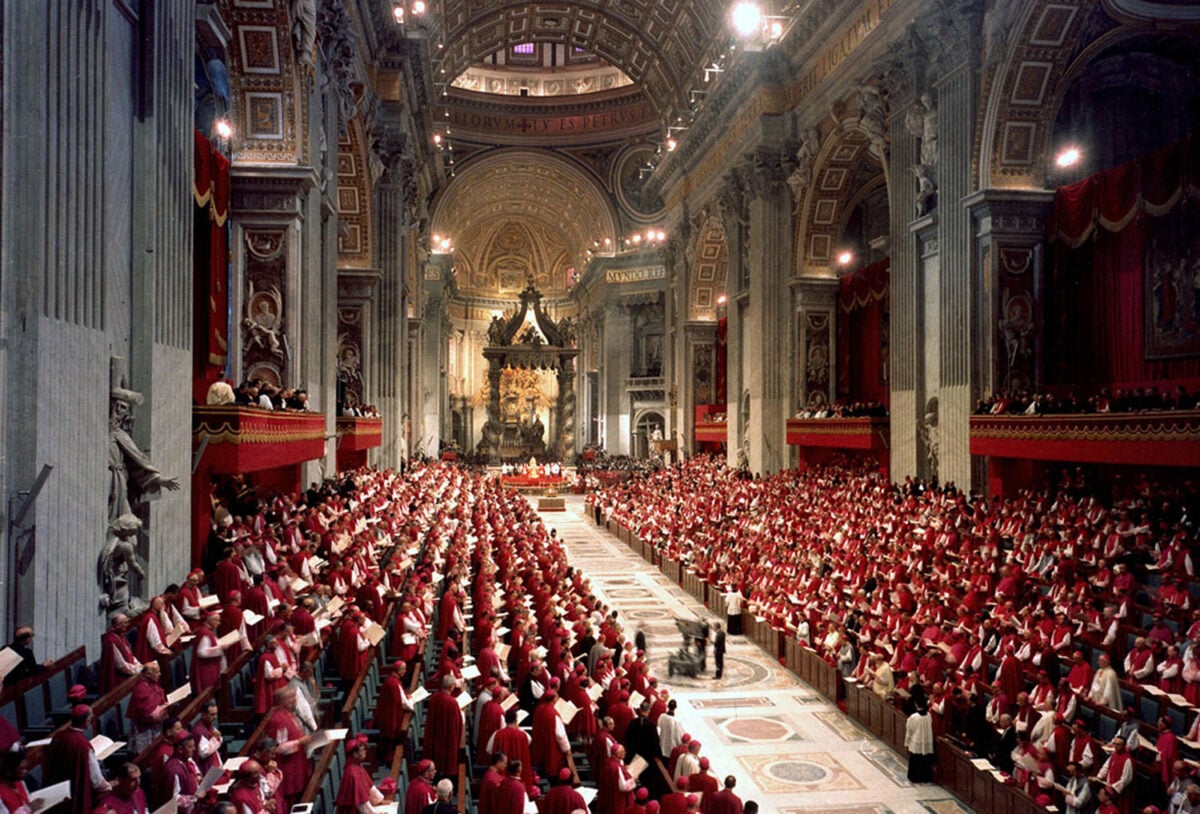
In his opening address at the Second Vatican Council, after astonishingly asserting that “often errors vanish as quickly as they arise, like fog before the sun,” John XXIII said: “The Church has always opposed these errors. Frequently she has condemned them with the greatest severity. Nowadays, however, the Spouse of Christ prefers to make use of the medicine of mercy rather than that of severity … rather than by condemnations.”
These remarks suggest a complete disregard for how deadly error truly is.
Regrettably, this attitude has become normative since the Council concluded in 1965.
In December 2015, under the direction of Cardinal Kurt Koch, the Pontifical Commission for Religious Relations with the Jews released a document titled “The Gifts and the Calling of God Are Irrevocable” in honor of the 50th anniversary of Nostra Aetate.
It stated that “the Catholic Church neither conducts nor supports any specific institutional mission work directed towards Jews,” noting a “principled rejection” of such an effort.
This is diabolical given that Christ Himself said in John 5:43 that the Antichrist will be hailed by the Jews as the messianic fulfillment: “I am come in my Father’s name, and you receive me not: if another shall come in his own name, him you will receive.”
How could the Church surrender its mission to those who are most susceptible to the deadly messianism of Antichrist? This is a perfect example of how false humility, indifference to heresy, and erroneous ecumenism have had disastrous consequences.
Modernism and Antichrist
What makes Modernism the synthesis of all heresies? While individual heresies undermine truths of the faith (e.g., the divinity of Christ, the sinlessness of Mary, etc.), Modernism attacks the root of truth itself. It dissolves the very distinction between truth and untruth, nature and supernature. It is what Fr. Denis Fahey (1883–1954) called “organized naturalism.”
Modernists see the Church as merely one institution among many, rather than the Mother of all nations. Modernists view the Church’s dogmas not as timeless truths, but as historically conditioned expressions of thought, conformable to the whims of the age. As such, Modernism does not merely contain heresy; it actually removes the very capacity to condemn it.
Read more: ‘The end of the Catholic religion’: Fr. Fenton on Vatican II
If the Catholic Church is the fullness of Truth and the Mystical Body of Christ, Modernism is the fullness of untruth and the body of Antichrist. In the second chapter of his Second Letter to the Thessalonians, St. Paul refers to a “restrainer” that holds back the coming of the Antichrist.
There have been various interpretations as to who or what this “restrainer” is. Cardinal Henry Edward Manning (1808–1892) famously identified it as papal authority, while many Early Church Fathers saw it as relating in some way to the Christianized Roman Empire. Both interpretations make sense — and are not mutually exclusive — considering that the Antichrist is described by St. Paul as the “man of lawlessness.” Lawlessness arises from a lack of true authority being exercised.
The Church’s authority is the visible exercise of Christ’s Kingship over man’s intellect and will. Her ability to declare truth, condemn error, and excommunicate are means by which she restrains the spirit of lawlessness. When the Church declares something anathema, she is utilizing her authority to declare it false. The restrainer can only restrain insofar as it applies its authority, not merely possesses it.
The great apostasy
The Dispatch
Elsewhere in the second chapter of his letter, St. Paul defines what has since become known as “the great apostasy.”
An apostate is someone who once adhered to the Catholic faith. This is what separates apostasy from mere unbelief; it is also not just a personal sin.
A man who commits adultery has not apostatized. Rather, apostasy is the renunciation of one’s relationship to the truth. It is the falling away of those previously submitted themselves to the deposit of faith. Importantly, this needn’t be explicitly announced publicly for it to happen.
The “great apostasy” does not necessarily mean that the majority of Catholic laity, clergy, or even the pope will publicly deny the Creed. Instead, a more gradual withdrawal may occur. This could happen by way of a slow replacement of the Church’s divine mission with a merely humanitarian one. In this way, the renunciation of authority is the apostasy, and is precisely what removes the “restrainer” and leaves the “holy place” open and vulnerable to desolation.
The apostasy of authority
Cardinal Joseph Ratzinger admitted in 1982 that Gaudium et Spes “is a revision of the Syllabus of Pius IX, a kind of counter-Syllabus.” If the Syllabus of Errors acted as a bulwark against Modernism, what are we to conclude about the purpose of a counter-Syllabus?
The post-conciliar openness to modernity’s so-called “principles” is often presented as a sort of profound act of humility, a willingness to entertain new insights. This is supposed to evoke notions of Christ’s own humility. In reality, it is a renunciation of the authority Christ Himself gave to the Church.
Implicit in the refusal to denounce error is the assumption that error is not fatal, and that to condemn it is an act of pride or triumphalism. In such a scenario, the exercise of authority becomes tyrannical.
Vatican II and Antichrist
The abomination of desolation prophesied by the prophet Daniel is better understood in light of this apostasy.
When the sanctuary is stripped of its authority and no longer proclaims truth, no longer condemns error, and no longer seeks to convert souls, it becomes desolate, empty, and lifeless. What appears to the world as an act of humility on the Church’s part is, in actual substance, an abdication that paves the way for the lawless spirit of Antichrist.
It is no coincidence that Vatican II, which declared itself to be merely “pastoral” and issued no anathemas, was followed by doctrinal, liturgical, and moral chaos. Again, the restrainer can only restrain when actualizing its authority, not just by existing in humble surrender.
If the great apostasy is this renunciation of authority, then the only reasonable response to it is the unapologetic reassertion of it by a declaration of the Catholic faith and of Jesus Christ’s sovereignty over our intellects, wills, families, societies, and nations in every way, and that those who deny this publicly are leading souls to hell.
The Church is the answer
Insofar as Modernists are animated by the spirit of lawlessness, they form the body of Antichrist. For by dissolving the barrier between truth and error, they imply the nonexistence of truth itself.
In Matthew 10:34, Our Lord says: “Think not that I am come to send peace on earth: I came not to send peace, but a sword.” It is no mystery why Antichrist would be interested in convincing souls of a false peace that strives for a vague unity not founded on the truth but on comfort, worldliness, and the brotherhood of mankind.
For Modernists, there is no difference between grace and nature, Church and world. Catholics, however, understand these differences. In the face of Modernist attacks since Vatican II, they defend the truth that Christ is Lord over both Church and State, that there is no other name under heaven by which men can be saved, and that no one comes to the Father except through Him and the fullness of Truth: the One, Holy, Catholic, and Apostolic Church.
- Pope Leo X, in the 1520 bull, Exsurge Domine, against the errors of Martin Luther, condemned the proposition “That heretics be burned is against the will of the Spirit.” ↩︎