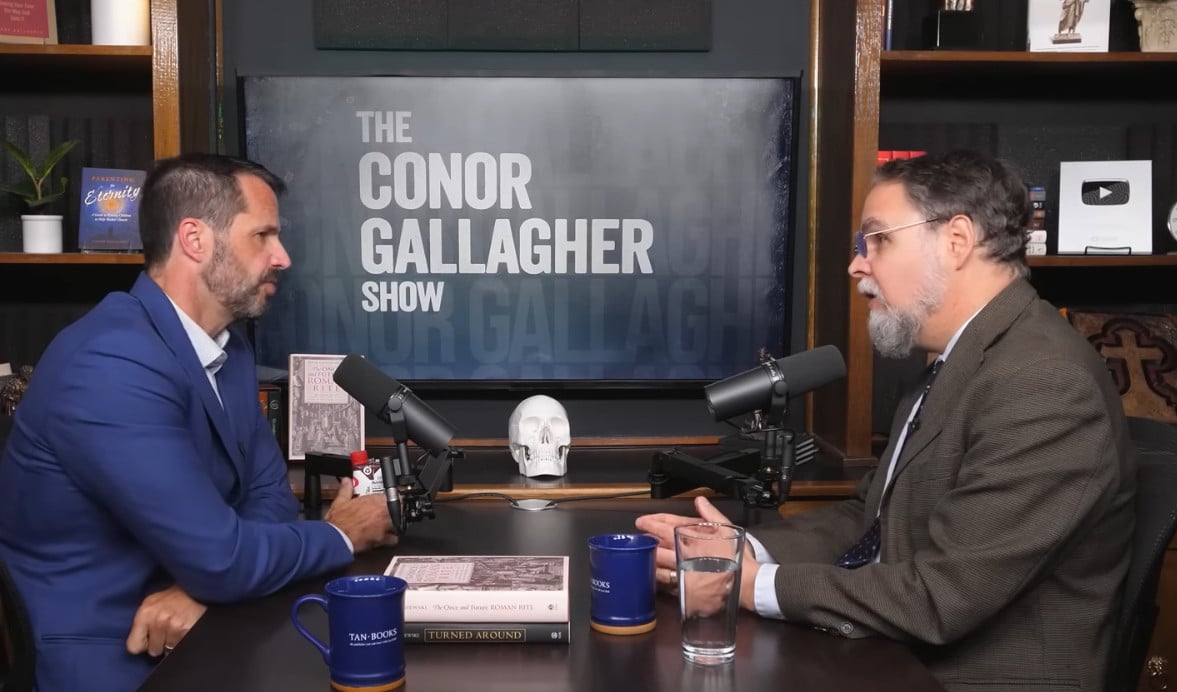
In a recent interview on The Connor Gallagher Show, Dr. Peter Kwasniewski not only made a series of striking admissions about Vatican II and its aftermath but also shared his latest “solution” to the problems that were caused by the Second Vatican Council.
Unlike conservatives who continue to insist that the Council was merely “misinterpreted,” Kwasniewski at least frankly acknowledged that Vatican II represented a departure from the Church’s prior posture toward modernity and modernism. He even admitted that certain conciliar teachings have generated serious doctrinal problems.
Yet, as we see repeatedly from those in quasi-traditional circles, having acknowledged the problem — at least to some degree — he refuses to follow his own reasoning to its logical conclusion and instead offers a type of laissez-faire “solution.”
The result is a position that has become increasingly common among members of the traditional establishment, often referred to as “Trad Inc.” They recognize the catastrophe, identify many of its causes, and even admit the existence of doctrinal deviations, but when the time comes to identify the remedy, they descend into strange, head-in-the-sand solutions. In the case of Dr. Kwasniewski’s “solution,” he retreats into a theory of gradual organic healing that leaves the root problem untouched.
Downplaying the conciliar coup
For the most part, the interview was fairly watchable, except for some expected Trad Inc-isms, such as Kwasniewski’s inability to denounce Benedict XVI and John Paul II for what they were: crypto modernists who greatly assisted in the destruction of the Church.
It is only near the end of the interview that things really started to go pear shaped when Kwasniewski stated that “the council had a naive view of modernity.”
This point is problematic, as it creates the impression that the council was well-intentioned rather than the culmination of a centuries-old revolution. Earlier in the interview, he does touch on the influence of Freemasonry and revolution, but for some reason he downplays this when he gives his final summary of the matter.
The “solution” became even more problematic when one considers that Kwasniewski has described Vatican II as a surrender to worldliness and has repeatedly implied that its errors should be formally condemned by a future pope or council. Why, then, he now takes a different path in this interview is a mystery.
When discussing erroneous and downright heretical conciliar teachings, including topics such as religious liberty and inter-religious relations, Kwasniewski acknowledges that these are genuine deviations but then states that “the deviation is not going to be corrected top down.”
“I don’t even think it’s necessary,” he stunningly declares.
Later on, Kwasniewski maintains that the Church will heal itself through a return to traditional liturgy, Thomistic philosophy, and the recovery of tradition. He explicitly stated that he does not believe “it’s ever going to be necessary to have a condemnation of the errors of Vatican II.”
To drive his point home, he told host Connor Gallagher, “Vatican II will be just a kind of embarrassing footnote, like, oh yeah, we tried this thing, it really didn’t work,” and that “it’s all going to take care of itself.”
The ‘zip it’ approach
Conservatives and semi-trads might lap this up, as it certainly is sugary, but this solution is fraught with errors and problems.
The Dispatch
First, for centuries the Church dealt with doctrinal error through authoritative condemnations, as in the cases of Arianism, Nestorianism, Protestantism, and Modernism. The Church never adopted the theory that doctrinal confusion could simply be allowed to fade away through organic developments.
One can hardly imagine Pope Paul III saying “yeah, this Protestantism thing is a real pain, but let’s just wait it out.” Surely a man of Dr. Kwasniewski’s dizzying Catholic academic pedigree would agree?
Kwasniewski himself has repeatedly argued elsewhere that the Church cannot tolerate discontinuity indefinitely and that errors require correction. He has also written of the need to reject innovations that embody a hermeneutic of rupture and has emphasized the necessity of restoring continuity with tradition all while urging action.
“Can anyone do anything about a wayward pope — mustn’t we just wait until God sorts it out for us?” he rhetorically asked while defending his decision to add his name to a 20-page open letter accusing Francis of heresy in 2019.
“The fact that God is ultimately in charge of everything has never been taken as an excuse to do nothing … The quietists among us would seem to think that it is enough to ‘leave it to God’; let Him preach if He wants the world, let Him journey to its remotest corners,” he exclaimed.
Later in his statement, Kwasniewski urged Catholics to “do all that we can for Christ and the Church, in whatever station we occupy … From those to whom more has been given, more will be expected. If we have been given to see a wolf in shepherd’s clothing, we are expected to do something about it.”
Kwasniewski’s current position therefore raises questions (and eyebrows). If Catholics under Francis were supposed to “do all that we can” by speaking up instead of waiting “until God sorts it out,” why now under Leo is Kwasniewski proposing the opposite of that, especially given that Leo has been continuing to implement Vatican II and the Francis agenda at breakneck speed?
Dr. Kwasniewski offers no convincing answer. Instead, in a vein all too similar to Michael Matt’s “zip-it” policy, he proposes that the Church’s life will “gradually heal itself” thanks to “good liturgy and good bishops.”
Unfortunately for Kwasniewski, history suggests otherwise. Errors that are not explicitly condemned tend to spread, and we need look no further than the past sixty years to see evidence of this. Things did not get better over time; they became exponentially worse.
Failing to draw the right conclusions
Even more troubling is the ecclesiological implication of Kwasniewski’s position. He admits the existence of deviations, doctrinal confusion, and the fact that key conciliar formulations have generated chaos, yet he insists that the existing structures of authority will somehow guide the Church back to tradition without ever publicly acknowledging their mistakes. For the sake of diplomacy and Christian charity, we will call this “wishful thinking.”
One of the central problems with the Trad Inc. mentality is precisely the refusal to draw the necessary conclusions from the facts before them. A man like Dr. Kwasniewski is indeed a great scholar and academic, akin to a walking Catholic encyclopedia, yet it is the conclusions he draws from that vast ocean of information that frustrate his critics.
Kwasniewski and Trad Inc. repeatedly identify the fruits of Vatican II as disastrous, acknowledge serious doctrinal tensions, and recognize that the post-conciliar revolution departed from previous Catholic practice, but then they want the faithful to remain committed to preserving the legitimacy of exactly the anti-Catholic, antichrist system that produced those outcomes. The mind is baffled. One is reminded of leftists who claim “socialism doesn’t work because real socialism has never been tried.”
This creates a permanent state of contradiction which, on the one hand, Vatican II is said to contain dangerous deviations, while on the other hand those deviations supposedly require no authoritative correction. The historical record offers little support for such optimism. The Church has never overcome major doctrinal crises merely by drifting away from them. She has overcome them through clear teaching, precise definitions, and solemn condemnations of error, often accompanied by the active martyrdom of clergy, prelates, and laity.
Probably the most serious question that needs to be posed to Dr. Kwasniewski in light of this latest “solution” is how many lost souls, as collateral damage, he makes provision for. If the post-conciliar synodal wreck is leading souls to hell by the second, then what would be a fair number to sacrifice while we “wait it out”?
Kwasniewski’s interview once again reveals the fundamental weakness within contemporary traditionalist conservatism. It is willing to acknowledge the disease but is unwilling to prescribe the correct cure. It can identify the contradictions but cannot (or perhaps will not) identify their true origins.
If Vatican II introduced deviations that have harmed the Church for decades, then a future full-on condemnation is not merely useful but absolutely necessary. Anything less leaves Catholics trapped in the very ambiguity that produced the crisis in the first place.