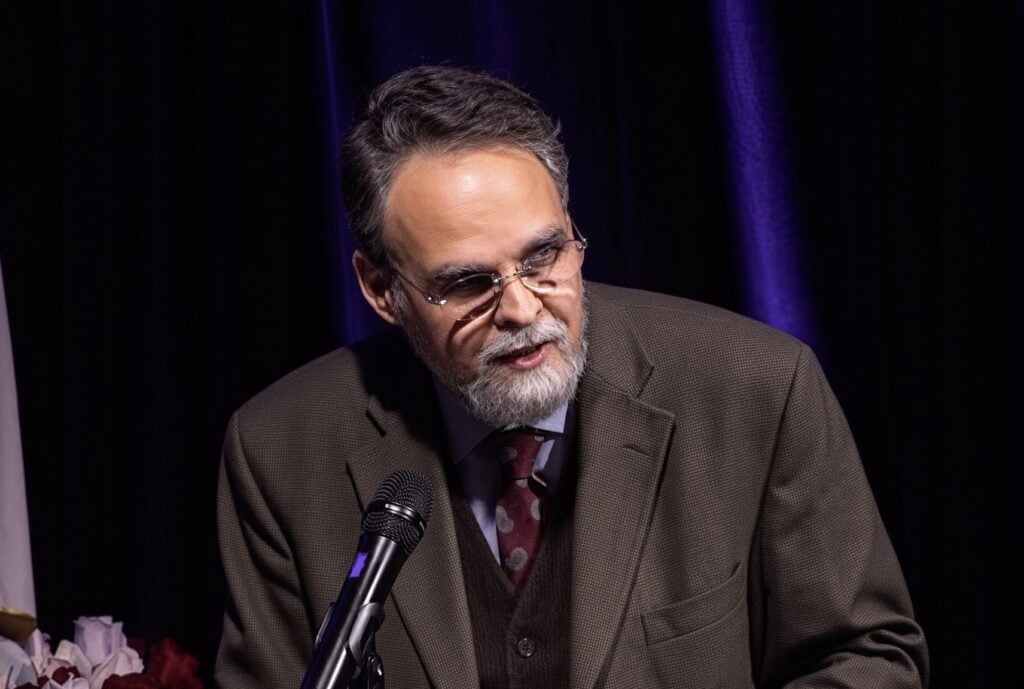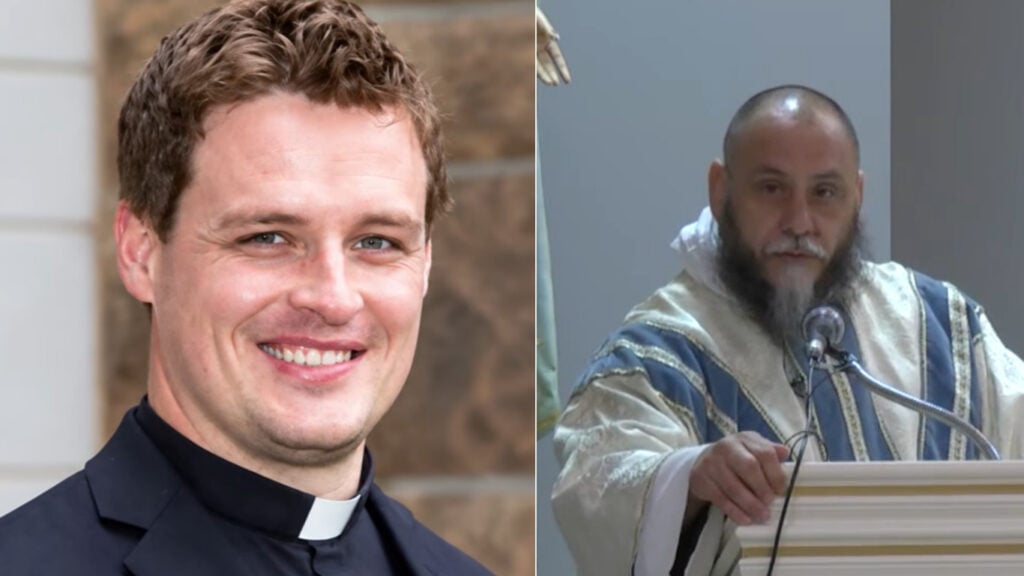
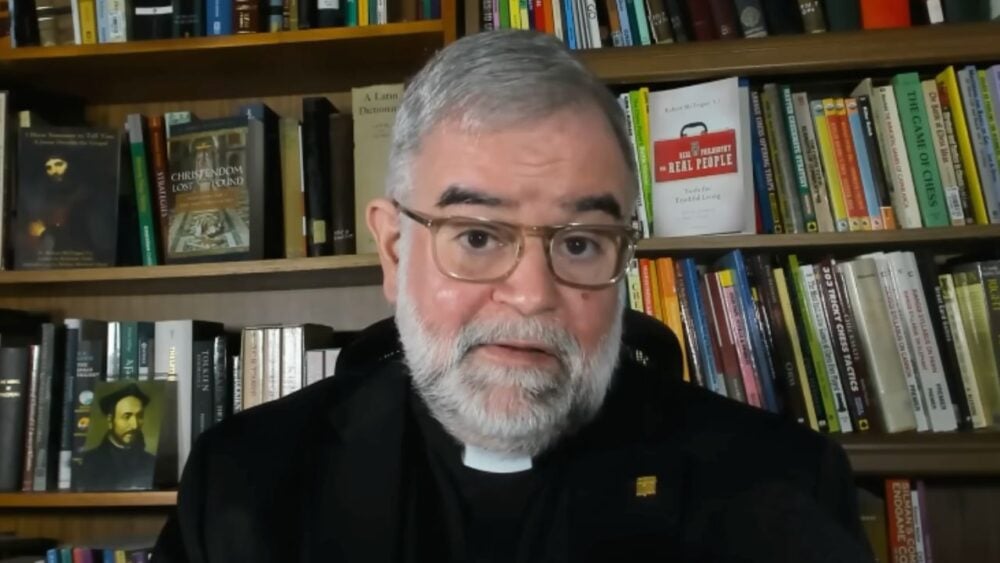
A recent short video by Fr. Robert McTeigue, S.J. — and the consequent praise it received from conservative Catholics, including Father Z, Mark Lambert, and Trad. Inc. “pope” Dr. Peter Kwasniewski — has put on full display the strawman-style reasoning of those who continue to not speak the “fullness of truth” about the crisis in the Church.
McTeigue’s podcast is hosted on The Stations of the Cross radio network. During his “Not One for Vatican II?” program, he attempts to expose an inconsistency concerning the meaning of “full communion with Rome.” Father argues that if acceptance of Vatican II is the litmus test for communion, then vast numbers of ordinary Catholics, clergy, theologians, and even bishops who reject teachings reaffirmed by Vatican II, especially on contraception and abortion, must also be considered outside full communion.
McTeigue’s central claim is that the authorities in Rome apply this standard selectively against Traditionalists while tolerating open dissent elsewhere. Although this observation contains a measure of truth in it given that it exposes the hypocrisy of the infiltrators in the Vatican, it ultimately falls short because it accepts premises that should themselves be rejected. More importantly, it ignores the real elephant in the room, for in attempting to expose contradictions within the conciliar framework, Fr. McTeigue leaves untouched the deeper and more decisive question, namely whether Vatican II and the religion that flowed out of it itself is Catholic.
Areas of deficiency
The first weakness of McTeigue’s argument is that it implicitly assumes Vatican II is a legitimate standard of Catholic communion. Father repeatedly accepts the claim that “full communion with Rome” means “full acceptance of the Second Vatican Council,” and then attempts to demonstrate that the standard is inconsistently enforced.
Even though he is correct in insisting that “full communion” is not universally enforced, the issue is not inconsistency of enforcement but the nature of the council itself.
A Catholic’s communion with the Church is not founded upon adherence to a single twentieth century council but upon adherence to the entire deposit of faith handed down from Christ through Scripture, Tradition, the Fathers, the councils, and the perennial Magisterium. No council can become the singular test of Catholicity in a way that eclipses the prior nineteen centuries of doctrine, especially not one that demonstrably opposes prior Catholic teaching in such a profound way that it constitutes the founding of a new religion.
Read more: Taylor Marshall is wrong: Vatican II actually did create a new religion — here’s proof
This very fact makes it immaterial whether a council is pastoral or dogmatic. If its documents contain heresy and heterodox teachings, it should be rejected and it can be safely assumed that it is not from the Holy Ghost. Of critical importance if the latter is true, if it contains heretical teachings, then the next step would be to question the legitimacy of the popes promulgating, teaching, and establishing these doctrines of demons.
Putting that aside for a moment, let’s assume it was a legitimate “pastoral council.” Historically, the Church never treated one pastoral assembly as the decisive criterion for belonging to the Catholic faith. Catholics were required to assent to everything the Church had always taught. The novelty of the post-conciliar era lies precisely in the attempt to elevate Vatican II into a kind of super-dogma against which all Catholics must be measured. McTeigue notices this phenomenon but does not sufficiently condemn it. Instead, he remains trapped inside the assumptions of the conciliar system. One can thus draw the conclusion that this demand for adherence to the false teachings of the Second Vatican Council is not a measure for “being Catholic,” but the entry requirements for becoming an initiate or member of the false modernist/ synodal religion that the heretical council gave birth to.
But let’s look at McTeigue’s repeating of the common claim that Vatican II was “pastoral and not dogmatic,” as though this somehow diminishes the problem. This line of argument often obscures rather than clarifies the issue. The problem with Vatican II is not merely that it was pastoral. The problem is that its teachings on religious liberty, ecumenism, collegiality, and relations with non-Catholic religions contradict prior magisterial teaching. A council does not become harmless simply because it avoids solemn definitions. Error remains error even when presented pastorally.
The Dispatch
Furthermore, McTeigue understates the binding character that the post-conciliar authorities themselves attributed to Vatican II. While many conservatives attempt to minimize the council by calling it “merely pastoral,” Paul VI himself insisted repeatedly that the council carried authority and demanded religious submission. Cardinal Fernandez repeated this demand to the SSPX recently. After the council, Paul VI declared that its teachings formed part of the ordinary magisterium and must be accepted by the faithful. Thus, the attempt to reduce Vatican II to a non-binding collection of suggestions does not correspond to how the conciliar popes themselves presented it. The crisis therefore cannot be escaped by appealing to the pastoral nature of the council alone.
Read more: ‘The end of the Catholic religion’: Fr. Fenton on Vatican II
This leads to one of the most glaring contradictions in McTeigue’s position. He wants simultaneously to maintain that Vatican II is authoritative enough to function as the standard for communion while also suggesting that its authority is somehow limited because it was pastoral. But if the council is genuinely authoritative, then Catholics would be obliged to assent to teachings that appear contrary to prior doctrine. If it is not authoritative in that way, then the entire postconciliar insistence upon unconditional acceptance collapses. McTeigue conveniently, as in the case of Trad Inc., circles this contradiction without resolving it.
Another weakness lies in the emphasis on hypocrisy rather than truth. McTeigue devotes much attention to the fact that dissenters on contraception are tolerated while Traditionalists are punished. This observation is accurate enough as a sociological point, but hypocrisy does not settle doctrinal questions. Even if the hierarchy treated all dissenters equally, the fundamental issue would remain unchanged. The decisive question is not whether modernists are disciplined less harshly than Traditionalists. The decisive question is whether Vatican II teaches doctrines compatible with prior Catholic teaching or not. And as we know, it doesn’t.
Avoiding the root cause of the crisis
By focusing excessively on unequal treatment, McTeigue reduces the crisis in the Church to a matter of fairness and consistency rather than truth and falsehood. Someone needs to break it to Father and the rest of Trad Inc. that Catholicism is not preserved by administrative consistency but by fidelity to divine revelation. Catholics should be rejecting errors not because they are selectively enforced but because they are contrary to the faith handed down through the ages.
Bringing up Humanae Vitae also reveals a significant limitation. McTeigue correctly notes that many Catholics reject the teaching against contraception despite Vatican II’s reaffirmation of it in Gaudium et Spes. However, this does not prove Vatican II’s legitimacy. Heretics and schismatics throughout history have often retained fragments of Catholic teaching while denying others. The fact that Vatican II reaffirmed certain traditional moral teachings does not establish the orthodoxy of the council as a whole. A mixed document containing both orthodox affirmations and dangerous novelties cannot be defended merely because some parts are correct.
Indeed, one could argue that the post-conciliar collapse in moral theology was facilitated rather than prevented by the ambiguities of the council. The new emphasis on human dignity, conscience, dialogue, and adaptation to the modern world created the atmosphere in which dissent flourished. The rejection of Humanae Vitae did not emerge in a vacuum. It arose within the broader spirit of doctrinal softening and aggiornamento unleashed during and after the council itself.
Most importantly, McTeigue never directly confronts the conclusion that follows from his own observations. If Vatican II cannot be reconciled with prior Catholic teaching, then Catholics not only may refuse assent to its novelties but must refuse assent. Not as some selective and uncatholic expression of recognize and resist, but because the post-conciliar church is not the Catholic Church. The true Roman Catholic Church cannot bind the faithful to error. Therefore, when a teaching (or in this case a whole council’s worth of teachings) contradicts the perennial magisterium, fidelity to the Catholic faith requires adherence to Tradition rather than submission to novelty. This is the real position Catholics should be defending.
The crisis is not fundamentally about whether contraception dissenters are treated differently from Latin Mass attendees. Nor is it merely about whether Vatican II was pastoral or dogmatic. The crisis concerns the introduction of doctrines and principles incompatible with the Catholic faith previously taught by the Church. And more importantly, the crisis concerns the fact that Rome and the Seat of Peter are illegally occupied by usurpers.
McTeigue’s arguments twist and turn within the logic of the conciliar system searching for an escape from contradiction. Yet there is no escape so long as one avoids the underlying reality that Vatican II is not an expression of the Catholic religion and that the religion that flowed out of the council was not Catholicism.
The truly Catholic position is to reject the Second Vatican Council wholesale as well as the post-conciliar/Synodal Church. Communion with the Roman Catholic Church is founded upon adherence to the perennial Catholic faith in its entirety. If Vatican II departs from that faith, then Catholics cannot assent to its novelties, regardless of how insistently modern “authorities” attempt to impose them.