

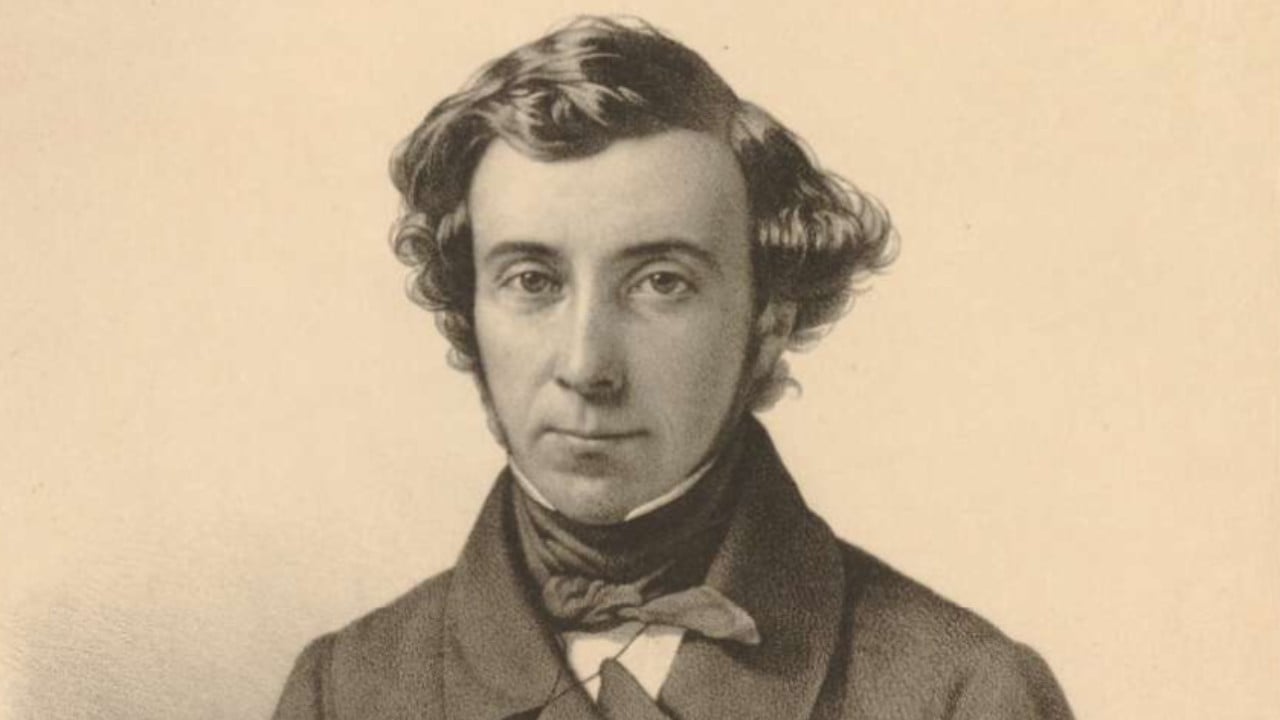
Alexis de Tocqueville (1805–1859) published Democracy in America after visiting the United States in the 1830s.
Among other things, the 19th-century French political thinker predicted that as young country matured, it would either become irreligious or Roman Catholic.
“America is the most democratic country in the world, and it is … the country in which the Roman Catholic religion makes most progress,” he wrote. But “men living in democratic ages are … very prone to shake off all religious authority.”
“I am inclined to believe,” he continued, “that our posterity will tend more and more to a single division into two parts — some relinquishing Christianity entirely, and others returning to the bosom of the Church of Rome.”
This year marks the 250th anniversary of the founding of the United States. In light of this milestone, several important questions need to be asked. Was Tocqueville right about religion in the United States? How is the Roman Catholic Church faring in America today? Is the United States on the path to becoming a Catholic country?
Tocqueville arrived in the United States on May 1, 1831. He spent the next nine months traveling the country. At that time, the population was nearly 13 million, with only about 1 million people — or roughly 7.8 percent — being Catholic.
Tocqueville described his fellow Catholics as “faithful to the observances of their religion” and “fervent and zealous in the support and belief of their doctrines.”
But not all members of the Mystical Body of Christ would have agreed with his assessment.
In a report submitted to Rome on the state of Catholicism in the US in the early 1800s, Bishop William Dubourg of Louisiana and the Two Floridas (1815-1826) expressed concerns with what he was seeing.
“It is scarcely possible to realize how contagious even to the clergy and to men otherwise well disposed, are the principles of freedom and independence imbibed by all the pores in these United States,” he said. “Hence I have always been convinced that practically all the good to be hoped for must come from the Congregations or religious Orders among which flourish strict discipline.”
Regardless, Tocqueville’s prediction that America would either become atheistic or Catholic was proving to be correct in the decades leading up to the Second Vatican Council.
The Dispatch
In 1950, the population of the United States had exploded to approximately 151 million. According to the Official Catholic Directory, Catholics at that time numbered just under 28 million, or 18.3 percent of the population. That means that in just 120 years, the number of Catholics in the United States more than doubled from its previous 7.8 percent of the population to nearly 20 percent.
It is important to ask whether these Catholics were — as Tocqueville once said — “faithful to the observances of their religion” and “fervent and zealous” in their beliefs.
Well, in 1955, 75 percent of Catholics attended Mass on a weekly basis. Bustling schools, large families, growing numbers of priests and women religious, as well as many other undeniable facts suggest that the Church was producing laity and clergy whose observance of and support for the faith was faithful, fervent, and zealous.
And what of Tocqueville’s prediction that Americans would lapse into “infidelity” and embrace irreligion? According to a Gallup study, only 2 to 3 percent of the US population in the late 1940s and early 1950s “did not report a formal religious identity.”
Catholic America stymied
Before the Second Vatican Council, the United States was on pace to become a Catholic-majority nation, with most Catholics faithfully adhering to the Church’s teachings, possibly as early as 2120 — if not sooner.
Thus, the United States would have become the Catholic nation Tocqueville predicted in fewer than 300 years.
Sadly, the story did not turn out this way.
Ten years after the Second Vatican Council ended in 1965, the percentage of Americans identifying as Catholic had risen to 23.5 percent of the population, yet weekly Mass attendance had fallen to just 54 percent. The post-conciliar period also saw a sharp decline in vocations, along with shuttered convents and closed churches.
Today, Catholics are just 20 percent of the overall US population as weekly Mass attendance rates are an abysmal 29 percent, which is a high-end estimate given that various surveys show even lower attendance rates, especially among Gen X and Millennial US Catholics.
To say nothing else, Catholics in America are undeniably losing their “fervor” and “zeal.”
Meanwhile, the number of Americans who identify as atheists, agnostics, or having no religious affiliation has now surpassed Catholics and stands at 28 percent of the population.
Looking back at Tocqueville’s writings, we can conclude that he was spot on in his prediction. Sadly, even though the United States was on track to be a Catholic country at one point, it is now headed in the opposite direction. But that doesn’t mean things cannot be reversed. It just means Catholics have a lot more work to do over the next 250 years.