
Editor’s note: The follow essay is reprinted from The Fatima Files. It is a continuation of “From monarchy to modernism: Blessed Karl of Austria and the martyrdom of Christendom” and has been lightly edited for stylistic and editorial standards.
The war emperor
Karl von Habsburg (1887-1922) played no part in the critical decisions that led up to the most fateful one of all, the sending of an ultimatum to Serbia. According to Niall Ferguson, it was principally the German decision to support, and indeed to “egg on,” an Austrian military strike against Serbia, which encouraged Franz Josef to attempt to “eliminate … Serbia as a political factor in the Balkans.”
There is no one who can say that Karl was against the moves taken by Austria to defend her position in Europe against the terrorist state that Serbia had become. He was not, however, motivated by a German chauvinism, which was the guiding inspiration to Pan-Germans of the time; those who saw in a possible war an opening to assert German dominance over Europe.
Karl had been of one mind with his deceased uncle Franz Ferdinand as to the need to federalize the Austrian Empire. The most critical aspect of this new devolution of power would have to be the granting of equal political status to the Slavic people living in the Kingdom of Hungary, which, since 1866, had been rendered an equal partner in the Austrian system. Franz Ferdinand had known that this would meet with the complete opposition of the Hungarian landed aristocracy that dominated the Hungarian parliament and government.
If, as Karl hoped, the Croats, Slovenes, Slovaks, and the Serbs could be given an equal position in the empire, this situation would satisfy the political ideal of “subsidiarity” offered by the Catholic Church as the best way of exercising and dividing power so as to give men and communities real control over their own affairs, power that would be consonant with the capacity of their practical judgment and in line with an legitimate exercise of political action in their own self-interest.
He knew, however, as had his imperial forebears, that such a system of semi-independent ethnic groups could only keep from fragmentation and acrimonious division by the unifying influence of the Crown and the Catholic Imperial Family. A common human and historical loyalty to a family that had been part of the European landscape for some 700 years would make all think about the overriding common good, rather than, merely, of the good of one group or another.
The Imperial Family was above, independent of, and “unrelated to” any particular “constituency” in the Empire or in the Hungarian kingdom. This is, of course, one of the major arguments advanced in support of the claim that a monarchy is superior to a republic as a form of social and political order. A king always has the prestige and, sometimes, the power to break the hold and the advantage of the wealthy oligarchy of any nation.
This desire to achieve a truly federal system in the empire that Karl was to inherit caused him to hesitate at one of the most significant and dramatic moments of his relatively short life. After more than two years of serving as a real soldier and commanding officer at the front, along with acting as a military liaison to the aged emperor, Karl received a telegram on November 11, 1916 that he knew must come. The emperor was seriously ill and Karl was needed in Vienna. On November 21, the end came for the man who had embodied what was great in the European tradition. Not only had Franz Josef von Habsburg (1830-1916) been emperor of Austria and king of Hungary since 1848, not only had he endured the assassinations of his wife, his only son, brother, and nephew, but he had also saved the Catholic Church by exercising his veto power over the selection of Cardinal Rampolla as the new pope in 1903. His intervention set the stage for the emergence of St. Pius X, the great champion of the anti-Modernist crusade.
Karl became emperor immediately on that fateful day in November. One of his first acts, one which must have been pressing on his Catholic conscience for a long time, was to prohibit a long standing custom, one insisted upon by his great-uncle during his reign, in which an officer of the Imperial Army was required to challenge to a duel anyone who attacked his honor. Such activity had been condemned by the popes decades before in the nineteenth century.
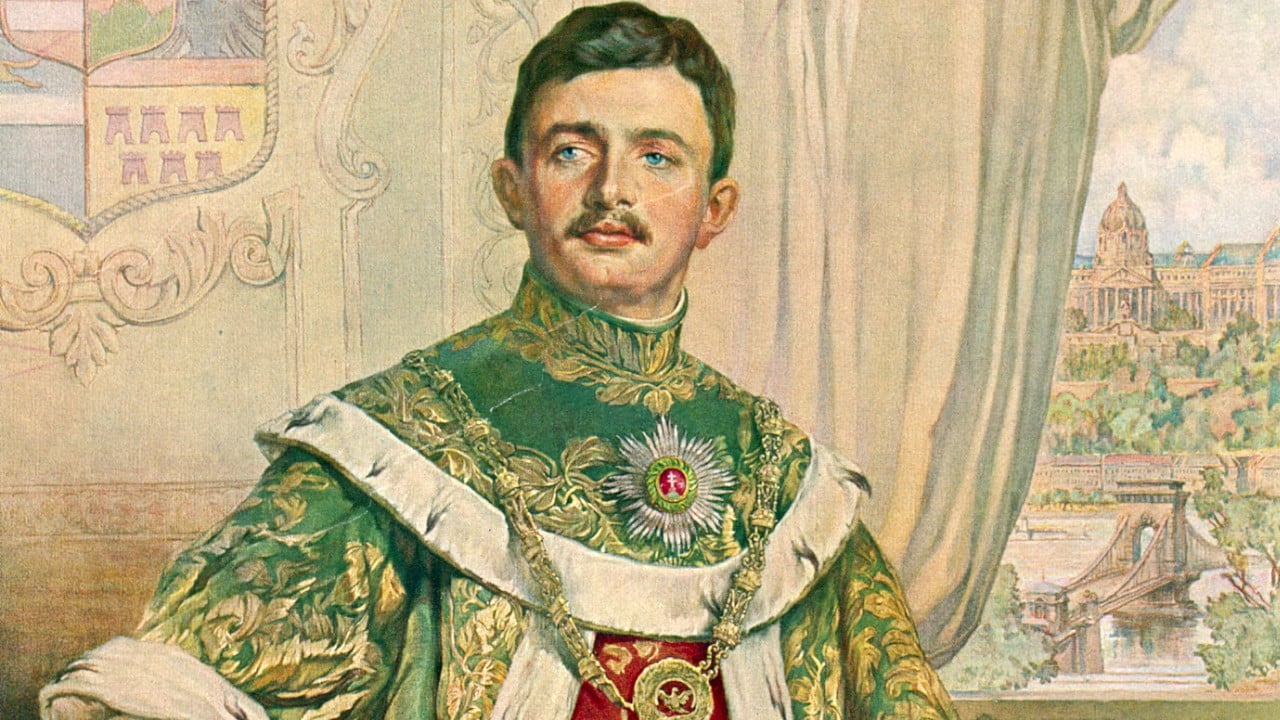
Before he could make the claim to be king of Hungary, Karl would need to be crowned in Budapest with the historic crown of St. Stephen, the symbol of the Catholic Hungarian Nation. The problem Karl had, in this regard, was a serious one. The coronation would have supreme religious significance. Along with being a sacramental action, it would put him in the line of Kings of Hungary who were heirs to the first Apostolic King. Failure to have the ceremony would undermine the Hungarian war commitment. One of the problems with performing the full ceremony surrounding the reception of the crown was the fact that he would need to charge up a hill (made up of soil from all the various districts of the Hungarian Kingdom), crowned, on horse back, with drawn sword, pointing his sword in all 4 directions while pledging to maintain the boundaries of the kingdom. Karl thought that this action, along with the taking of the coronation oath binding him to “protect St. Stephen’s lands,” would seem to imply a total commitment to Magyar (Hungarian) domination.
However, Karl soon recognized the need for such a spiritual-politico act to take place in the midst of the dreadful war. The ancient coronation robes which Charles would wear, and the ceremony in which these would be given to him, all dated back to those distant days of the tenth century. They represented a heritage of faith that was splendid, and solemnly rooted in bedrock to an ancient tradition.
It was amidst the adulation and acclaim of this most solemn and public event, that Karl von Habsburg revealed his deep humility and masculine piety. Years after the coronation, which was performed by the Cardinal-Primate of Hungary, we find the Cardinal recalling:
He [the King] prepared himself conscientiously for this great ceremony. He examined every detail and pondered the inner meaning of it all. Like a priest before his ordination — that was how devout and prayerful the King was before his coronation. I often had the opportunity of speaking with him during the period of preparation beforehand, and I remember observing him at the rehearsal as well as at the coronation itself. It was moving to see how the difficult burden of the feelings of responsibility had imprinted itself on his young soul. It was neither the ornamentation nor the pomp that interested him, it was only the duty that he was undertaking before God, before the nation and before the Church. He wished to be worthy of this, for which he had been chosen.
The Sixtus Affair
1917, the most pivotal year of the 20th century — which witnessed the fall of the Russian monarchy, the coming to power of Lenin, the Apparitions of the Blessed Virgin at Fatima, and the entrance of the United States into the Great War — dawned with a new emperor in Schöbrunn Palace who wanted to immediately set out on the path towards European peace. In this, he even pre-empted the concerted efforts on the part of Pope Benedict XV, in August of 1917, to bring peace to a bloodied continent that had endured three years of war.
There were attempts at internal political reform, which serve as the background of the peace initiative initiated by the Habsburgs and the Bourbons — the two most historically prominent Catholic families in Europe. Along with initiating government policies that would guarantee some type of social security for families in his realm, he attempted to reach out to the Czechs in order that they might feel themselves to be an integral and equal part of the Imperial System. Here, Karl was in full support of the Czech desire for greater political autonomy for Bohemia. 1
The problems which faced the Austrian monarch in his attempt to initiate a federalization of his realm was the same problem faced by the other monarchs of Europe when dealing with matters of peace or internal reform. The nineteenth and the early twentieth centuries had been the age of parliamentary government. The monarchs now had to work through a cabinet and a parliament over which they had varying degrees of control. Any initiative for the common good was thereby dependent on the support of special interest groups and their ministerial and parliamentary representatives. Such was the case with the cause of the Czechs. The Emperor’s proposals for autonomy for the nationalities was met with complete opposition on the part of his own prime minister Clam-Martinitz. In the autonomous Hungarian government, there was also outright hostility to the proposals. It would not be until the end was near in 1918, that Karl would issue a proclamation declaring the rights of the constituent peoples of his empire on his own royal initiative. It was the right thing to do; he should have done it earlier.
The “spirit of democracy” had, however, sunk too deeply into the blood and bones, not to mention the brain of Western Man. The release of 2,000, primarily Czech, political prisoners, on the initiative of the Emperor was criticized by those who saw it as a sign of weakness and a concession to “troublemakers.” In an interesting note in this regard, Niall Ferguson makes the following statement, “There were also ethnic minorities who did not much want national independence before 1914, though some would later embrace it. The Czechs and the Slovaks in Austria-Hungary, for example; but also the Jews there, with the exception of the few Zionists.” Obviously, the peoples of Central Europe were not chomping at the bit to “break free” from centuries-old Habsburg rule.
The “Sixtus Affair” began when one of Empress Zita’s brothers, Prince Sixtus of Bourbon-Parma wrote a letter in a French newspaper, which was followed up upon by high level French officials, including President Raymond Poincaré. Sixtus had been excluded from service in the army of the French Republic on account of his descent from King St. Louis IX. He was able, however, through royal contacts throughout Europe, to receive a commission in the Belgian Army. After Karl became emperor in late 1916, he asked his wife to establish regular contacts with her brother with a view to making overtures to the British and French governments. For the benefit of millions, the first official overtures came via the Duchess of Parma, the mother of the Empress and of Prince Sixtus.
The Dispatch
Throughout this back-channel, contact established between officially belligerent parties. Prince Sixtus, and his brother Xavier, were continually attempting to present a realistic picture of the new Emperor to the Entente Powers. We find this view presented in a British foreign office report, signed by W. Gugot, which reads:
The Emperor used to make an impression on the general public of being an amiable but colorless young man. In reality he is full of character and autocratic. He takes advice up to a certain point from the Empress, who is very intelligent, but in no sense under her thumb … All the recent changes have been made by the Emperor alone on his own initiative. He has become an immensely popular figure in Austria.
Throughout the negotiations with the French and the British — all behind the backs of the Germans — the Emperor/King’s Czech foreign minister Count Ottokar Czernin, undercut the effort. Around February 1917, he sent a message to the Bourbon princes, knee-deep in the ongoing negotiations, saying that the alliance between Austria-Hungary, Turkey, Germany, and Bulgaria was indissoluble and that a conclusion of a separate peace for Austria-Hungary was permanently barred.
The terms that Karl was offering to the British and the French were extremely generous. Karl was willing to have the Central Powers hand over Alsace-Lorraine as well as parts of Italy, craved by the Masonic Italian State. He was, also, more than amenable to the restoration of the sovereignty of Belgium and to the setting up of a Southern Slav kingdom, which would include the Serbs and constitute an integral and equal part of the present Austro-Hungarian Monarchy. Prince Sixtus would write, after the war:
It was well known that the Emperor of Austria had very clear views and decided willpower on this point, that he was in accord with the cherished hopes of Poland, Bohemia, Croatia, and Yugoslavia. The most bona fide representatives of those countries had expressed their entire confidence in their young sovereign. But there was no desire to go further, or to destroy further. Nobody wished to break essential and necessary bonds or to arouse interior and exterior hatreds between neighbors. The Emperor Charles would have gone on further, for his duty clearly showed him that he could not uselessly sacrifice his people to the obstinacy of an ally whose pride was causing his coming destruction … a separate peace with Austria would have realized the principle object of the war … The lives of thousands, nay millions of men would have been saved.
The efforts made by Karl ultimately would be for naught, except for the sanctity of his own soul. The secret agreement between Britain, France, and Italy called the Treaty of London of 1915, would prove an unmovable obstacle. The Italians were committed to territorial aggrandizement at the expense of the Austrian Empire. They would demand fulfillment of the treaty’s promises even if it mean continuation of the bloody trench war. Moreover, Georges Clemenceau, having become one of the “revolving door” prime ministers of the French parliamentary republic, in November 1917, was unscrupulous in his treachery when the contents of the Sixtus negotiations were officially revealed to him. In April 1918, he proceeded to publish the contents of the letters in which Emperor Karl promised the French government to use his personal influence to support the French claims to Alsace-Lorraine. Immediately, not only did a separate Austrian peace become impossible, but Karl completely lost his standing vis à vis his German allies. There were even concrete proposals, made by the Germans, to invade and assimilate her ally Austria. In this regard, to his credit, the American Secretary of State Robert Lansing, decried this action of Clemenceau as “a piece of the most outstanding stupidity … an unpardonable blunder.”
Join the Counter-Revolution: Become a monthly donor at Integrity today!
There is little real question as to whether or not this was a “blunder.” The Entente Powers, now backed by the power of Woodrow Wilson’s troops and his crusade to “Make the World Safe for Democracy,” were ideologically committed to the break-up and extinction of the ancient Empire, which had held together Central Europe for some 500 years.
This Masonic Revolutionary ideological commitment was most perfectly displayed in, perhaps, the last serious attempt, on the part of Emperor Karl, to reach out to the “enemy” in order to bring peace to a ravaged Europe. This overture was made to the United States, whose entrance into the war Karl felt to be an indication of certain defeat for the Germans and Austrians. The peace proposal, which included much discussion of Karl’s federalistic plans for the ethnic groups of Central Europe, was made by Dr. Heinrich Lammasch to George Herron in February of 1918. Dr. Lammasch, former three-time president of the International Court of Arbitration at The Hague, was an intimate and trusted friend of Emperor Karl. George Herron was a former Congregationalist minister, and hero of the American Socialists, who served as the unofficial eyes and ears of Woodrow Wilson in Europe during the United States’ involvement in the War. Their meeting took place in Berne, Switzerland on February 3-4, 1918.
At first impressed with Lammasch’s proposals, Herron asked to “sleep on the matter.” During the night, he stated that he “wrestled with this temptation as Jacob wrestled with God near Yabbok.” By morning he knew that he had gained complete victory over himself: Lammasch had been nothing but an evil tempter. No! The Habsburg monarchy had to go because the Habsburgs as such were an obstacle to progress, democracy, and liberty. To top off the actions of this man who was totally committed to the American Democratic Messianism of his political master, Woodrow Wilson, he offered the broken Lammasch one of his own books against peace. Such were the flint-heads upon which Blessed Emperor Karl cut his sanctity.
The end of Christendom
If we can say that “Christendom” is a system of societal and political organization that explicitly or implicitly relies on the ancient tradition of embodiment of the natural and divine law in institutions and structures meant to express the created and redeemed nature of mankind, with anointed leaders whose offices have a sacral character, then we can say that Christendom fell in 1918. It fell in Russia with the triumph of the Marxists in 1917. It fell in Central Europe with the fall of the ancient Habsburg and Hohenzollern dynasties. 2 And it ceased to be a possibility in Western Europe with the wartime triumph of political atheism, also called secularist democracy. It was publicly displayed at the signing of the Treaty of Versailles in which, for the first time in the history of European Christian civilization, a treaty was signed which did not invoke the Holy Trinity. To demonstrate that the pope had no jurisdiction, even indirect, over the affairs of the New Democratic Europe, the Holy See was completely excluded from all the conferences that were being held to create a stable post-war order in overwhelmingly Catholic Central Europe.
At the age of 31, Karl was placed in the vortex of the forces, which were systematically toppling the structures of government and culture that had existed from time immemorial. He tried to hold it together — that delicate system of nationalities, cultures, and loyalties — by making peace offers to the belligerent and ideologically blinded Woodrow Wilson, proclaiming on his own initiative the rights of the peoples of his empire and of the Hungarian kingdom, and by trying to piece together governments to rule a nation that was disintegrating. It was his duty; he tried to perform his duty. Which ancestor of his had a worse task? And yet he achieved holiness in the doing.
After two attempts to regain his Hungarian throne, from a “regent” who refused to acknowledge the claims of his king, Karl and his wife Zita, along with their children, were led to a British ship and unceremoniously dumped off on the Portuguese island of Madeira. Without money or permanent accommodations, not even being given money to buy firewood for the little shack in the mountains they were forced to occupy due to their inability to pay for the hotel in which they first stayed when they arrived on the island, Karl was being prepared to endure his moment of Calvary.
A modern saint dies
In all this talk of Karl as the Emperor, we have forgotten to consider his position as father. In his love for his children, the affection shown by a true Christian man was displayed in his last months of life. Archduke Otto, his eldest son, spoke years later of his father’s constant encouragement of his family, telling them that they still had faith and hope, emphasizing that they still had one another. Otto and his sister Archduchess Adelheid would spend long hours on walks with their father while he talked to them about a whole range of things.
He answered their questions and tried to help them understand the particular position of their family and the duties of a Christian ruler under God. A certain sadness touches us when we find out that the Blessed Emperor’s last illness came upon him on account of a cold caught on a visit to the neighboring city to buy toys for his children. A few days later he had to admit he was ill and was confined to bed. Pneumonia set in. When doctors were summoned, he initially protested on account of the complete lack of funds. He suffered much from the doctors’ primitive treatments, turpentine injections in the leg, and “hot cupping” of his back, which raised terrible blisters and brought him to a state of agony.
Joining his sufferings to the offering of the Holy Sacrifice of the Mass that was performed in his room every day, he was heard to say, “I must suffer like this so my people will come together again.” When it became obvious that he was dying, he was given Extreme Unction. He asked that his son be brought into the room for the ritual. “I would have liked to have spared him all that yesterday. But I had to call him to show him the example. He has to know how one conducts oneself at times like this — as a Catholic and as an Emperor.” The next day he called Otto into his room again. The child slipped in and was kneeling, crying by the bed. “I love you so much,” were his final words to his wife. He no longer even had the strength to kiss the cross that his wife held before him. “I can’t go on much longer. Thy will be done … Yes … Yes … As you will it … Jesus!”
In saying the Holy Name, he died. So now we do not feel so bad. A modern man has fought against the modern world — and won.