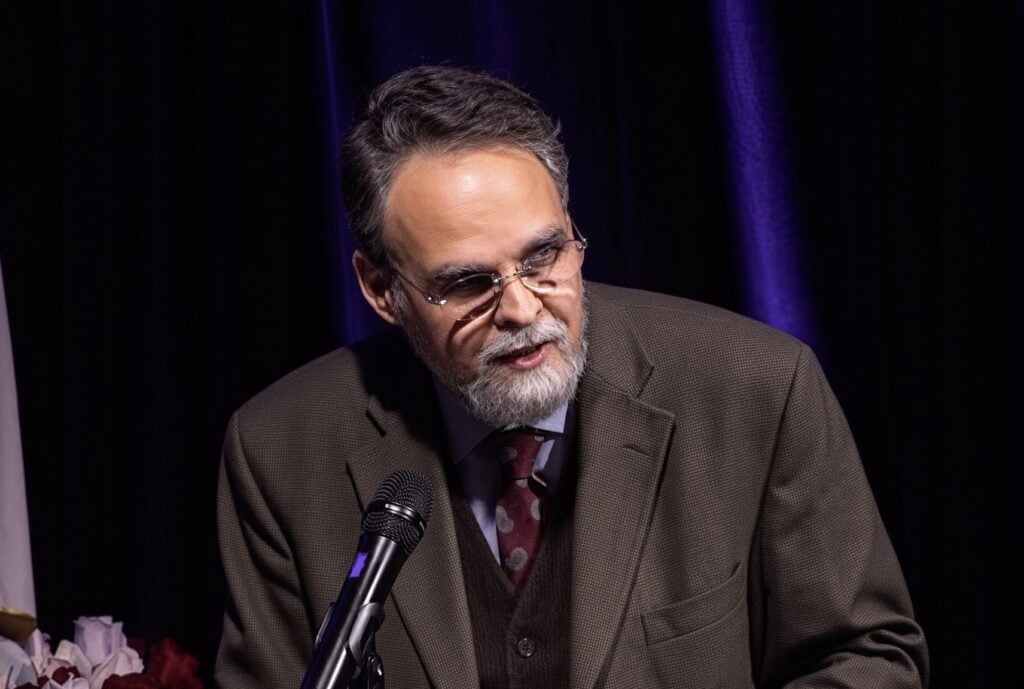
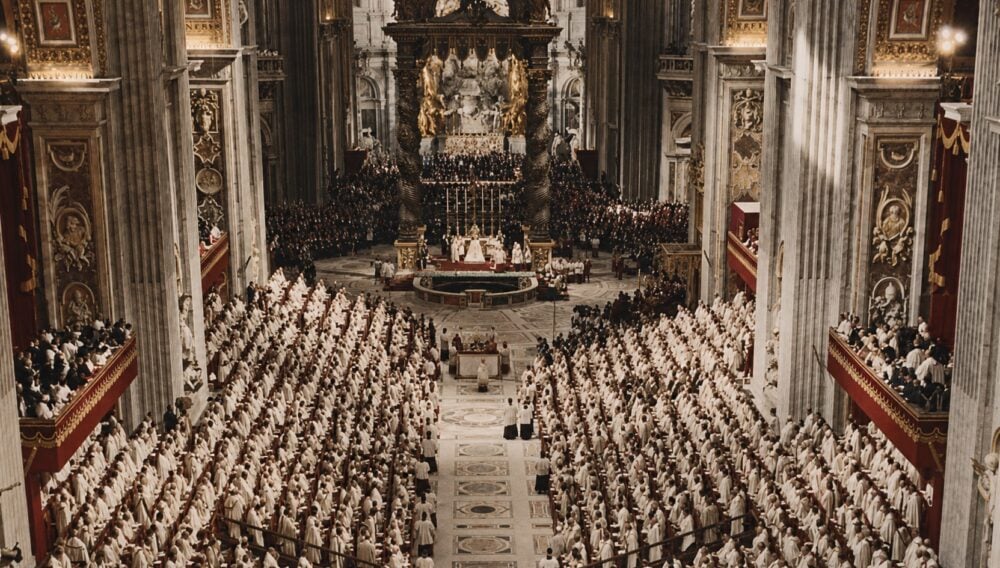
Earlier this week on X, Dr. Taylor Marshall vehemently denied that Vatican II founded and perpetuated a new religion.
This is somewhat peculiar given that it comes from the author of Infiltration: The Plot to Destroy the Church from Within, a book built on — if not explicitly, then at least implicitly — the premise that modernist and Masonic antagonists sought to, and succeeded in, transforming the Catholic Church and its beliefs from within.
If we zoom out a bit, a broader overview of the matter makes it glaringly evident that a new religion at odds with Catholicism was not only established at Vatican II but was substituted for it in the years afterwards and then imposed upon the faithful. This was the culmination of a campaign that began long before the 1960s.
Vatican II was a Modernist coup
Prior to the Second Vatican Council, the seeds of theological revolution had already been planted within the Church. The “new religion” did not suddenly appear in 1965. Rather, Vatican II gave official shelter and legitimacy to errors and heresies that previous popes had repeatedly condemned under the names Liberalism, Modernism, and the “new theology.”
Pope St. Pius X described Modernism in Pascendi Dominici Gregis (1907) as “the synthesis of all heresies” and warned that Modernists remained inside the Church while secretly working to transform it from within: “they put into operation their designs for her undoing not from without but from within.” The danger, according to Pius X, was not open rebellion but internal subversion. He was correct in this observation.
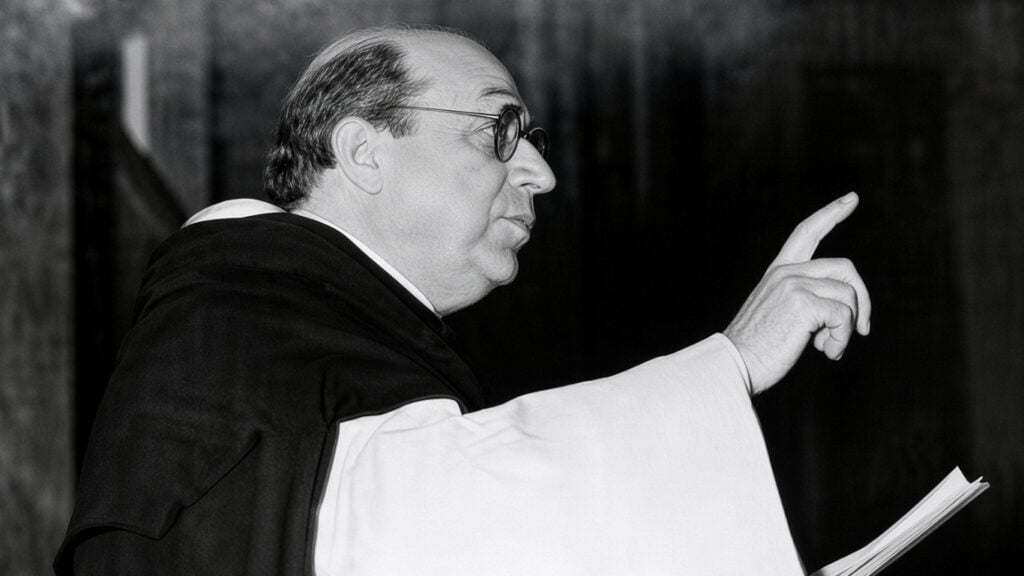
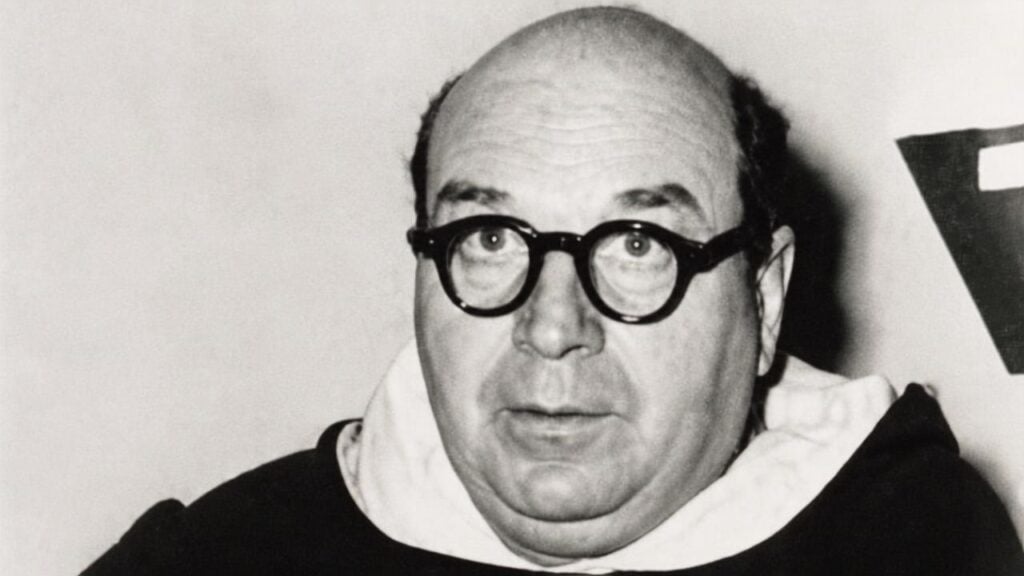
Among the chief forerunners of the conciliar revolution was the French priest Fr. Pierre Teilhard de Chardin. His evolutionary theology reimagined Christianity in terms of cosmic progress rather than immutable dogma. The Church repeatedly censured his writings before the Council, but after Vatican II his influence exploded among theologians and clergy. Likewise, Fr. Henri de Lubac, Fr. Yves Congar, and Fr. Karl Rahner all faced restrictions or suspicion under Pope Pius XII for advancing novel theological methods that weakened St. Thomas’s scholastic precision and blurred doctrinal boundaries. These same men later became influential experts at Vatican II. Congar himself boasted at the Council that he was seeking to overturn the previous four centuries of Church teaching.
The liturgical movement also became a vehicle for innovation. Fr. Annibale Bugnini, later architect of the Novus Ordo Missae, openly advocated sweeping reforms before the Council. Archbishop Marcel Lefebvre later accused him of pursuing “a new conception of the Church” through the liturgy itself. The old Roman rite expressed sacrifice, priesthood, and transcendence with clarity; while reformers increasingly emphasized community, dialogue, and adaptation to modern man. Sacrosanctum Concilium itself refers to the priest as one who merely “presides” over the “assembly” at the “table of the Lord.”
Even before Vatican II, some of its most influential theologians were already undermining the Church’s traditional teaching on ecumenism and religious liberty. Fr. John Courtney Murray in the United States argued for a new understanding of Church and state relations that earlier popes such as Pope Pius IX had rejected in the Syllabus of Errors. Though silenced for a time under Pius XII, Murray was rehabilitated during the Council and helped shape Dignitatis Humanae. He later admitted in 1967 that the “development” of the doctrine on religious liberty had yet to be fully explained.
Thus the “post-conciliar Church” did not arise in a vacuum. Vatican II served as the triumph and institutionalization of long developing Modernist currents that previous popes had struggled to contain.
The new religion
The Second Vatican Council did not merely introduce “pastoral adjustments.” It substituted the Catholic faith with a new ecclesiology, a new theology, and new disciplines that fundamentally altered the beliefs and understanding of the Church and her mission. This is not mere speculation, those who wrote the Council’s document admitted their goal was not continuity but an entirely new direction.
The clearest example is found in Lumen Gentium, which replaced the identification of the Catholic Church as the Mystical Body of Christ by declaring that the Church of Christ “subsists in” the Catholic Church. Prior popes had taught unequivocally that the Catholic Church is the Mystical Body. Pope Pius XII wrote in Mystici Corporis Christi (1943): “The Mystical Body of Christ and the Roman Catholic Church are one and the same thing.” The conciliar phrase “subsists in” opened the door to the idea that the true Church somehow extends beyond Catholic boundaries and exists partially in schismatic and Protestant communities.
The Dispatch
This new ecclesiology opened the door to a new ecumenism. Before the Council, the Church sought the conversion of non-Catholics to the one true faith. Pope Pius XI condemned false ecumenism in Mortalium Animos (1928), insisting that Christian unity could only come through return to Rome. Vatican II instead praised separated communities as means of grace and encouraged dialogue rather than conversion. It also said the Incarnation of Christ meant Our Lord was united “in some way” to all men, thereby diminishing baptism. Unitatis Redintegratio also declared that the Holy Ghost “has not refrained from using them as means of salvation.” This marked a profound doctrinal shift beyond the borders of Catholcism and into the territory of a new counter-faith.
The Council also introduced a new doctrine on religious liberty in Dignitatis Humanae. Earlier papal teaching explicitly rejected the proposition that every man possesses a natural right to religious freedom in public. Yet Vatican II declared that such a right “has its foundation in the dignity of the human person.” This contradicted the teaching of Pope Gregory XVI in Mirari Vos and Pope Pius IX in the Syllabus of Errors.
A new understanding of the Church’s role in the world emerged in Gaudium et Spes. Instead of emphasizing the opposition between the City of God and the spirit of the world, the Council adopted a tone of optimism toward modernity. Man was increasingly placed at its center. Paul VI’s speech at the United Nations in 1965 was exhibit 1A of this new orientation. While speaking to so-called global leaders, he did not mention the name of Our Lord or His Blessed Mother but rather invoked words like “brotherhood,” “man,” and “dignity.”
These doctrinal and theological changes produced a religion markedly different in spirit, language, and purpose from the Catholic faith. In true revolutionary fashion, it was all codified in the decades that followed. The Church that once spoke of conversion, condemnation of error, and the social reign of Christ the King, now spoke of dialogue, human dignity, ecumenism, and openness to the modern world.
The antagonists’ confessions
The strongest evidence that the post-conciliar Church represents a new religion comes from the very men who created and defended it. Again and again, the architects of Vatican II described the Council not as a continuation of tradition, but as a new beginning, a rupture, and a transformation of Catholic consciousness.
Perhaps the most revealing admission came from Fr. Joseph Ratzinger, later Benedict XVI. In his 1966 book The Theological Highlights of Vatican II, Ratzginer claimed that the Church during the 100 years before the Council had become “excessively one-sided” in its anti-Modernist “zeal.” The “cramped thinking” of that period, he alleged, “once so necessary as a line of defense” was actually a “narrow” theological outlook that reflected an “outmoded negative defensiveness.”
Writing in Principles of Catholic Theology, he described Gaudium et Spes as “a revision of the Syllabus of Pius IX, a kind of counter-syllabus.” The original Syllabus of Errors issued by Pope Pius IX had condemned liberalism, religious indifferentism, and reconciliation with modernity. Ratzinger openly admitted that Vatican II represented a reversal of that anti-modernist stance.
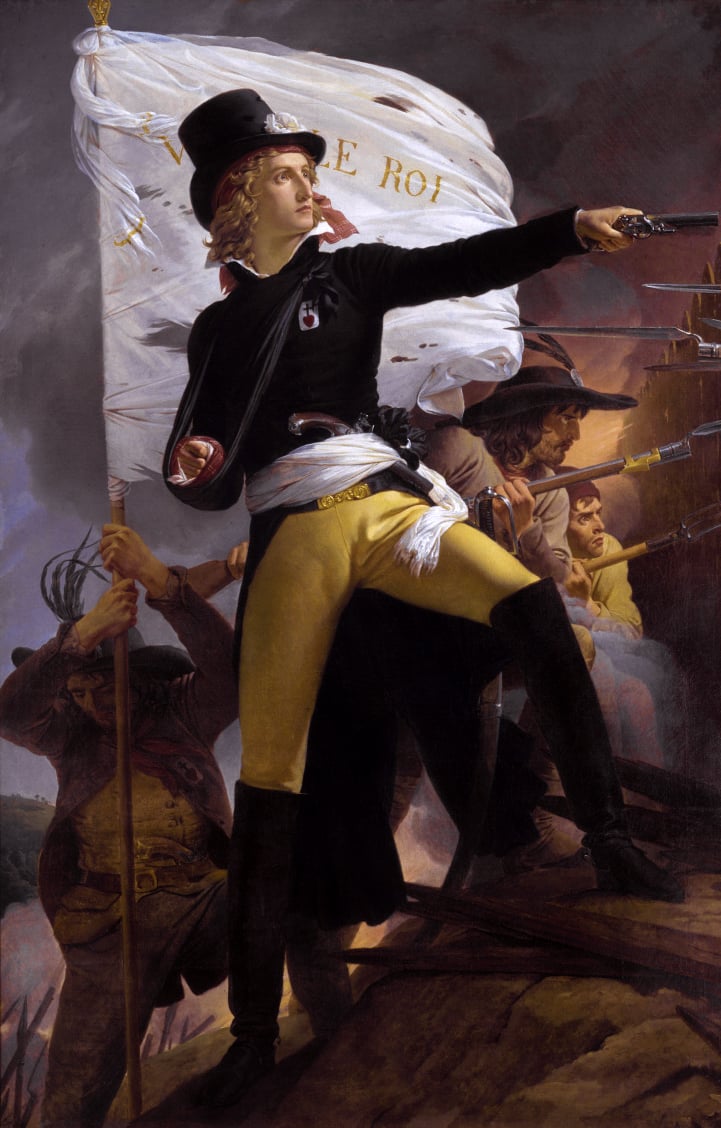
Likewise Cardinal Léon-Joseph Suenens, one of the leading liberal voices at the Council, infamously declared that Vatican II was “the Church’s 1789,” unmistakably comparing it to the French Revolution. Just as the French Revolution overthrew the old social and political order, Vatican II was understood by its proponents as overthrowing the old Catholic order. “The Second Vatican Council marked the end of an epoch … it brought to a close the Constantinian era, the era of ‘Christendom’ … it marks a turning point in the history of the Church,” Suenens also exclaimed in 1967.
The evidence is clear
The liturgical revolution provides even starker proof of rupture. The hierarchy itself called the reformed liturgy the “New Mass.” Considering the ancient principle lex orandi, lex credendi which teaches that the law of prayer determines the law of belief, a radically altered liturgy then necessarily expresses altered doctrine. Archbishop Annibale Bugnini stated plainly that the reform intended to remove from Catholic worship “every stone that could even remotely constitute an obstacle or difficulty” for Protestants. The sacrificial language, silence, gestures of reverence, and explicit emphasis on propitiation were systematically reduced. The new liturgy reflected a new theology.
John Paul II acknowledged the unprecedented novelty introduced by Vatican II. In Redemptor Hominis (1979), he wrote: “I am entering into the rich inheritance of the recent pontificates. This inheritance has struck deep roots in the awareness of the Church in an utterly new way, quite unknown previously, thanks to the Second Vatican Council.” A consciousness “quite unknown previously” is damning evidence not of continuity, but transformation.
By their own words, the conciliar reformers believed they were constructing something completely new. It turned out also completely alien to 2,000 years of revealed truth
An inevitable conclusion
Even a surface-level glance at the novelties introduced since the Council makes it undeniably clear that we are dealing with a new religion. A child will be able to draw the obvious conclusion that a new rite of ordination (1968), a new Mass (1969), a new rite of baptism (1969), a new rite of marriage (1969), a new rite of confirmation (1971), a new rite of extreme unction (1972), a new rite of penance (1973), a new breviary (1970), a new calendar (1969), new holy oils (1970), a new Code of Canon Law (1983), a new Way of the Cross (1991), a new catechism (1992), a new rite of exorcism (1998), a new martyrology (2001), and even a new set of mysteries added to the Rosary (2002), is the definition of a new religion.