
The American Catholic Encyclopedia was published in fifteen volumes from 1907 to 1912 under the guidance and support of Archbishop John Farley of the Archdiocese of New York.
The Encyclopedia’s long list of contributors includes clergy who assisted with Farley’s ill-fated Modernist magazine, The New York Review: Fr. James F. Driscoll, Fr. Francis P. Duffy, Fr. Francis E. Gigot, and other prominent American prelates like James Cardinal Gibbons, Archbishop of Baltimore from 1877 until his death in 1921.
Read more: Modernism would have flourished in New York had it not been for St. Pius X
The Encyclopedia was not the first endeavor of its kind. Starting in 1839, Fr. Jean-Baptiste Glaire and Viscount de Walsh published the original “Catholic Encyclopedia” (Encyclopédie Catholique) in 18 volumes. However, by the early 20th century, many academics in the American Church, including some faculty at the Catholic University of America, felt that an English-language encyclopedia was needed — one that would be more in keeping with modern sensibilities.
For many traditional-minded Catholics, the Encyclopedia appears to be entirely orthodox. It is a pre-conciliar source, written in English, easily accessible online on platforms such as Catholic Answers, New Advent, and Wikisource, and purports to cover all important areas of Catholic thought.
Although the Encyclopedia can serve as a useful starting point for research in many less controversial areas, it would be a mistake to accept it uncritically as a definitive authority. This article will examine some of its flaws.
Style and scope
According to its original editors, “The Catholic Encyclopedia … proposes to give its readers full and authoritative information on the entire cycle of Catholic interests, action and doctrine.”
But how can a single academic work claim to speak authoritatively on all aspects of Catholic doctrine and interests? Non-magisterial sources tend only to become “authoritative” within the Church over time, by way of universal use and acceptance. This is not a status which a work can simply arrogate to itself.
What’s more, the Encyclopedia proposed to serve as a comprehensive database, despite its obviously local and particular character: all of the editors and most of the contributors were American, primarily from the East Coast, and moved in some of the most liberal academic circles of the time.
The editors continue: “Designed to present its readers with the full body of Catholic teaching, the Encyclopedia contains not only precise statements of what the Church has defined, but also an impartial record of different views of acknowledged authority on all disputed questions, national, political or factional.”
This claim is ironic given that one can find subjective judgements about the value of many Catholic works given without any justification throughout the Encyclopedia. Furthermore, in articles that cover multiple viewpoints on a disputed issue, the authors invariably name their preferred position as the best one and cast others in an unfavorable light.
These concerns aside, the liberal and oftentimes Modernist academic culture that the editors and contributors of the Encyclopedia came from clearly affected its content and orthodoxy, especially in the realm of Bible scholarship.
The Dispatch
Biblical Modernism
The Encyclopedia displays a consistent bias against the historical reliability of Scripture.
In an article titled “Biblical Exegesis,” Fr. Anthony Maas claims that “it would be wrong … to consider the text of its [Scripture’s] historical portions above suspicion of corruption.” Maas proceeds to appeal to certain passages from St. Jerome in an attempt to distinguish between the inerrant “sacred” content of Scripture and the “profane” historical elements, which, he argues, do not represent the truth of fact but only common opinion.
This line of thinking was already condemned by Pope Leo XIII in 1893 in Providentissimus Deus. It was later denounced even more explicitly by Pope Benedict XV in 1920 in Spiritus Paraclitus, where he vindicates St. Jerome against these abusive citations and shows him as a true champion of the historical truth of Scripture.
Read: The 19th-century U.S. Archbishop who tried (and failed) to promote an Americanist Bible
Another example occurs in the Encyclopedia’s article on the Book of Judith by Fr. Hugh Pope. In it, Pope presents as not only acceptable but even advantageous the opinion that the book is a mythologized “amplification” of a true story — into which characters who never existed are inserted and set in an entirely different time period than that of the original events.
This position cannot be reconciled with Catholic teaching on the truth of the narrative portions of Scripture. Pope’s article fails to give sufficient preference to the traditional Catholic view, which holds that any historical confusion caused by the names in the text is a result of the errors of copyists and translators, not from the inspired composition itself.
St. Pius X and the Catholic Encyclopedia
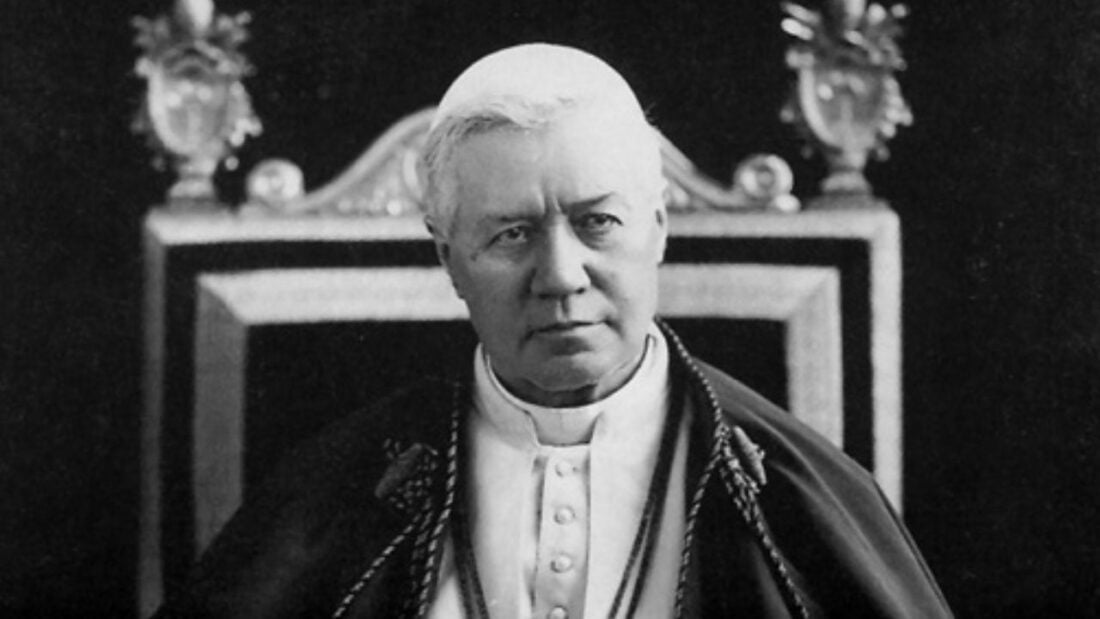
In January of 1908, St. Pope Pius X ordered Fr. Edward J. Hanna’s article titled “Absolution,” along with other works by Hanna, to be reviewed in Rome on suspicion of heresy.
Hanna had been proposed as a candidate for the Archbishop of San Francisco. While the curia ultimately declined to censure the article, St. Pius X did not seem satisfied. Hanna’s episcopal appointment was delayed several years.
That summer, Archbishop Farley visited Rome to meet with the pope. Historian Fr. Michael J. DeVito gives an amusing account of their encounter:
“Around August 7, 1908, Farley had an audience with Pius X. The audience seemed to have gone on interminably for those who were waiting for the next audience with the pope. At the end of his meeting, Farley was reported to have rushed out with a look of consternation, his zucchetto was askew, his ferraiulo twisted almost completely around, his hair tousled, his countenance flushed. When the members of the next audience met with the pope they reported that Pius X walked over to a chair on which was a beautifully bound volume of the Catholic Encyclopedia that Farley just presented. The Holy Father, they said seized the volume with both hands, flung it to the floor of his library saying what an evil thing the Encyclopedia was because it was vitiated by suspected articles.” 1
When asked afterward if his own seminarians should buy the complete set of the Encyclopedia’s volumes, Farley sheepishly commented that “it would be too much of a distraction.” 2 Perhaps he was embarrassed to promote the work to the degree he had before his encounter in Rome. In any case, such a dramatic response on the part of St. Pius X should urge great caution and scrutiny when citing the Encyclopedia.
- This anecdote comes from a letter by Rev. Thomas F. Coakley, who was then secretary to the rector of the North American College in Rome. See DeVito, The New York Review (1905-1908) (New York, 1977), p. 290. ↩︎
- Shelley, “John Cardinal Farley and Modernism in New York,” in Church History, Vol. 61, No. 3 (Sept. 1992), p. 360 ↩︎