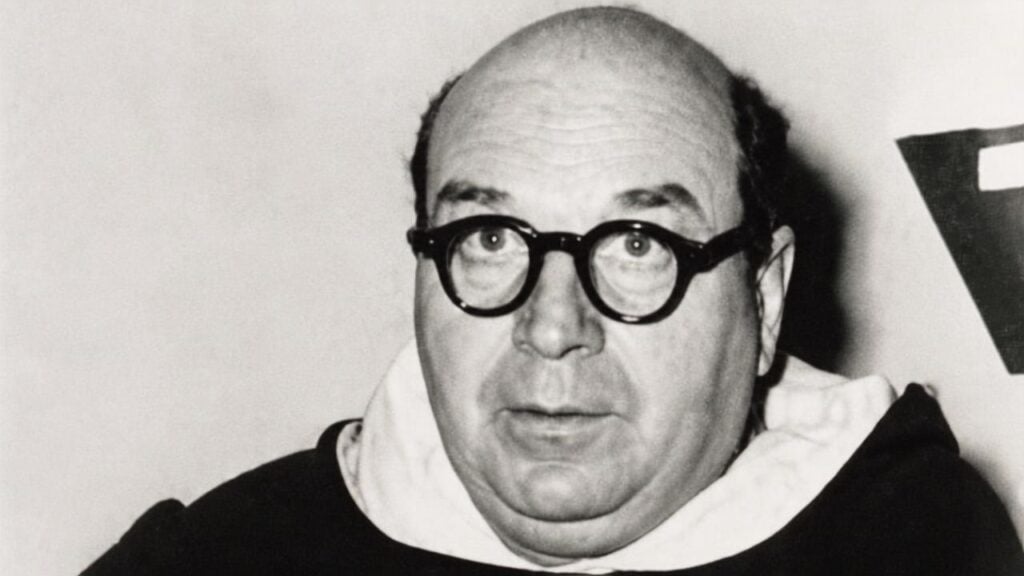
Editor’s Note: This essay is Part III of a new series critically reviewing the efforts of Father Félix Morlion (1904-1987). Part I discussed his involvement with the US Deep State; Part II discussed his efforts with ‘Pro Deo University;’ Part IV will speculate about his role with the assassination plot against John Paul II.
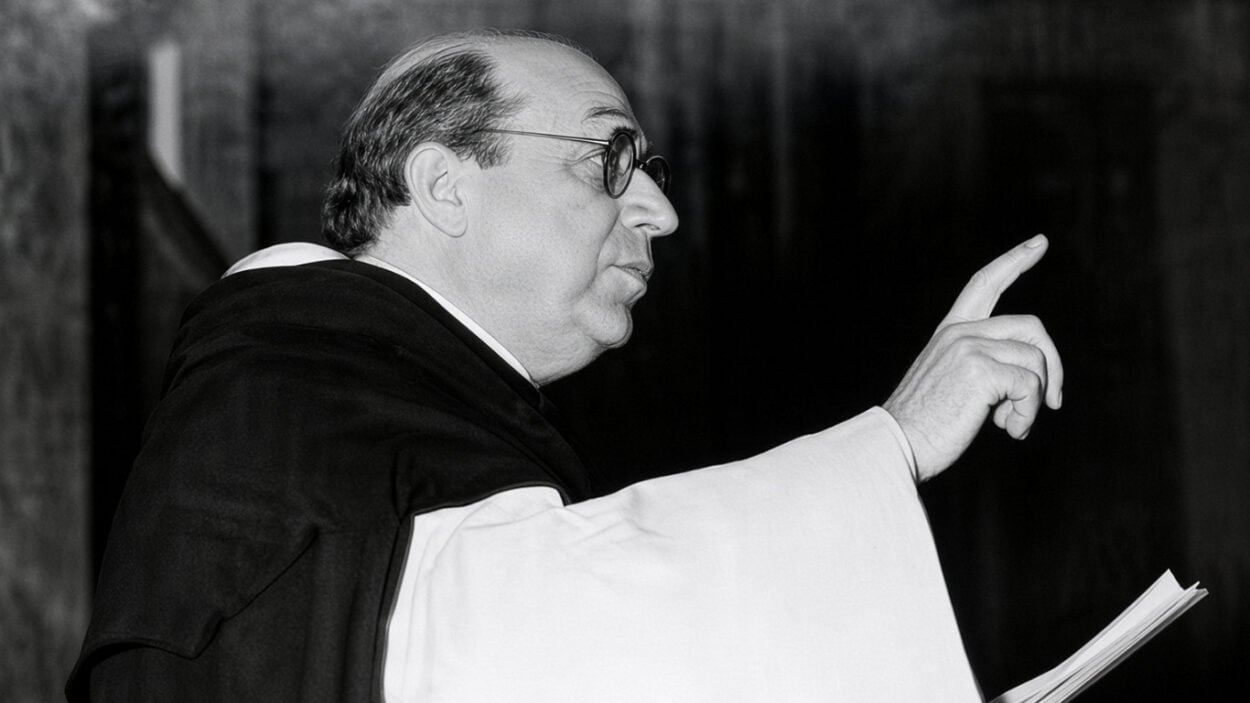
Father Félix Morlion helped lay the groundwork for the conciliar document Nostra Aetate (“Declaration on Non-Christian Religions”) while serving as president of Pro Deo University. Although Morlion played no direct role in the conciliar proceedings, he was instrumental in forging the personal relationships from which the declaration emerged. This was chiefly by facilitating cooperation between Augustin Cardinal Bea and Rabbi Abraham Joshua Heschel, the latter of whom was the principal Jewish activist in its drafting. Journalist Joseph Roddy exposed this all important Bea-Heschel connection in his 1966 LOOK Magazine exposé.
Nostra Aetate was one of the landmark progressive documents of the Second Vatican Council. By proposing that the Church, in its relations with Islam, Buddhism, Judaism, and Hinduism, “rejects nothing that is true and holy in these religions,” Nostra Aetate could be interpreted in such a way as to abrogate the Kingship of Christ. 1 Thus, it represented a far-reaching shift in Church teaching, one with momentous consequences for the Church’s mission to the world in the contemporary era.
In a 1964 letter to Henry Luce, Father Morlion outlined his basic ideological presuppositions. “If man’s dignity, and man himself, is to survive, the philosophy of Democracy under God must be applied to the newly liberated and newly independent countries.” 2
To achieve these goals, Morlion established the American Council for the International Promotion of Democracy or CIP, a non-governmental organization in the United States to link Pro Deo University to its American financial backers. 3 The steering committee for the CIP included a glittering array of high-profile American powerbrokers, including George Deluca, the Lieutenant Governor of New York; Frank Altschul, Secretary of the Council on Foreign Relations; Ellsworth Bunker, future Ambassador to South Vietnam; and Paul Felix Warburg, scion of the legendary Jewish banking family whose uncle was the first director of the Federal Reserve Bank. 4
As written about previously, the ideological aims of Pro Deo University made Morlion receptive to the cause of ecumenism and dialogue with the world’s false religions. A critical part of his program was involving Jewish and Protestant communities in the activities of his institute. He therefore sought to appoint at least five Americans to the 12-member Board of Trustees for Pro Deo University, including two American Catholics, two Protestants, and one Jewish member. In 1955, Morlion traveled to the United States, where he conferred with Rabbi Morris Kertzer, director of interreligious affairs for the American Jewish Committee (AJC), and Dr. David Danzig, the AJC’s Program Director, about which Jewish figure ought to serve on the Board of Trustees. In exchange for the appointment of a Jewish board member, Father Morlion asked for a donation of $50,000, a sum worth more than $600,000 today. 5 A 1957 memo from Morlion to the AJC outlining his overtures to the Jewish community provides a window into the real sources of funding for Pro Deo University. From 1953 through 1955, Morlion received some $94,250 from various Catholic sources, including Samuel Cardinal Stritch, Archbishop of Chicago; Edward Cardinal Mooney, Archbishop of Detroit; and Archbishop Richard Cushing of Boston. Meanwhile, Henry Luce had personally contributed $40,000. Combined with other sources, Protestants had donated a total of $109,500. 6
The Dispatch
The AJC eventually decided to hand over the money, initiating a close relationship with Morlion’s organization that precipitated Nostra Aetate. In Rome, Morlion proved an aggressive promoter of Jewish interests. In July 1957, for instance, as part of the quid-pro-quo for a donation to appoint a Jewish Board of Trustees member, Morlion arranged an audience between Dr. Irving Engel, President of the AJC, and Pope Pius XII. In the meeting, the pope read a brief statement condemning the “violation of fundamental rights inherent in the human person” which had been meted out to Jewish refugees after the Second World War. 7
The audience with Pius XII represented a major stride in the Jewish effort to persuade the Church to abrogate its call to explicit conversion and instead more or less recognize the legitimacy of post-Christian Judaism as a religion. The effort paid off with Nostra Aetate. When the AJC learned in 1961 that Pope John XXIII had tasked Cardinal Bea with coming up with a conciliar statement on the Jews, the AJC contacted Morlion to seek help in influencing Bea’s deliberations. In July 1961, Morlion arranged for a meeting between Zachariah Shuster, the director of the AJC’s Paris office; Dr. Ralph Friedman, director of the AJC’s foreign affairs department; and Bea. In the meeting, the aged cardinal made clear his eagerness to produce a mutually acceptable document on Jewish issues. The AJC then appointed Rabbi Abraham Heschel, who apparently first met Bea while the two were students in Berlin, 8 to serve as its negotiator with the churchman over the text of the document to became Nostra Aetate. 9
Heschel proved to be a highly adept negotiator for Jewish interests. In the torturous drafting process for Nostra Aetate, Heschel played a critical role in persuading Bea’s subcommittee on the Jewish declaration to adopt language maximally favorable to Jewish interests. In a memorandum entitled “On Improving Catholic-Jewish Relations,” submitted to Bea in May 1962, 10 Heschel articulated four demands for the Church: (1) a repudiation of the charge of “deicide,” with the specific inclusion of this word; (2) an acknowledgment of the legitimacy of Judaism; (3) mutual dialogue; and (4) the establishment of a Vatican commission to eliminate antisemitism in the Church. 11 Prior to the documents submission to Bea, Morlion helped vet the draft to ensure its acceptability, thereby playing a major role in permitting Heschel to influence the deliberations of the Second Vatican Council. 12 Some of Heschel’s demands were incorporated in the text of Nostra Aetate, although the explicit use of the word “deicide” was later removed by Paul VI himself amid a torrent of controversy in the last two Council sessions in 1964 and 1965.
Join the Counter-Revolution: Become a supporter of Integrity today!
Later, Father Morlion played a key role in orchestrating Bea’s secret March 1963 meeting in New York City with the “modern Sanhedrin” involving numerous figures in American rabbinical Judaism, including Rabbi Louis Finkelstein of the Jewish Theological Seminary; Rabbi Emmanuel Rackman, former president of the Orthodox Rabbinical Council of America; and Rabbi Albert Minda of Reform Judaism’s Central Conference of American Rabbis. At the meeting, Bea promised that the Church would adopt a declaration substantially conforming to all of Heschel’s demands for the declaration. 13 Eventually, Bea, Morlion, and Heschel decamped to a conference in honor of Bea held in New York City attended by numerous powerful dignitaries, including Cardinal Spellman; Cardinal Cushing; Greek Orthodox Archbishop Iakovos; Nelson Rockefeller, the Protestant Governor of New York; and U. Thant, the Buddhist Secretary General of the United Nations.
The successful adoption of Nostra Aetate at the Second Vatican Council occurred in no small part due to Father Félix Morlion’s extensive contacts in both Rome and the United States, thereby making him one of the silent agents of the revolution in the Church that has consumed it since the end of the council in 1965.
- Paul VI, Nostra Aetate (‘In Our Time,’ or ‘Declaration on the Relation of the Church to Non-Christian Religions’), (October 29th, 1965), 2, official Vatican translation. ↩︎
- Father Félix Morlion letter to Henry Luce, ‘The American Stake in the Accreditation of the Italian Government of the International University of Social Studies “Pro Deo” Rome,’ (February 8th, 1964), Box 52, Folder 7, quoted in chapter 39, David A. Wemhoff, John Courtney Murray, Time/Life, and the American Proposition: How the CIA’s Doctrinal Warfare Program Changed the Catholic Church (South Bend: Wagon Wheel Press, 2022). ↩︎
- Valerie Aubourg, ‘“A Philosophy of Democracy under God,”: C.D. Jackson, Henry Luce et le movement Pro Deo (1941-1964), Revue française d’études américaines,’ Number 107 (March 2006), pp. 34-5. ↩︎
- Ibid., pp. 35-6. ↩︎
- Father Félix Morlion, ‘Financial Conditions Regarding the Nomination of a Jewish Member to the Board of Trustees of the International University of Social Studies “Pro Deo” in Rome,’ (July 13th, 1957), AJC Archives, Record 1505, in the ‘Timeline’ Collection, ‘Interreligious’ Category, Subcategory ‘Catholic-Jewish Relations,’ Group ‘AJC and Pro Deo, 1957-1962). Link: https://ajcarchives.org/Portal/Default/en-US/RecordView/Index/1505. ↩︎
- Ibid. ↩︎
- Pope Pius XII, statement reprinted in ‘Memorandum to AJC Chapter Instructing Them How to Communicate the Significance of AJC’s Audience with Pope Pius XII to the Public,’ AJC Archives, Record 1498, in the ‘Timeline’ Collection, ‘Interreligious’ Category, Subcategory ‘Catholic-Jewish Relations,’ Group ‘Audience with Pope Pius XII, 1957’. Link: https://ajcarchives.org/Portal/Default/en-US/RecordView/Index/1498. ↩︎
- This statement repeatedly reappears in the record of Nostra Aetate but appears to be based on verbal conversations from either Heschel or Bea or both to different sources. ↩︎
- Edward Kaplan, Spiritual Radical: Abraham Joshua Heschel in America, 1940-1972 (New Haven: Yale University Press, 2007), 235, 239-341. ↩︎
- Ibid., p. 243. ↩︎
- Rabbi Abraham Joshua Heschel, ‘On Improving Catholic-Jewish Relations,’ (May 22nd, 1962), American Jewish Committee Archives, Call Number 1527. ↩︎
- Edward Kaplan, Spiritual Radical: Abraham Joshua Heschel in America, 1940-1972 (New Haven: Yale University Press, 2007), p. 243. ↩︎
- This eventful and significant meeting is described in numerous sources, including Rabbi Marc H. Tanenbaum, ‘Heschel and Vatican II: Jewish-Christian relations,’ paper presented at the Memorial Symposium in Honor of Rabbi Abraham Joshua Heschel (February 21st, 1983), 11; Joseph Roddy’s famous Look article ‘How the Jews Changed Catholic Thinking’ (January 1966), 19-213; and Cardinal Bea’s authorized biography by his secretary Father Stjepan Schmidt, Augustin Bea: The Cardinal of Unity, trans. Leslie Wearner (New York: New City Press, 1992), pp. 425-8. ↩︎