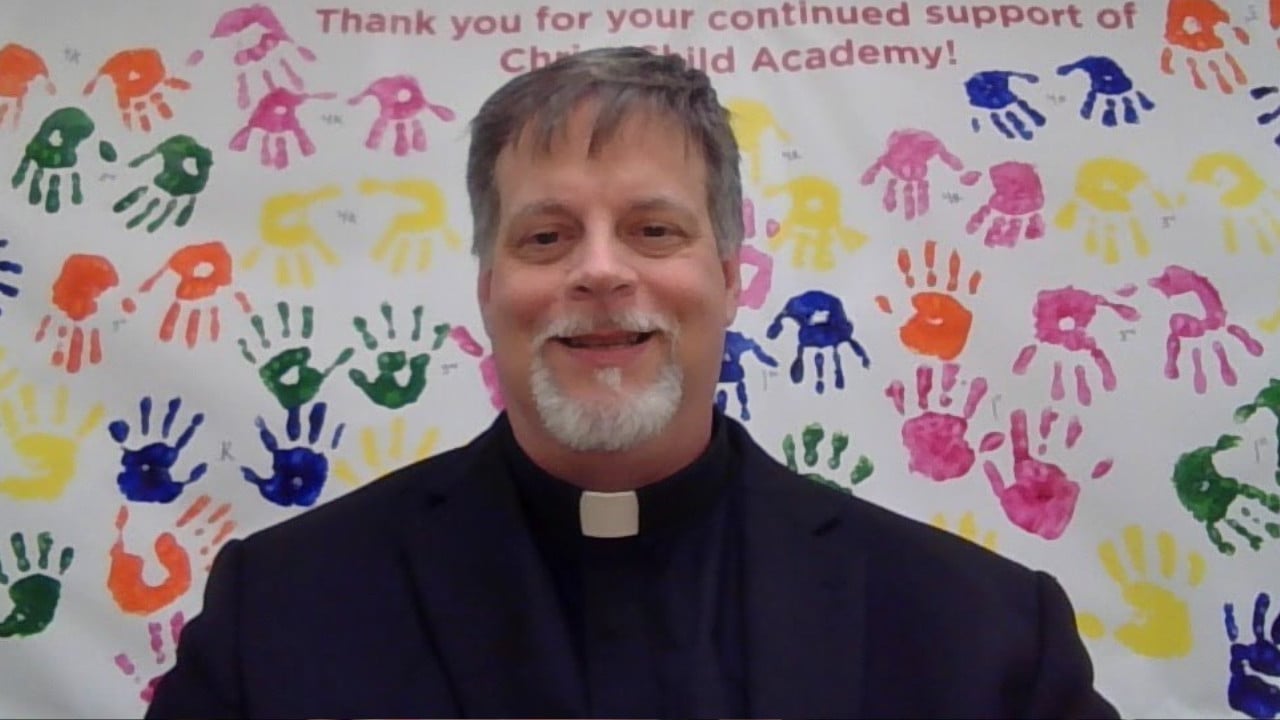
A recent bulletin letter written by Fr. Paul Fliss, pastor of Sheboygan South Catholic Parishes in Sheboygan, Wisconsin, was criticized by Traditional Catholics this week on social media. But a closer examination reveals he was merely echoing the synodal party line.
The parishes Fliss oversees includes one operated by the Institute of Christ the King Sovereign Priest (ICKSP), which has permission to say the liturgy in the Latin Rite.
Fliss was criticized for his seemingly ignorant and naïve claim that the principal distinction between the Traditional Latin Mass and the Novus Ordo is merely one of language. This is wrong, of course, but as we will see, Fliss was merely echoing what his inept superiors have said previously.
‘A step backward’
Fliss audaciously expresses hope that “the grace of God will help” Catholics who are “attached” to the Traditional Mass so they will eventually “move past dependence on the old Latin Mass and come into communion with the rest of the Church in celebrating the Mass in the vernacular.”
Fliss then described the approved (ICKSP) Latin Mass as a mere “accommodation” and asked: “Why would someone want to take a step backward in their faith and spiritual life?”
Fliss completely misses the point, as language has never been the primary issue surrounding the TLM, but rather the doctrinal truths the Latin Mass represents and expresses.
Martin Luther, who has been praised by several Synodal prelates, including the late Jorge Bergoglio, also advocated for the use of vernacular liturgy. His demands were more or less adopted at Vatican II thanks to the influence of Protestants.
Sacrosanctum Concilium “brought the worship of the Roman Catholic Church so much closer to what we are accustomed to,” Anglican Bishop John Moorman confessed in his memoirs on the Council.
As has been pointed out repeatedly at Integrity and elsewhere, if the only real difference between the two forms of liturgy was Latin versus English, then celebrating the Novus Ordo in Latin would have satisfied Traditional Catholics. Of course, the issue is much deeper.
The Novus Ordo but in Latin
Although Fliss’ bulletin was evidence of the persistent misunderstanding — or perhaps willful ignorance — of the traditional position, it is important to note that this is not unique to him.
Last year, Leo XIV shared a similar sentiment when he said in an interview with Crux shortly after his papal election, “Well, you can say Mass in Latin right now. If it’s the Vatican II rite there’s no problem.” He then went on to say that if the reformed liturgy were celebrated properly, one should ask whether there is really “that much difference” between the two liturgical experiences.
As shocking as this reductionist view of worship might sound, it shows that Fr. Fliss does not hold some fringe view, but rather one in line with the orthodox synodal understanding.
Read more: ‘It’s a trap!’ How the Latin Mass will be used to domesticate Trads in the Synodal Church
Cardinal Pietro Parolin, one of the highest-ranking Vatican officials after the Pope, has made similar comments as well.
In a message to French bishops, he encouraged them to find pastoral solutions that would “generously include those sincerely attached to the Vetus Ordo,” but explicitly added that this should be done “in harmony with the directives of the Second Vatican Council regarding the Liturgy.”
This was an extremely troubling admission as it clearly shows that Rome’s goal is not the permanent coexistence of the two liturgical traditions, but an intention to phase out the TLM and integrate those who attend it into the post-conciliar liturgical re-education program.
The Dispatch
Contradicting Vatican I
One of Fliss’s statements that caused Traditional Catholics to react strongly was his claim that the Traditional Latin Mass is permitted for those “who have not grown deep enough in faith to accept the Mass approved after the Second Vatican Council.”
This assumption clashes directly with preconciliar magisterial teaching. In Mirari Vos (1832), Pope Gregory XVI rejected the notion that the Church could have been fundamentally deficient or in need of a “restoration and regeneration” as though it had previously failed in her divine mission.
The First Vatican Council also taught explicitly that the “doctrine of faith which God has revealed has not been proposed, like a philosophical invention, to be perfected by human ingenuity, but has been entrusted as a divine deposit to the Spouse of Christ to be faithfully guarded and infallibly declared.”
Active participation ‘before all else’
Ironically, Fliss’ bulletin is valuable because it accurately expresses what the Second Vatican Council intended.
Although many conservative defenders of Vatican II, such as Peter Kwasniewski, argue that the Council never envisioned the marginalization of the Traditional Latin Mass, Sacrosanctum Concilium repeatedly identified one overriding objective: the active participation of the faithful.
“Mother Church earnestly desires that all the faithful should be led to that fully conscious and active participation in liturgical celebrations,” it says. “In the restoration and promotion of the sacred liturgy, this full and active participation by all the people is the aim to be considered before all else,” it also reads in paragraph 14 (emphasis added).
Fr. Fliss’s reasoning therefore faithfully follows this principle of the postconciliar church’s first and only council.
In his bulletin message, Fliss also explained that Vatican II sought “participation that leads to becoming a more vibrant Church” and that the faithful should move beyond attending a Mass “where the priest says his prayers.”
Join the Counter-Revolution: Donate today!
Conciliar Trads and conservative apologists should therefore not criticize Fr. Fliss as he is merely carrying out what the Council instructed and doing what Leo, Parolin, and other high-ranking clergy are advising.
A gradual phasing out of the TLM
This brings us to the part of Fliss’ bulletin that should be of greatest concern to those who have not yet fully left former Ecclesia Dei and/or Indult Latin Mass communities.
Fr. Fliss outright tell his readers that the Traditional Latin Mass community under his care (presumably the ICKSP) “should not invite other Catholics to join their group” and that attendance at the old liturgy should only be tolerated once “as an educational experience.”
In stating this, Fliss gives away the goal of the Synodal hierarchy: to usher Catholics away from the Latin Rite and to integrate them back into the “ordinary” form.
This process is perfectly aligned with Traditionis Custodes, of which the accompanying letter explained that the reformed liturgical books are intended to become the unique expression of the Roman Rite.
Fliss’ bulletin letter gives every indication that the Latin Mass is viewed as a temporary pastoral concession for those who are yet to be integrated into the Novus Ordo liturgical reforms. If anything, he deserves a pat on the back for stating openly what many of the wicked postconciliar church’s documents imply surreptitiously: that the goal is to get rid of the TLM, and, in the process, of whatever is left of the Catholic faith.