If you recite the nursery rhyme Humpty Dumpty in Latin, it is still the nursery rhyme Humpty Dumpty.
The same goes for saying the neo-Protestant meal “liturgy” and its Jewish prayers in Latin: it simply remains the Novus Ordo Missae.
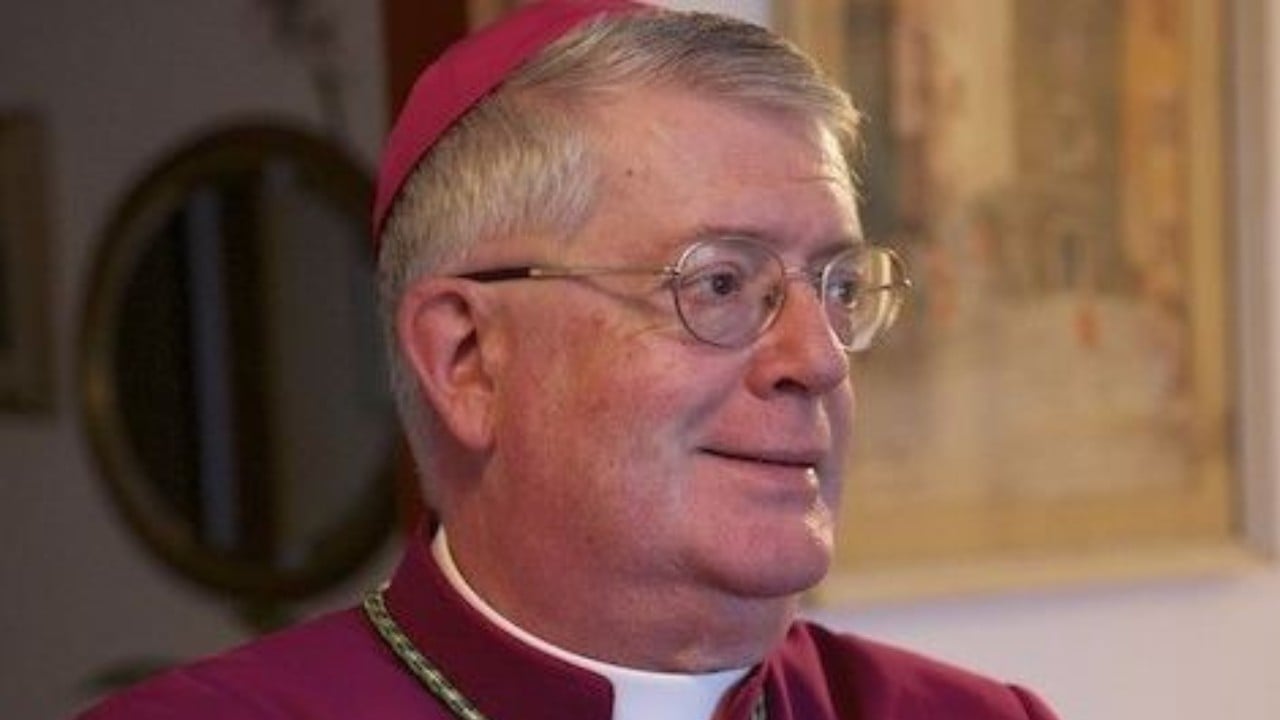
The mythical and completely asinine proposal of a Novus Ordo Mass offered in Latin was once again raised in comments made by Archbishop Guido Pozzo, the former secretary of the now defunct Ecclesia Dei organization (2009-2019).
Pozzo’s “solution” was put forth during an interview with AdVaticanum. His remarks highlight the immense chasm that exists between the Vatican’s sly approach to liturgical reconciliation and the real concerns of devout Catholics.
In the interview, Pozzo defends the desirability of having at least one Sunday Mass said in Latin according to the Novus Ordo rubrics in every diocese, accompanied by Gregorian chant. He also argues that the Novus Ordo and the traditional Roman Rite should not be regarded as incompatible or opposite expressions of Catholic worship.
While acknowledging that the “older liturgy” [sic] can help recover aspects of Catholic doctrine and spirituality that have often been obscured in post-conciliar practice, he nevertheless maintains that the principal challenge is not the distinction between the “old” and new rites but the quality with which the liturgy is celebrated.
As keen observers must notice by now, these arguments fail to address the many foundational problems at the heart of the matter.
Number one, the issue has never been simply one of language, aesthetics, or liturgical style. Rather, it is over the preservation and transmission of the Catholic faith itself through the Church’s ancient liturgical tradition.
Pozzo’s proposal for a Latin Novus Ordo Mass in every diocese appears to rest on, at least in part, the claim that traditional Catholics are merely “attached” to the older “forms” of worship, which is what John Paul II said in his Ecclesia Dei motu proprio.
If Latin alone were the issue, then a reverently celebrated Novus Ordo in that language would have satisfied traditionalists decades ago. The fact that it has not should indicate that something much deeper is at stake.
The traditional Mass is cherished and fought for because it is the liturgical embodiment of the Catholic faith as it was handed down through centuries of organic development and sanctified by countless saints. Its prayers, ceremonies, gestures, and silences express a distinctly Catholic understanding of sacrifice, sin, grace, redemption, and the transcendence of God. It does not just reflect doctrine but actively forms and transmits it. Consequently, “attachment” is the wrong word. Catholics adhere to the traditional Roman Rite because it is a complete and coherent expression of the true faith.
For this reason, the suggestion that a Novus Ordo celebrated in Latin could adequately answer traditionalist concerns misses the central point, and should be rejected by Catholics as this places them in a side chapel in the Conciliar Cathedral, where they are allowed to exist merely on the goodwill of the synodal revolutionaries.
The Dispatch
Reverence isn’t the main issue
Pozzo argues that when the Novus Ordo is celebrated faithfully, reverently, and according to the rubrics, the distance between it and the traditional Mass is considerably reduced. While many would agree that a reverent celebration is preferable to an irreverent one, they would nevertheless reject the conclusion that reverence resolves the fundamental difficulties posed by the post-conciliar reforms.
The problems with the Novus Ordo are not limited to abuses, improvisations, folk music, or liturgical creativity. Such practices only worsen a much graver issue, but they are not its source. The deficiencies are built into the structure of the reformed liturgy itself. The replacement of the traditional Offertory, the introduction of new Eucharistic Prayers, the simplification or removal of numerous ancient elements, and a general shift in emphasis that places greater stress upon the communal aspect than upon the propitiatory sacrifice offered by the priest on behalf of the faithful, are some of these deficiencies.
A Novus Ordo celebrated in Latin remains the Novus Ordo. Gregorian chant cannot restore prayers that were removed, ad orientem worship cannot recover ceremonies that were suppressed, and greater solemnity cannot alter texts that have been substantially revised. The issue is theological first and aesthetic second.
You cannot reconcile the irreconcilable
Archbishop Pozzo insists that the traditional and reformed liturgies should be understood within a hermeneutic of continuity rather than rupture. This is more of the unconvincing post-conciliar nonsense. Continuity cannot simply be asserted; it must be demonstrated.
The unprecedented nature of the post-conciliar liturgical reform, which involved the extensive revision of prayers, ceremonies, calendars, and rubrics, constituted a genuine break in practice, regardless of how the reform is interpreted theoretically.
Interestingly, Pozzo himself acknowledges that the traditional liturgy more clearly manifests certain realities that have often been obscured in contemporary Catholic life, including the sacrificial nature of the Mass, the transcendent dimension of worship, and the unique role of the ministerial priesthood.
While he attributes these deficiencies primarily to poor implementation rather than to the reformed liturgy itself, it is dishonest to not admit that persistent imbalances are evidence that the reform contributed to the very problems it was supposed to solve.
The “indult” in an insult
Pozzo’s proposal is his suggestion that every diocese should provide at least one regular Latin Novus Ordo Mass, is an insult. Even if one were to replace his proposal with a weekly celebration of the actualTraditional Latin Mass, it would still be wholly inadequate.
The traditional liturgy is not a special interest, a cultural preference, or an occasional devotional option. It is plain and simply the ordinary expression of Catholic worship. Restricting access to a single parish or a single Mass enforces the idea that the Latin Mass and its adherents are an exotic oddity.
Traditional Catholic life requires more than a Sunday Mass. It requires access to the sacraments, catechesis, parish life, schools, religious formation, and the full liturgical cycle rooted in the traditional rites of the Church. In other words, it demands a Catholic Church. Not a fake church in which one must beg and plead to be Catholic.