A controversy surrounding a historic statue of Our Lord overlooking the town of Felanitx on the Spanish island of Mallorca has once again highlighted the Left’s hostility towards Catholicism, tradition, and religion.
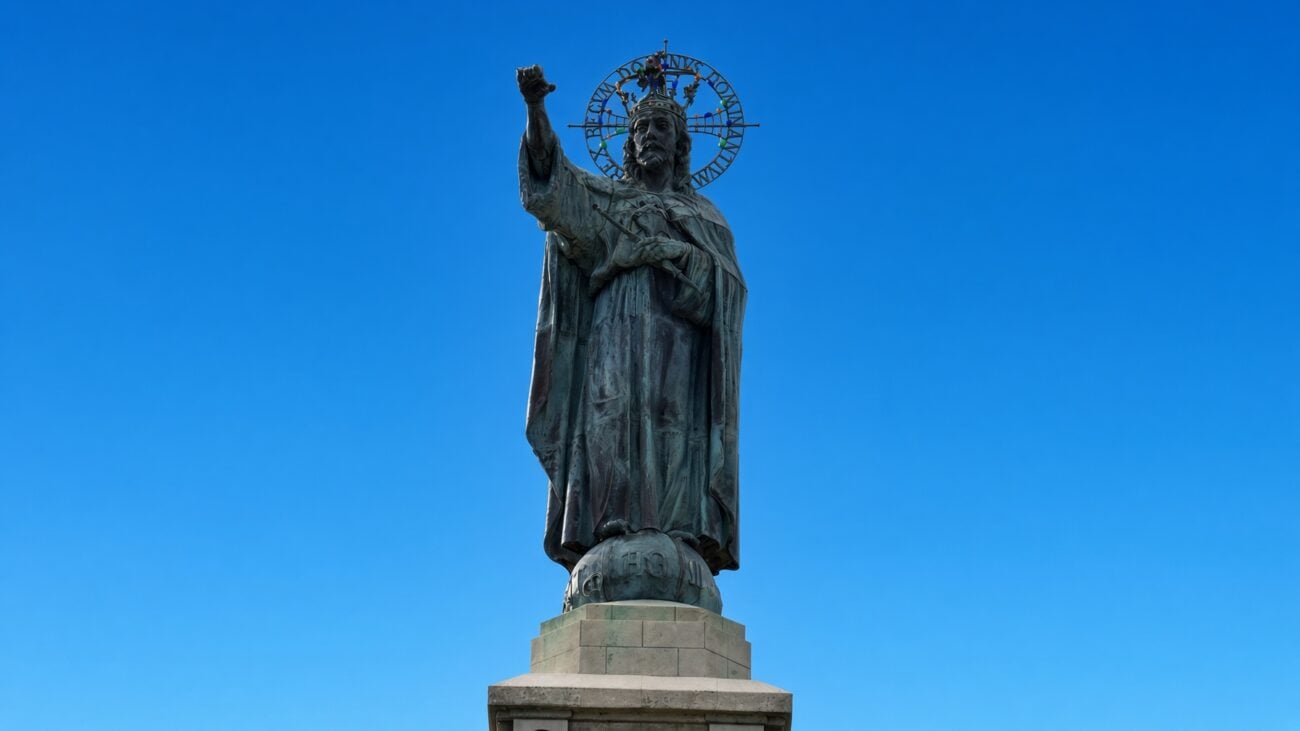
From its commanding position on the Puig de Sant Salvador, the monument shows Christ extending his right arm over the surrounding countryside. This depiction is what Mallorcan researcher Bartomeu Mestre, a socialist, finds objectionable.
While generations of Catholics have interpreted the gesture as Christ blessing the faithful below, Mestre claims that Our Lord’s outstretched arm resembles a fascist salute, akin to the Roman salute widely adopted by illiberal European movements during the 1930s and 1940s.
The statue, which is located near the historic Sanctuary of Sant Salvador, was inaugurated and blessed on July 1, 1934 during the Spanish Second Republic. Its origins stretch back to 1928, however, when Canon Mateu Alzamora promoted the construction of a monument dedicated to Our Lord. The original design, prepared by Mateu Oliver i Capó, depicted the Sacred Heart of Jesus with both arms extended.
Allegations of Falangist symbolism
As reported in the Catalonian outlet dBalears, Mestre argues that the original representation of the Sacred Heart was replaced by a more imposing figure whose extended right arm symbolizes the Spanish Falange and alleges that individuals involved in redesigning the monument had connections to the movement.
According to Mestre’s research, Catholic priest Antoni J. Móra Alcover commissioned sculptor Tomàs Vila, who subsequently entrusted the work to fellow sculptor Francesc Salvà i Pizà. Mestre identifies both as Falangists and claims there was significant overlap between members of a local Catholic organization and the political movement.
Integrity has already raised 33% of its Fall fundraising goal: Click here to keep us going!
On October 2, Mestre, supported by 33 citizens and the historical association Memòria de Mallorca, submitted a petition to Spain’s Ministry of Territorial Policy and Democratic Memory requesting an examination of whether the statue should be included in the national catalogue of symbols considered contrary to democratic values.
Notably, Memòria de Mallorca, a crypto-Marxist organization masquerading as a defender of human rights, focuses its energies on documenting alleged atrocities committed under Franco’s reign and eradicating Spain’s glorious traditionalist and nationalist heritage.
On October 9, the ministry accepted the application for consideration. Possible measures that can now be taken include historical contextualization, alteration, or even removal, depending on the authorities’ findings.
The Dispatch
Although Mestre has stated that he does not necessarily wish to erase the monument’s history, but rather to have its origins “investigated and explained,” the petition explicitly raises demolition as a desired outcome.
Regional officials defend the statue
The controversy has provoked strong opposition from local authorities, who fall on the center-right of the political spectrum. Felanitx mayor Catalina Soler has defended the monument’s religious and historical significance, insisting that the raised arm represents Christ blessing the town. The Balearic regional government has likewise expressed its determination to defend the statue through all available lawful means.
Supporters point out that the monument was inaugurated in 1934, two years before the outbreak of the Spanish Civil War, and that it was not included in the Balearic government’s 2019 inventory of Francoist symbols. The Catholic organization Hazte Oír has called for the monument to receive formal cultural-heritage protection.
Vox parliamentarian Sergio Rodríguez has also challenged the campaign against the statue during a debate in the Balearic Parliament, describing the petition as “biased and sectarian.” Rodríguez perhaps came closest to identifying what critics believe to be the complainants’ true motives when he asked, “What exactly bothers them? Is it Christ Himself? It is absolutely ridiculous.”
Who were the Falangists?
The Falangists were members of the Falange Española, a Spanish nationalist political movement founded in 1933 by José Antonio Primo de Rivera. Its ideology, known as Falangism, combined authoritarian nationalism, national syndicalism, opposition to Marxism and liberal parliamentary democracy, and strong elements of Spanish Catholic identity.
Falangists advocated a unified Spain and a corporatist economic order intended to overcome class conflict while drawing inspiration from Italian Fascism. In February 1934, the Falange merged with the Juntas de Ofensiva Nacional-Sindicalista, forming the Falange Española de las JONS.
Following the outbreak of the Spanish Civil War in 1936, Falangists supported the Nationalist cause, and in 1937 General Francisco Franco incorporated the movement into a broader state political organization.
The Social Reign of Christ the King transcends ideology
The statue’s representation of Christ with His arm outstretched expresses a theological truth that stands independently of the political convictions of those who commissioned or constructed the monument: that all authority must subject itself to His Kingship.
The Falangists, and their modern-day political heirs, had noble aspirations for Spain that were strongly rooted in the Catholic faith. It is clear that this issue has nothing to do with setting straight the “historical memory,” but everything to do with the Left’s fear of the return of Christ’s reign over society.
What Spain, Europe, and the world need right now is Catholics who recognize Christ as King and are inspired to rid the globe of the twin viruses of Liberalism and Marxism.