
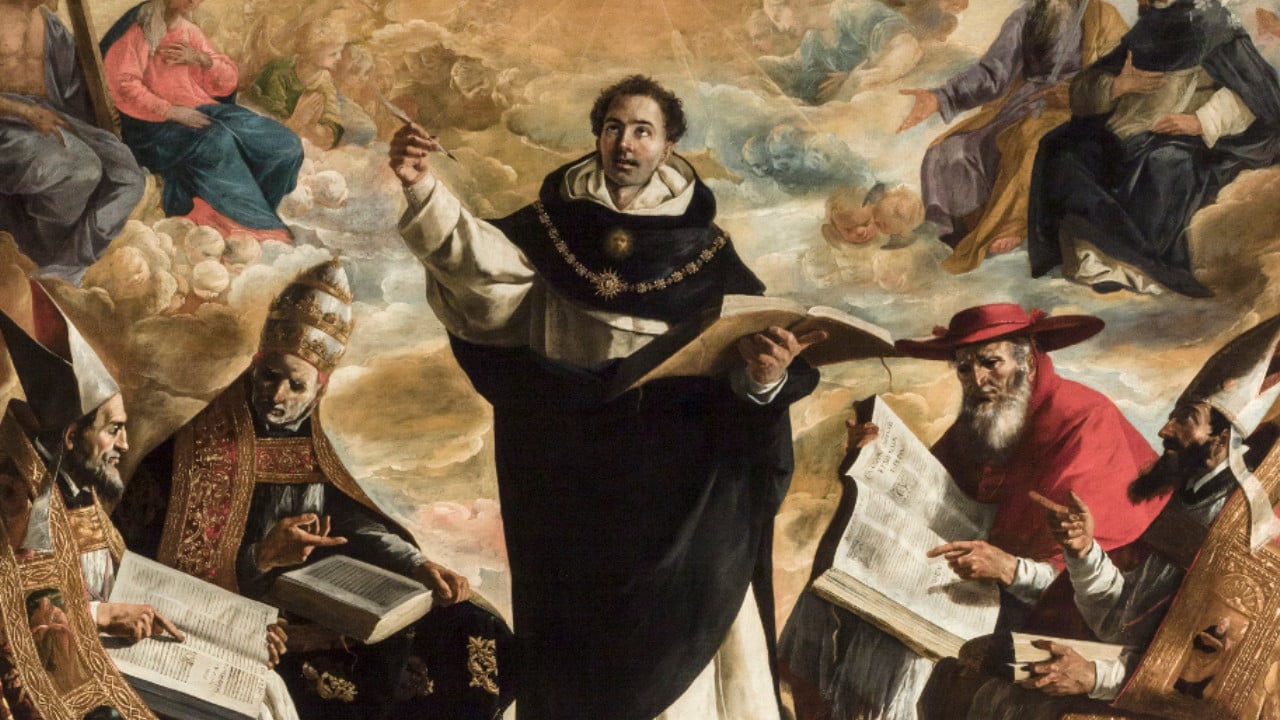
What is perhaps most astonishing concerning St. Thomas Aquinas’ treatment of the Natural Law in the section of the Prima Secundae of his Summa Theologiae entitled De Legibus (On Law), is the fact that St. Thomas understands the precepts of the Natural Law to be immediately evident to any rational mind which possesses the normal faculties of man. 1
This system of law, “written into the hearts of men” as St. Paul would have it, is both universal and immediately evident. This law is universally acceptable to all men due to the fact that they all share in the exact same nature which provides them with certain capabilities and inclines them towards certain ends or goals.
According to St. Thomas, any rational agent can recognize the law “written in his heart,” as soon as he understands himself to be oriented to certain goods which are fitting objects of pursuit by a rational being. Man recognizes in these experiences of “goal orientedness,” that there are laws inherent in his nature which cannot be overlooked if he is to realize a successful human life.
Law and human desire
To understand what St. Thomas means when he speaks about the Natural Law, we must remember that St. Thomas does not have the same view of law that has shaped our collective consciousness since the Enlightenment. For the most notorious philosopher of the 18th century “Enlightenment,” Immanuel Kant, law was something imposed on the human agent from the “outside” in order to regulate conduct which has its origin on the “inside,” in the human agent himself.
Even though we may explicitly reject Kant’s claim that the only moral law which is valid is one that is “imposed” on the self, by the self, we implicitly accept Kant’s description of law as a restriction of activity imposed from without. We do this when we think of the moral law as being imposed, as from the outside, by God Himself. In this case, God, in imposing the moral law on man, would be acting to impede the interior movements towards fulfillment which are the substance of man’s life. Such a view is completely contrary to the traditional Catholic understanding of the moral law as this is formulated by St. Thomas.
In this regard, even though the Natural Law is rooted in the Eternal Ideas of God through which he providentially provides for the well-being of all of His creatures, it is still the law of our nature. Here, we must also remember that our nature, although fixed as regards our type or essence (i.e., we are humans), is dynamic in its particular concrete realization in every individual human being. We don’t grasp the Natural Law by reflecting upon a mere abstract concept, but rather, by reflecting upon our own experienced desires and inclinations. For St. Thomas, and for the great Catholic moral tradition, human inclinations are a law revealing the inner reason and purpose of man’s nature as that nature has been eternally understood by the Divine Intellect.
Read more: Joseph de Maistre: Catholic statesman, writer, opponent of the Enlightenment
It is for this reason that the Primary Precepts of the Natural Law directly relate to the inclinations of the human soul. Rather than saying “don’t do” such and such, the first precepts indicate to the human mind of the individual that it ought to do such and such. The primary precepts, emerging from the primary inclinations of human nature, are precepts and laws that are specifications of the general command of the First Principle of Practical Reason which demands that we “pursue the good and avoid and repudiate evil.”
The requirement that we strive to fulfill an inclination is a requirement that we fulfill an inclination in such a way that the act will be designated as morally good. To be morally good, an act must be in accord with right reason. An act is in accord with right reason insofar as it is in accord with the final and ultimate end of human life. Therefore, the First Precepts of the Natural Law demand that we pursue properly human goods in accordance with proper human ends. These “ends” or “goals” — plural — must be in accord with man’s proper ultimate end. This end is the obligatory goal of all human beings. To pursue another end is to either fail to recognize the very reason for acting, or worse, intentionally misdirect desire and action.
The primary precepts of the Natural Law: The basic desires of human nature
One of the reasons why St. Thomas is so cryptic when it comes to describing exactly those inclinations which he takes to be the primary motivating drives of all men, and the first laws of human nature, is because of his insistence that they are self-evident to all men who are reflective enough to consider the direction of their own desires.
If reflected upon, who would not know that sexual relations are not really a matter of casual contact and, instead, are immediately related to a long-term relationship and procreation? Who would deny that the purpose of the human mind is to understand reality and express that understanding in speech? Would anyone think that human life, unlike all other forms of natural life, can be taken away from an individual without sufficient moral justification and not merely because of a choice based upon personal desire or circumstance? Who would deny that men must live within a society governed by rules which require the subordination of passion to the dictates of reason. 2 Hence the primary precepts: “Know God,” “Procreate Your Own Kind,” “Preserve your Own Life,” “Live at Peace with those Around You,” and “Understand the World in which You Exist.”
The secondary precepts: When human nature meets human affairs
If the Primary Precepts of the Natural Law are to ordain the proper path of concrete human action, they must become real “laws” by commanding us to do or not to do something specific. What should we do or not do in a very specific area of human action? As examples, “Know God” has, as a derivative precept, “Worship God in the way that He has revealed as fitting”; “Procreate your own kind” becomes “Do not commit adultery”; or “Harm no man” becomes “Do not murder.” These laws or basic understandings are written into our nature as being seen as “fitting” ways of behavior to achieve the good and prosperous human life.
The Dispatch
If these “secondary precepts” of the Natural Law are “written into the human heart,” why did many pagan or even our own neopagan societies “forget” this Natural Law and act in a debased way? In this regard, St. Thomas Aquinas states that “evil persuasions,” “vicious customs,” and “corrupt habits” accumulating over centuries might hinder Man’s understanding of the Natural Law and what it dictates.
Enjoying this article? Become a monthly supporter today!
As an illustration of this, we might mention St. Thomas’s example, taken from Julius Caesar’s The Gallic Wars, in which he cites the ancient Germans as a tribe which did not recognize the Secondary Precept of the Natural Law against stealing. What St. Thomas fails to tell us is that Caesar does not say that the Germans did not see the wrongness of theft. Rather, he observed that the Germans saw nothing wrong with taking the property of non-Germans. Apparently, they encouraged theft beyond their own borders for the purpose of exerendae juventutis (i.e., exercising the youth) and minuendae desidiae (i.e., minimizing sloth)! 3
The Divine Law: What God gave when man lost the plot of human existence
If the moral law is so “self-evident” because it is written into all of our inclinations and moral sensibilities by the Creator, why do we need the 10 Commandments, or what St. Thomas calls the Divine Law? According to St. Thomas, there is no difference between what the Natural Law commands and what the Divine Law commands.
The Divine Law is simply a re-promulgation of the Natural Law because the Law had become blurred in the understanding of Man through Original and Personal Sin. This is what the 10 Commandments are. The Commandments are part of the Divine Law, which was promulgated by God to provide for a sure and certain road map to both Man’s imperfect natural ends and his perfect supernatural end.
These Commandments presuppose the inclinations which the primary precepts of the Natural Law express. How these inclinations are to achieve the goal given to them by nature is precisely what the Commandments legislate. Moreover, what is also presupposed is the connatural recognition that the 10 Commandments are good on account of the fact that they are in full accord with the primary inclinations of Man. We can understand, then, how a primitive or non-Christian culture could eagerly accept the 10 Commandments as a clarification and specification of a way of being and acting that they already, in a basic way, understand to be good. Those who clearly understand marriage to be a good, will not be totally disoriented when they are told that part of the dignity is the aspect of indissolubility. 4
The question to be asked is this: Is it easier to convey the Natural Law and the Divine Law to pagans than it is to convey them to contemporary liberals?
Connaturality: Law and feeling
According to St. Thomas, there is a pneumatic symbiosis [i.e., a conscious harmony of the different powers of the human soul] between thought, feeling, and inclination. This symbiosis is the Natural Law, insofar as this is Man’s participation in the God’s Eternal Law. 5
The Eternal Law is God’s own providential understanding of the way in which He has ordered all things to their natural ends. This understanding, which is Law in its fullest sense, is “imprinted” on creatures, particularly rational creatures, when they are created with a specific nature. 6 Just as the beings which God understands and wills to create are not static but constantly advancing towards a state of greater actuality, the law which God imprints on nature is a law of desire meant to impel men towards the proper ends of human nature. 7
This Thomistic view of the Natural Law belies the typical caricatures of this doctrine. The ideas that law is imposed upon man as contrary to and unsympathetic with his nature, his natural tendencies, or his own desires, is merely a caricature propagated by the two odd fellows who are actually 18th century soulmates, Jean-Jacques Rousseau and Immanuel Kant. In trying to intellectually justify their romantic and sentimental attachment to the idea of the fully autonomous man, they reject objective law as a form of “heteronomy.” Heteronomy is the imposition of law from without. By denying this, Rousseau and Kant affirmed as legitimate only those laws which one “imposed” upon oneself, whether individually or in a democratic collectivity.
To say that not only is the Natural Law not opposed to natural inclination, but is actually natural inclination, is to challenge the fundamentals of Liberalism’s understanding of law and morality. It is, moreover, to broach issues and intellectual vistas within our own Catholic Thomistic heritage which have become obscure and inaccessible.
The reason the Thomistic understanding of law and, consequently, the entire Catholic understanding of man has become obscured is because we implicitly, if not explicitly, accept Liberalism’s characterization of objective moral norms and laws as something burdensome as a hindrance to our desires. We simply believe that our desires ought to be burdened and hindered, whereas liberals desire to entangle us in a web of positive law, the sole purpose of which is to allow us to satisfy every whim without interfering in anyone else’s satisfaction of their every whim. According to both views, law and desire are opposed. To say that desire is law is to say something which neither we nor they seem capable of understanding.
- St. Thomas Aquinas, Summa Theologiae, I-II, Q. 94, Art. 2. Also, Summa Contral Gentiles, III, 129. ↩︎
- St. Thomas Aquinas, Summa Contra Gentiles, III, 129. Also, ST I-II, Q. 94, Art. 2. ↩︎
- ST, I-II, Q. 94, Art. 4. Cf. Julius Caesar, Gallico Bello, VI, 23. ↩︎
- ST, I-II, Q. 91, Art. 4. ↩︎
- ST, I-II, Q. 91, Art. 2. ↩︎
- Ibid. ↩︎
- ST, I-II, Q. 91, Art. 2, ad 3. ↩︎