
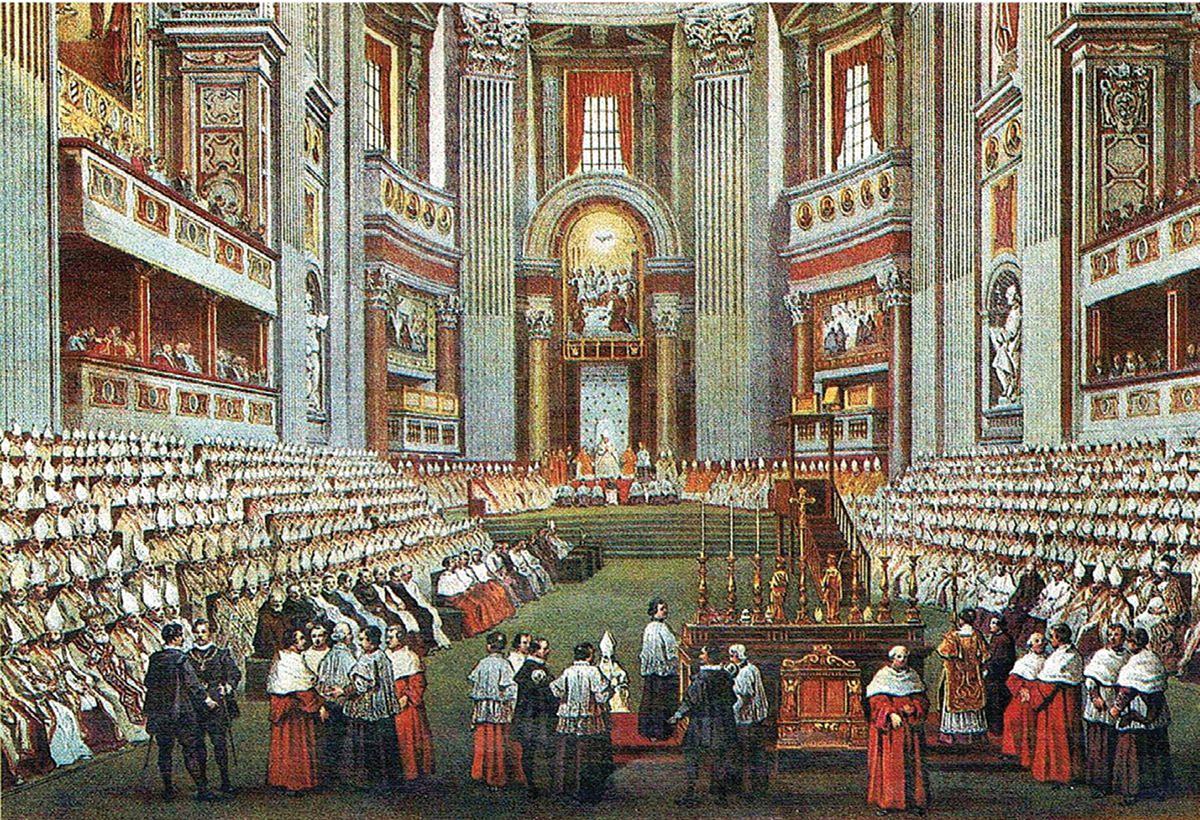
When the Fathers of the First Vatican Council gathered under Blessed Pius IX from December 8, 1869 to October 20, 1870, it was in large part to raise a standard against a world increasingly dominated by rationalism, materialism, naturalism, and religious indifferentism.
On April 24, 1870, they did exactly that when Vatican I promulgated the Dogmatic Constitution Dei Filius.
Against the said errors that plagued the world at that time, and continue to do so now, the Council’s doctrinal teaching concluded with eighteen canons, each condemning a proposition contrary to the Faith with the ancient formula anathema sit — “let him be anathema.”
For many post-conciliar Catholics, as well as young persons and those who are new to the Traditional faith, this ancient Greek word might fall strangely on the tongue and even sound slightly ominous. In fact, the word anathema carries significant weight in Church history and signifies a solemn ecclesiastical condemnation.
In the context of Vatican I, the formula anathema sit marks the proposition condemned as contrary to the Catholic faith, which means it is far stronger than a mere expression of theological disapproval and definitely not “just a pastoral suggestion.” Whenever this formula appeared, Vatican I was drawing a doctrinal boundary and declaring that the condemned proposition could not be held consistently with Catholic teaching.
Sadly, even at the time of Vatican I, the dark forces of Modernism in all its forms were already subverting the Church from within by promoting Biblical historicism, rationalism, doctrinal development, and the like. Despite valiant attempts to counter the Modernist heresy by men such as St. Pius X, by the time Vatican II was opened, the condemnations of Vatican I were all but forgotten, and a great tragedy unfolded: in one way or another, their exact opposite were enshrined in the documents of Vatican II.
These condemnations, of course, have not magically disappeared, nor are they somehow no longer in effect. We can only pray that a time will come when Catholics have shepherds who treat them with the solemn respect they deserve.
A telling exercise for the reader would be to identify how many of these condemnation the modernist church embraces, promotes, and condones.
While Dei Filius does indeed contain 18 canons, the Council numbered them within four sections: I.1–5, II.1–4, III.1–6, and IV.1. For the sake of convenience, we will simply number them one to eighteen. These four groups of condemnations pertain to God and creation, Revelation, faith, and the relationship between faith and reason.
God, the Creator of all things
The first five canons defend the Catholic doctrine of God against atheism, materialism, and pantheism — three errors that today are rampant both in the world and in the so-called Synodal Church.
The first condemns anyone who denies the one true God, Creator and Lord of things visible and invisible, as revealed in the Catholic faith, while the second condemns materialism, which is the erroneous assertion that nothing exists except matter.
The third takes aim at pantheism by condemning the proposition that the substance or essence of God and of all things is one and the same. This idea, which is, of course, extremely popular today, even among apostate prelates such as Fr. Richard Rohr and the late Thomas Keating, claims that God is the universe or that the universe is a part of God.
The fourth builds on this teaching by condemning theories which claim that Creation is an extension or development of God Himself.
The fifth canon teaches that God freely created both spiritual and material creatures from nothing and that creation was not forced upon God by some necessity of His nature.
Divine Revelation
The next four canons defend both natural knowledge of God and supernatural Revelation.
The Dispatch
The sixth condemns the assertion that God cannot be known with certainty from created things by the natural light of human reason and therefore rejects both rationalism and false fideism. Rationalism is the belief system, par excellence, that the modern world and its institutions, such as the United Nations, is built upon. It is from which liberalism and the “rights of man” ultimately emanate.
The seventh shows that reason alone is not enough, as the canon condemns the denial that God can reveal Himself supernaturally and instruct man concerning Himself and the worship due to Him.
The eighth rejects the claim that man cannot be raised by God to knowledge and perfection surpassing his natural powers, while the ninth canon condemns anyone who refuses to receive as sacred and canonical the books of Scripture as enumerated by the Council of Trent, or who denies their divine inspiration. It is not difficult to see how conciliar churchmen have sought to skirt around these teachings by claiming advances in research now allow for a “deeper” understanding of the Bible.
The nature of Faith
Six further canons defend the supernatural character and objective credibility of Christian faith.
The tenth condemns the claim that human reason is so independent that faith cannot be commanded by God, and the eleventh rejects the reduction of divine faith to ordinary human knowledge. The so-called Enlightenment is grounded in this false treatment of reason as not needing to submit to faith. Secularism is the instantiation of this erroneous position into the political arena by upholding a strict separation of Church and State.
The twelfth canon condemns the idea that Revelation cannot be confirmed by external signs and that faith should rest merely upon private religious experience or internal inspiration. Accordingly, the thirteenth canon defends miracles and condemns those who declare miracles impossible, dismiss them as myths, or deny that they can be known with certainty. Modern churchmen often cast doubt on miracles in Scripture and seek to provide rationalist explanations for them.
The fourteenth canon safeguards the freedom and supernatural character of faith, and the fifteenth rejects the proposition that a Catholic who has received the Faith stands in precisely the same position as one who has never believed. Again, it is shocking to observe how this exact error is now enthusiastically promoted by the post-conciliar hierarchy, as evidenced by Francis saying in 2013 that even atheists can be saved.
Faith and reason
The final three canons are particularly important for our age, in which the temptation exists to place human learning above Revelation.
The sixteenth condemns the claim that Revelation contains no mysteries properly so called, or that all doctrines of faith can eventually be demonstrated from natural principles by sufficiently advanced human reason.
Support Integrity’s growing number of contributors: Become a monthly donor!
The seventeenth rejects an unlimited autonomy of the sciences, in that genuine scientific truth cannot contradict revealed truth, while the final canon, the eighteenth, condemns the proposition that, as human knowledge advances, Catholic dogmas may eventually receive a meaning different from that which the Church has understood and understands.
This final condemnation provides an essential principle for understanding doctrinal development. Catholic doctrine can develop in clarity, precision, and depth, but truth cannot develop into its opposite. Tragically, as with so many, if not all, of these condemnations, we have seen clergy after Vatican II trying to convince us of exactly that: that dogma can change into something completely different and new.
One of the most ominous instances of this came during Leo XIV’s interview with Crux in 2025 when he said, “we have to change attitudes before we ever change doctrine.”
The eighteen anathemas of Dei Filius are therefore not merely relics of nineteenth-century theological disputes; they speak with even greater urgency today, as the very errors they condemned have evolved into still more distorted and nightmarish mutations.
The message of Vatican I’s eighteen anathemas is therefore as necessary now as it was in 1870. Fashions may pass, ideologies may rise and fall, and empires disappear, but the Divine truth of the Catholic faith remains eternal.