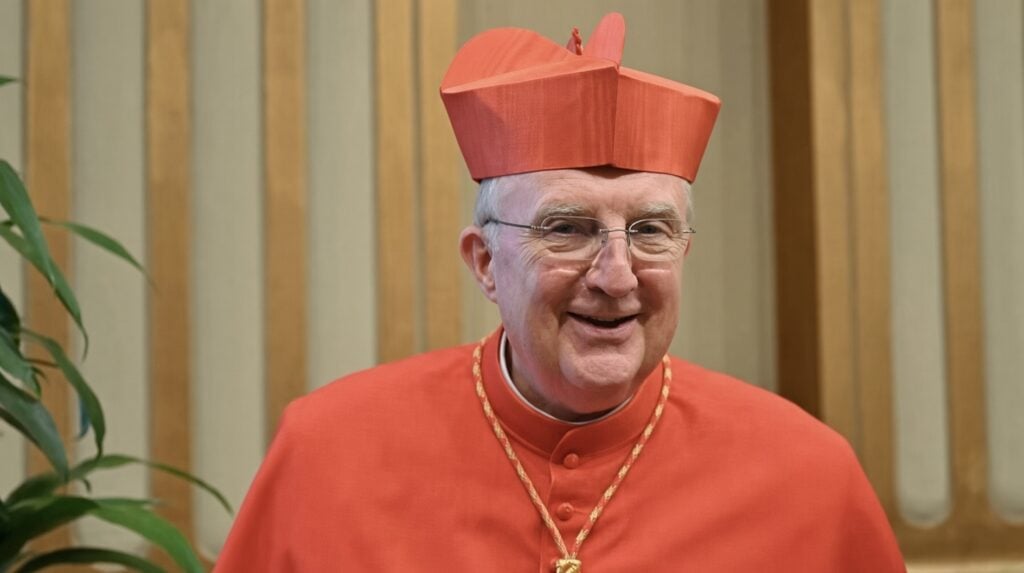
Synodal Cardinal Gerhard Müller occupies a peculiar place within contemporary Catholic discourse.
For years he has been presented by conservative and false traditionalists as a corrective to theological confusion raging in the Church because he occasionally criticizes doctrinal ambiguity, liturgical abuse, and progressive excesses.
At the same time, he has a history of promoting heterodox ideas foreign to the Catholic faith.
In his book Catholic Dogmatics for the Study and Practice of Theology, Müller claims that “in the Eucharist the believer does not consume the physical elements of Jesus’ body, but in the signs of the consecrated bread and wine he communicates in the humanity of Jesus.”
Statements like this are positively Protestant.
On the subject of Mariology, Müller once wrote, “We are not talking about deviating physiological particularities during the natural birth process.”
This undermines the concrete physical reality associated with the perpetual virginity of Our Lady.
The Kingship of Christ
Müller granted an interview with Kath.net last week to discuss the Society of Saint Pius X (SSPX) and the wider crisis in the Church. His remarks only confirm that the praise he receives for his supposed orthodoxy is wholly unjustified.
On the topic of religious liberty, Müller said that “To speak here of Catholic states, which should enforce the still valid belief of the need for salvation of the Catholic Church with state measures, seems to be quite anachronistic.”
He then insists, “In the repeated demand that there should be no religiously neutral state … the [SSPX] should name the states where they intend to enforce this program.”
Müller is confusing different issues here. The question is not whether Catholic confessional states are practically achievable in contemporary pluralistic societies, but whether previous magisterial teaching consistently affirmed that civil authorities have duties toward the true religion. According to pre-conciliar popes, rulers do indeed have obligations toward the true religion. Müller’s dismissal of traditional Catholic political theology as “anachronistic” reduces doctrine to mere historical circumstance.
What Müller could have said is that circumstances have regretfully changed today and that states are no longer able to discharge their debt to Christ. One should not imply that this development makes the principle itself functionally erroneous, or that it is ideal that it is longer practically achievable.
The Second Vatican Council
Müller frames resistance to Vatican II as though the only alternatives are acceptance or Protestant style subjectivism. He states that “one cannot be … Catholic if one subjects binding statements of the Church’s magisterium to one’s subjective standard.”
Müller avoids the elephant in the room with this slight-of-hand remark. The question is not whether doctrine should be judged subjectively, but whether the doctrines being judged are Catholic at all. In this case, he does not address the tragic fact that the new synodal religion’s novel and ambiguous formulations not only cannot be interpreted according to previous magisterial teaching but are completely opposed to unchanging and unchangeable Catholic teachings.
The Dispatch
It is thus every Catholic’s right, including the SSPX’s, to question and determine whether statements, formulations, and new teachings and disciplines are in harmony to earlier ones. This is not subjectivism or disobedience, but a case of protecting one’s salvation by wanting to conform to the perennial magisterium of Holy Mother Church.
Accusations of Protestantism
Müller intensifies his argument by invoking parallels to Martin Luther.
“The [SSPX] would have to explain the difference between their attitude and Luther’s statement during the Leipzig disputation when he said: ‘Councils can also err!'” he exclaims.
One must remember that Catholicism allows for distinctions between infallible definitions, disciplinary decisions, prudential judgments, pastoral formulations, and non-definitive teachings. To demonstrate where discontinuity has occurred and to ask whether particular conciliar expressions require qualification or clarification — as the SSPX has done in its dealings with the Vatican — is not the equivalent of adopting a Protestant ecclesiology.
Next, Müller weighs in on the subject of papal authority.
The SSPX does “not seem to notice the contradiction to the Catholic faith that the Roman Pope is the ultimate criterion of Catholicity in case of doubt,” he argues. “Only the Church of Peter was always established in faith and remained free from errors.”
Certainly Catholics affirm papal primacy and reject private judgment as a substitute for ecclesial authority, but all evidence indicates that those occupying the Vatican are not Catholics and the religion they promote is not Catholicism. Now, one can argue that the Arian crisis demonstrated how large portions of the episcopate can fall into confusion and that popes throughout history have made prudential mistakes and occasionally made statements requiring later clarification. But what we are dealing with now is full-blown apostasy and an alien religion flowing from Rome — a religion to which no Catholic can or should subject themselves to. The Church is indefectible; therefore, the post-conciliar religion cannot be the fruit of the Catholic Church.
Failing to understand the crisis
Müller proceeds to acknowledge the existence of a serious crisis. He refers to “real aberrations of individual bishops and theologians of the Catholic faith and abuses in the liturgy” and condemns “progressivism, which delivers the revealed truth of Christ to changing currents of the spirit of the age.” Later, he references “heretical deviations into atheistic rainbow ideology.”
But after admitting all this, he still portrays Traditionalist resistance largely as an overreaction.
“Only in a state of extreme persecution, when contact with the universal Church and Rome is completely impossible, would the consecration of a bishop morally be justified,” he argues.
Read more: Conservative Catholic complaints about the crisis in the Church ignore its root cause
If he was a faithful son of Holy Mother Church, Müller would recognize that this is precisely the moment we are living in. He would then declare that the false religion currently entrenched in Rome should be rejected whole and entire by Catholics across the world.
Indeed, if doctrinal confusion exists, if liturgical life has collapsed, if bishops tolerate and promote serious errors, and if modern ideologies have infiltrated ecclesial life, then appeals to a mild form of resistance are not only erroneous but wholly inadequate. Serious actions, like concreting bishops against the Vatican’s wishes, must be taken.
Lastly, and perhaps most importantly, the real question that the SSPX must ask — and which Müller must provide an answer to — is this: When do we give up the charade and admit that the Vatican is no longer the home of the Catholic Church but the seat of an antichrist religion?