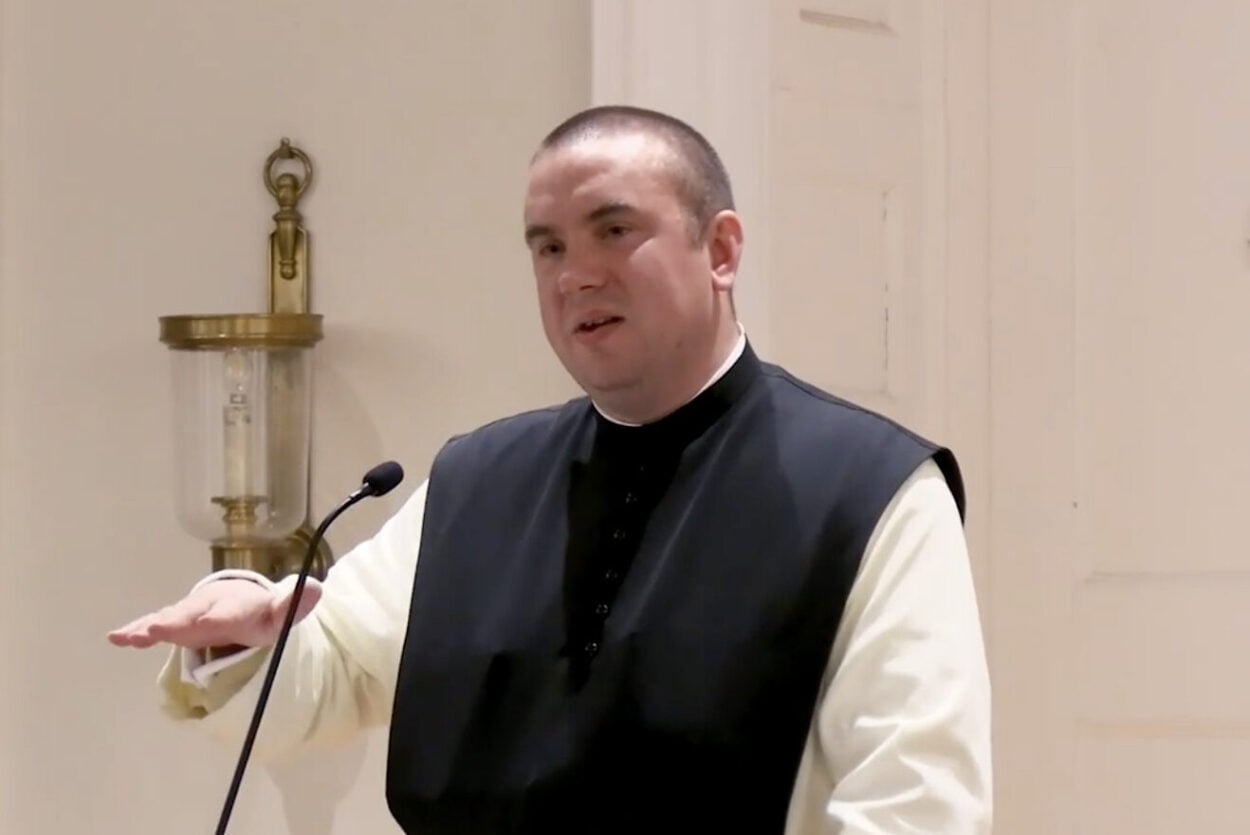
Last Friday, German outlet katholisch.de reported that Fr. Edmund Waldstein will not be returning to his teaching position at the Benedict XVI Philosophical-Theological University of Heiligenkreuz in Austria. The university’s rector, Wolfgang Klausnitzer, said Waldstein would not be invited back for the remainder of his tenure. Waldstein has since been allowed to pursue further studies in philosophy in Rome.
While Waldstein’s title as lecturer remains, it may now be in jeopardy as Klausnitzer has related that the university’s senate will reconvene in the winter of 2027 for potential reevaluation.
Waldstein has been one of the leading clerical voices in the Catholic “neo-integralist” movement, which began roughly in the mid 2010s and solidified with the launch of The Josias website in 2014. He has since co-authored several books on the subject. The movement is closely aligned with prominent “post-liberal” Catholics, who have gained prominence in recent years and will be discussed more below.
The persecutory campaign against Waldstein, a Cistercian monk and respected theologian, began in 2025 when his writing on the legitimacy of capital punishment for heretics in a Catholic regime gained recognition.
Wilhelm Guggenberger, dean of faculty at the Catholic University of Innsbruck, related in May 2025 that faculty at the institution issued a statement arguing that Waldstein’s view “contradicts the understanding of the Church as presented by the Second Vatican Council.” Innsbruck theologian Professor Michaela Quast-Neulinger also alleged that “Integralist positions clearly contradict Catholic teaching and the legal framework of a democratic constitutional state.”
Drawing the attention of Rome?
Waldstein hails from a prominent European family. He responded to his critics in May 2025 with a post on his personal blog Sancrucensis, refuting the charge that he was a “dangerous right-wing extremist whose work is linked to the harassment of women theologians at Austrian faculties.”
While courageously maintaining his position on the per se legitimacy of capital punishment for heretics, he admitted that he sometimes had “gone too far when it [came] to the application of principles” and reaffirmed his commitment to Francis’ novel teaching on the death penalty and “the teaching of St. Pope John Paul II on the rule of law and democracy.”
In the same blog post, Waldstein curiously linked his defense of integralism to Dignitatis Humanae (DH), the same document which many — both traditional and conciliar Catholics — have long since argued is at rupture with Catholic doctrine as it was always taught and received. On The Josias blog, Waldstein dedicated four essays to the defense of DH, 1 substantially adopting the thesis of Professor Thomas Pink — whose own argument for continuity has been called into question.
In what is difficult to not see as coincidence, the Abbey that Waldstein belongs to was subjected to an Apostolic Visitation one month later in June 2025 to protect it from “possible internal and external threats.”
Public intellectuals take notice
On X Sunday, James Patterson, a longtime opponent of the integralist and post-liberal movement, appeared to relish in Waldstein’s persecution, calling him a bad theologian. “For those keeping track of such things,” he remarked while sharing a screenshot of the unfortunate news.
Thomas Howes, Patterson’s collaborator and co-author of a recent book with him provocatively titled “Why Post-Liberalism Failed,” took a more conciliatory path. On X, he said measures against the Austrian monk were “heavy-handed” and wished Waldstein could continue teaching.
Waldstein’s supporters responded swiftly to defend him on the platform. Dominican Fr. Gabriel Mosher denounced the removal as an “injustice.” Gen Z commentator Christian Wagner called it “absolutely unbelievable.” Theologian Michael Sirilla and political commentator Sohrab Ahmari both lamented the “terrible” news.
As of the publication of this article, Fr. Waldstein has yet to make a public statement about the matter, which remains mostly confined to German outlets.
Neo-Integralism and the Post-Liberals
John Monaco has pointed out the hypocrisy of the apparent cancelation.
“You can be an Austrian Catholic theologian and argue for women’s ordination, contraception, and same-sex ‘blessings,’” he said on X. But if, like Waldstein, “you criticize liberalism, you lose your teaching position. I’m not even an integralist, but this is absurd.”
The Dispatch
Major conservative media outlets such as National Review, The Bulwark, The Washington Examiner, and Illiberalism.org have been opposed to the post-liberal and neo-integralist movements for several years, regularly smearing their efforts as totalitarian and socialist, among other mischaracterizations.
In truth, the post-liberal movement is lead by good Catholic men such as Harvard Professor Adrian Vermeule, intellectual Gladdin Pappen, Catholic University of America theologian Chad Pecknold, and Notre Dame professor Patrick Deneen.
As mentioned above, Waldstein was the mind behind and former editor of The Josias. After the publication of Deneen’s 2017 important book “Why Liberalism Failed,” the post-liberals shed the “neo-integralist” label of years past and adopted the post-liberal moniker.
James Patterson is a post-liberal critic and vehement opponent of Catholic integralism — the political doctrine that arranges the State according to the Social Kingship of Christ. He has accurately described its goals as follows:
“Post-liberal conservatism is very different from mainstream American conservatism. Mainstream conservatism has its roots in Anglo-American colonial customs, the Scottish Enlightenment, the Founding, and the 20th-century Judeo-Christian consensus. Post-liberal ideas have their origin in the Catholic reactionary thought of continental Europeans like Joseph de Maistre, Juan Donoso Cortés, and Carl Schmitt.”
Death penalty, Leo XIV, and the post-conciliar authorities
The tension between Waldstein and his supporters’ commitment to the Church’s traditional teaching on the death penalty with what is presented on the subject by conciliar Rome will likely continue to cause problems.
Already, Leo XIV has staked out a position at variance with Catholic doctrine. Last autumn, he explicitly stated that one cannot be considered “pro-life” while also defending the death penalty. In April 2026, without qualification, Leo said “I condemn capital punishment,” while also defending Francis’ claim that the death penalty is simply “inadmissible” based on concerns for human dignity.
While still Cardinal Robert Prevost in 2022, Leo denounced the death penalty as something he was “Not personally [against],” but rather “the Church teaches that the death penalty is inadmissible.”
All of this is contrary to the teaching of the Catholic Church on the per se legitimacy of the State to inflict death on malefactors, including heretics in a Catholic regime for the salvation of souls and for the defense of religion, both of which the common good is inextricably linked. The Roman Catechism (Fifth Commandment) explicitly teaches the former and Saint Thomas (II-II, Q. XI, Art. 3) does the same with the latter.
In fact, when it comes to capital punishment for heretics, the opposite view has been authoritatively, even infallibly, censured. For instance, in his bull Exsurge Domine against Martin Luther, Pope Leo X condemned the following proposition:
33. That heretics be burned is against the will of the Spirit.
Catholics are therefore bound in conscience, under pain of serious sin, to believe that it is consistent with the will of the Holy Ghost to prosecute heretics in a Catholic regime, up to and including capital punishment. Approved theologians have long since maintained this, with Jesuit master Cardinal Johann Franzelin (1816-1886) remarking “it is not lawful for any Catholic to deny these definitions [of Pope Leo X] are infallible.”
One hopes that Waldstein will recall these principles if he makes a public statement on the matter, being sure to remind those who are in authority over him of their perennially valid and unchanging character, even if their application is morally impossible today.
- Of the four essays, two [1], [2] have been removed from The Josias while the other two are apparently inaccessible. Their subsequent analysis by Rorate Caeli has also been deleted. However, Waldstein’s 2014 paper entitled “Religious Liberty and Tradition” remains accessible. ↩︎