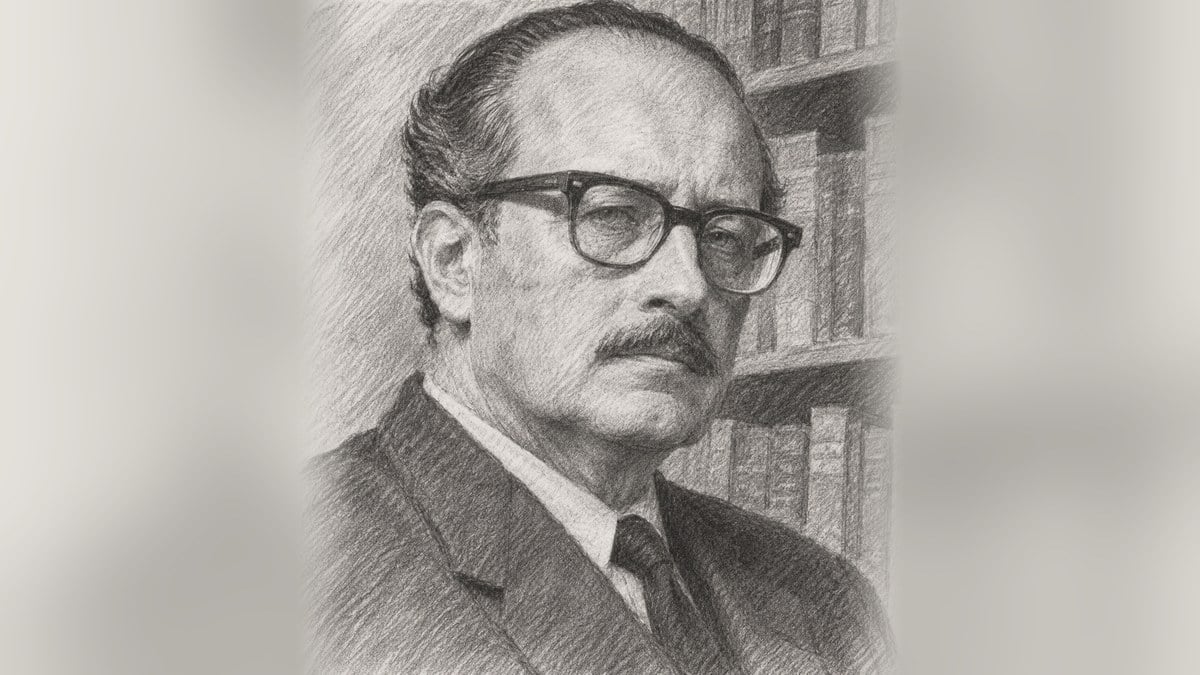
While not as well known in Catholic Traditionalist circles as, say, Joseph de Maistre, Juan Donoso Cortés, or G.K. Chesterton, few twentieth-century thinkers attacked the foundations of modern civilization with the intellectual ferocity of Nicolás Gómez Dávila (1913–1994).
The Colombian Catholic, aristocrat, and self-described “authentic reactionary” did not stop at rejecting the excesses of modernity but relentlessly attacked its fundamental political and theological roots.
Understanding what the Social Reign of Christ both implied and demanded, Gómez Dávila saw democracy, egalitarianism, secularism, and the religion of progress for what they were: manifestations of a deep-seated rebellion in which man seeks to dethrone God and establish himself as the ultimate source of authority.
The recluse of Bogotá
Gómez Dávila was born in Bogotá in 1913 into a wealthy Colombian family and spent much of his childhood and adolescence in Paris, where he received a European education influenced by Benedictine schooling.
Health struggles disrupted his formal studies but afforded him time to master classical languages and immerse himself in Western literature.
Upon returning to Colombia, he withdrew from public life, devoting himself to his family, his Catholic faith, and a formidable private library. He shunned academia and political office, preferring the company of Plato, Augustine, Aquinas, and the great European counter-revolutionaries.
His principal achievement was Escolios a un texto implícito (Scholia to an Implicit Text), first published in 1977, followed by further collections containing thousands of aphorisms, or scholia, that served as an indictment on modernity.
Liberal democracy as a theological heresy
Gómez Dávila refused to acknowledge that political authority can be understood apart from theology.
Democracy, in his analysis, was an ideology founded on the assertion that sovereignty originates in man rather than God. He regarded the democratic doctrine of popular sovereignty as a secularised theology, transferring to humanity an authority that properly belongs to God.
Where liberals and conservatives dispute how democratic power should be exercised, Gómez Dávila’s radical criticism questioned the very legitimacy of treating the collective human will as the ultimate source of political authority.
His opposition also targeted the sacred cows of capitalism and socialism, insofar as both subordinate the higher ends of human existence to material prosperity, production, and the satisfaction of appetites. For Gómez Dávila, their apparent disagreement masked a shared modern anthropology.
Importantly, the Colombian philosopher rejected the notions that history necessarily advances towards a more rational or just society, that it possesses automatic salvific power, or that majorities can manufacture truth.
Hierarchy, inequality, and the Christian order
Completely at odds with modern political sensibilities, but firmly rooted in Catholic political thought, were Gómez Dávila’s views on equality, which he rejected as the supreme political virtue.
The Dispatch
Instead, he recognised that civilisation depends upon distinctions between wisdom and ignorance, sanctity and sin, nobility and vulgarity, legitimate authority and mere power.
“Hierarchies are heavenly. In hell, all are equal,” he famously wrote.
Click here to support Integrity’s independent Catholic journalism!
His aristocratic outlook was not a haughty yearning for privilege but rested on the conviction that human beings differ in virtue, judgment, and spiritual accomplishment, and that a society which refuses to acknowledge excellence will ultimately lose the ability to recognize authority.
While some might accuse him of worshipping the state, nothing could be further from the truth. He rejected the notion that any political institution, whether parliamentary democracy or revolutionary dictatorship, could save fallen man. For him, the central question was how to establish an order that acknowledged both man’s limitations and his need for subordination to truths he did not create.
These convictions placed Gómez Dávila firmly in line with Catholic Integralism, rooted as it is in the recognition that political society cannot be indifferent to man’s supernatural end.
The Church against the modern world
Gómez Dávila’s traditional Catholicism made his response to the post-conciliar demolition project merciless.
“The progressive Catholic is only active in zealously seeking for whatever he can still hand over to the world,” he declared, elsewhere asserting that it is better to have “a small church with Catholics than a numerous one with Rotarians.”
“The progressive clergy crowns the towers of the church of today not with a cross but with a weathervane,” he observed with trademark severity.
Gómez Dávila recognised the danger of measuring Christianity by its popularity and condemned the theological assumptions underlying aggiornamento as a betrayal of the Church’s transcendent vocation.
The authentic reactionary
Gómez Dávila was no conventional counter-revolutionary. Doubting that political programs could reverse modernity’s spiritual catastrophe, he instead advocated principled resistance.
Contrary to Bergoglio and Prevost’s program of elevating man, Gómez Dávila warned that “the Antichrist is, probably man” and that “humanity is the only totally false god”.
He also diagnosed another political malady, observing that “today’s conservatives are nothing more than liberals who have been ill-treated by democracy.”
For Catholics seeking to form their political conscience, Gómez Dávila remains an indispensable guide, not least for his devastating verdict on modernity: “The modern world shall not be punished. It is the punishment.”
Sources and further reading:
- Nicolás Gómez Dávila, Escolios a un texto implícito (1977), Nuevos escolios a un texto implícito (1986), and Sucesivos escolios a un texto implícito (1992).
- Guillermo Hoyos Vásquez, Don Nicolás Gómez Dávila, Spanish thinker and authentic reactionary | Arbor
- Óscar Torres Duque, View of Nicolás Gómez Dávila: The Passion of Anachronism
- Stuart Chessman, “Nicolás Gómez Dávila and the Church of the Council: Aphorisms,” The Society of St. Hugh of Cluny
- The Authentic Reactionary: Selected Scholia of Nicolás Gómez Dávila
- Wikipedia