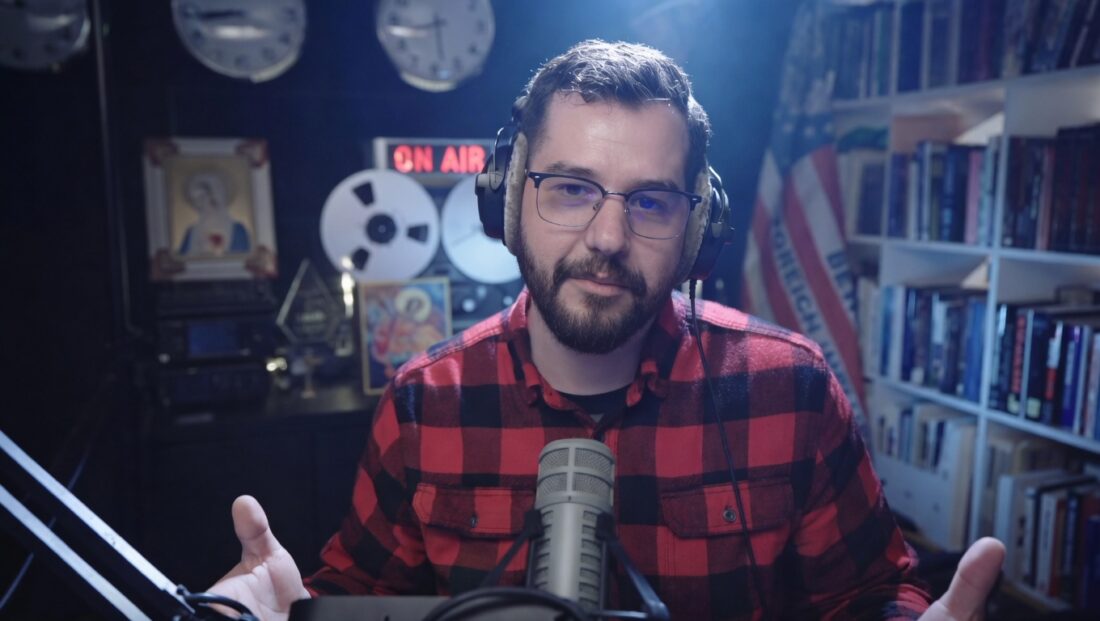
Editor’s note: Integrity editor American Reform conducted this exclusive interview with David Reilly, host of The Backlash podcast, while attending the Thomas Massie election-night party earlier this month. Be sure to follow Dave on X and subscribe to his YouTube channel.
The Massie campaign and the influencer strategy
American Reform: Why are you at this event for Thomas Massie today?
Dave Reilly: I was invited to Kentucky by a content creator named Tiffany Cianci, who had the idea to bring roughly thirty influencers together to engage in what you might call targeted outreach — producing content in the district and uploading it from Kentucky IP addresses on platforms like X, TikTok, and Instagram. There has been a recent shift in the business algorithm on TikTok and Instagram specifically that surfaces more locally uploaded content to local audiences. The idea was to get a group of influencers creating media with people from Kentucky, for Kentucky, in order to drive as many people as possible to the polls.
Young people are far more primed to vote for Thomas Massie, but they also tend to be more apathetic — they don’t believe their vote matters. Meanwhile, boomers who have been watching Fox News are convinced Massie is the devil incarnate. So the core of the strategy was to drive youth voter turnout as an offset to that voting bloc.
American Reform: Is this a proof of concept, or has it been deployed previously with success? And what do you make of this strategy going forward, given the very large generational divide we’re seeing — particularly among young right-leaning voters, Gen Z men, traditional Catholics who care deeply about faith and country, versus older generations?
Dave Reilly: This kind of strategy has been going on very quietly for the last two years, but this is the first time that bringing in outside content creators to a specific race has been publicized openly. If Massie wins, I believe that model will be replicated in races across the country as a way of generating energy and reaching young voters. So this will be something of a bellwether. We are looking for a measurable bump in youth turnout — if we were successful, the data will show it.
More broadly, I think this race is going to be enormously consequential for American politics because it is the first time the Israel lobby has so nakedly attempted to purchase a congressional seat in full public view. There was an article published in Haaretz describing the Kentucky congressional campaign as the most important election in Israel today. That tells you something. The boomers have a stranglehold on the Republican Party and on the discourse. They will employ cancel culture and left-wing tactics when activated by operatives like Chris LaCivita and Susie Wiles. If Massie wins, it demonstrates they can be beaten — and that if we work together we can actually prevail. If Massie loses, those of us who are skeptical of Israeli influence in American politics will be looking at a backlash that has not been calculated for. The more money poured in, the more conspicuous the lobby becomes, and the more people are awakened to it.
What’s striking is the gap between the campaign’s public-facing messaging and what his constituents are actually discussing. Massie talks about the Israel lobby, Miriam Adelson, Paul Singer — the donor class. The people at his rallies are talking about the Jews. So there’s a clear divergence between the official campaign language, which centers on farming policy, the Second Amendment, and the First Amendment, and what ordinary supporters understand to be the real stakes. They are hyper-aware that these are not just any billionaires — they are foreign billionaires from Israel, bombing Gaza. They get it.
The America First movement and the future of the GOP
American Reform: What do you see for the nascent America First faction within the Republican Party? Can it overcome Donald Trump and his MAGA movement, or does everything rise and fall with him?
The Dispatch
Dave Reilly: It will be very interesting to see what Trumpism without Trump looks like. They tried it with Ron DeSantis, and it did not work — he was simply not the right vessel for it. But we are seeing a realignment of several distinct coalitions: independents, the MAHA movement, purple-district voters, and America First, all beginning to coalesce into something genuinely new. In the past week, I have been on the ground here alongside Democrats, independents, a lesbian, a communist, and myself — a far-right, borderline-fascist traditional Catholic. And we have all been getting along and working together. That has been genuinely strange, and I think we may see more of it.
As for the Republican Party itself, I think it is largely a matter of waiting for the boomers to die off. Fox News functions like a neutralizer — like the device from Men in Black that wipes your memory clean. The moment Fox News comes on, everything a boomer has learned from lived experience is erased and replaced with whatever Rupert Murdoch wants them to believe. That is not a problem that can be overcome directly. It is a problem that time solves. And while we wait, the right response is to get married, have many children, catechize them in the nature of this fight, and raise them to be capable of seizing the power vacuum that will exist when that generation passes. Our side needs to be ready to move efficiently when that moment arrives.
Crisis in the Church and the Society of St. Pius X
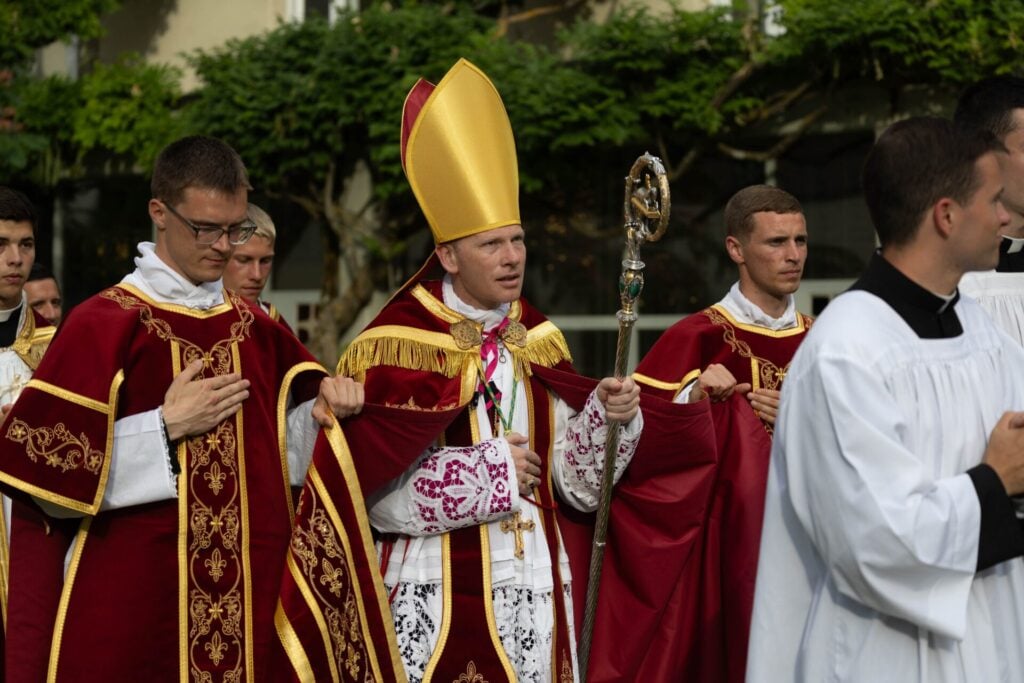
American Reform: I know you have been close with Bishop Richard Williamson — God rest his soul — as well as Bishop Fellay and others in the SSPX. You are a traditional Catholic yourself. Tell us what you make of the upcoming consecrations and what they bode for the Society and how can they be justified in the midst of this crisis in the Church?
David Reilly: The crisis in the Church is implicit in the question — and it is undeniable. You can see it in vocations, in seminary attendance, in the statistics of who still believes in the Real Presence of the Eucharist. There are dioceses preparing to close scores of parishes — one in Minnesota, St. Cloud, is moving from well over a hundred parishes to a fraction of that number. There is a crisis, and it is pervasive. And everything the Society does is predicated on that reality. There are those who deny it, but the evidence is overwhelming.
Critically, it is not just the formation being given to the laity that has failed — it is the formation being given to priests. Seminarians are no longer being trained to understand themselves as offering a sacrifice for the remission of sins. They are being formed to be presiders over a people’s assembly. That is a fundamental rupture. So it is absolutely necessary to have priests trained in the priesthood the way the Church has always trained them. That is the Society of St. Pius X’s primary mission. They are a priestly society, not a lay society.
I am not a member of the SSPX, but I fully applaud their efforts. As a Catholic man in 2026 with three children and one on the way, I want my children catechized and confirmed in the actual Catholic Faith — not in novelty, not in ecumenism, or religious liberty. I want the whole Faith undefiled, as my father received it, and as my grandfather would have received it. That is what the Society exists to preserve. I think the consecrations are completely necessary, and if I were to be excommunicated alongside them, so be it. The Society of St. Pius X saved my life. I would not be here without them. God bless them.
The role of Integrity Magazine
American Reform Final question: how important is an outlet like Integrity Magazine and its commitment to counter-revolution — not only within the Church, but in civil society and in America today?
Dave Reilly: It is long past due. The traditionalist movement has existed for fifty or sixty years, and yet a great deal of the commentary has been exclusively focused on what is happening inside the Church, without examining the practical application of Church teaching to civil society at large. That gear has been missing from the traditionalist toolbox for too long. Especially when it comes to overarching questions — Zionism, foreign influence, the coming of the Antichrist, the potential rebuilding of the so-called Third Temple. These are serious questions that touch on theology, on matters of orthodoxy and heresy. Traditional Catholics have sometimes treated the internal crisis of the Church as a way of avoiding those larger societal confrontations rather than engaging them directly.
Read more: What does Integralism look like in the 21st century?
There has been a real vacuum since the death of Father Denis Fahey (1883-1954). John Deary addressed some of this as well, but it has been largely absent. I am very encouraged to see not only Integrity Magazine but a broader awakening among Catholics to the multi-generational religious war we are all part of — a growing understanding of the nature of the fight. This is not merely a matter of some liberalism in the Vatican, or some liberalism in America. It is the existential battle between Christ and Antichrist, which began the moment the crowd cried out “let His blood be upon us and upon their our children.” We are reaching a fever pitch in that conflict, and we have front-row seats. It is going to require heroic virtue. It is going to require people willing to put their lives on the line for the truth. God bless Integrity Magazine and everything you are doing. I look forward to seeing what you have in store.
American Reform: Thank you very much. God bless.
This transcript has been lightly edited for clarity and publication.