

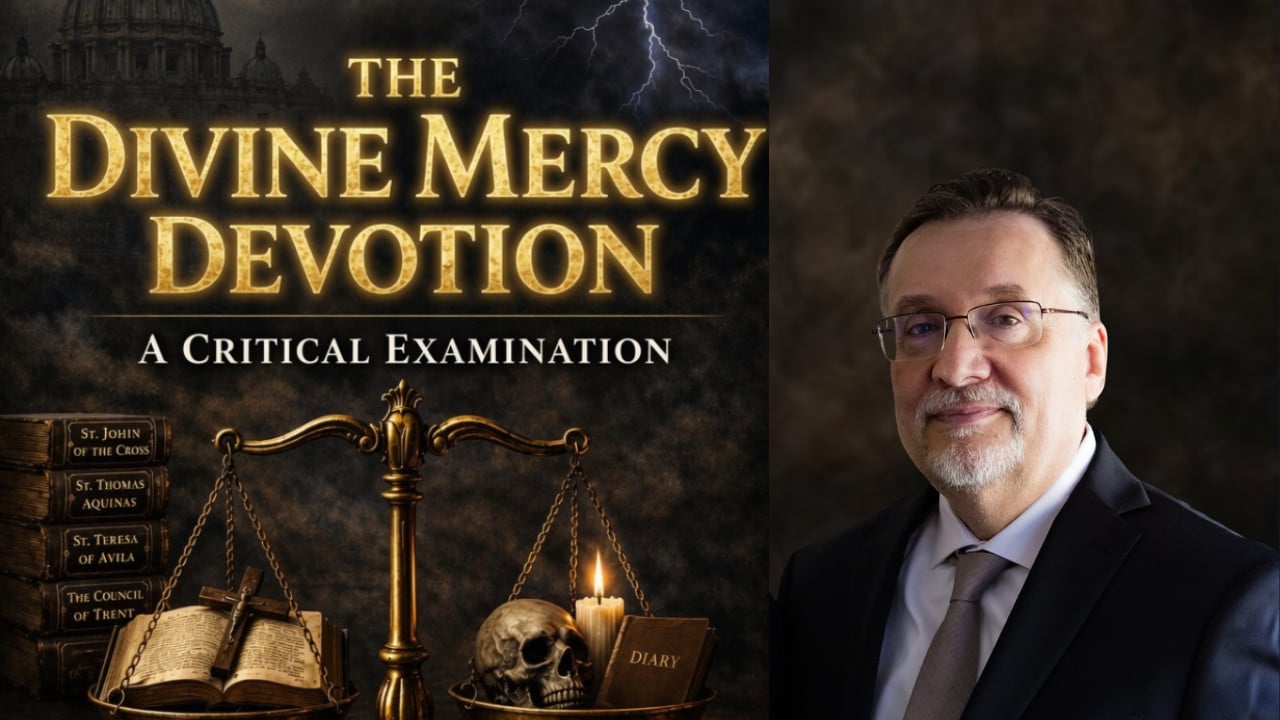
Kirk Hansen is the author of the recently released book The Divine Mercy Devotion: A Critical Examination.
Coming in at 240 pages, it is the culmination of many years of research. Its eighteen chapters examines whether the Diary of Sr. Faustina Kowalska reflects “the marks of authentic private revelation” and if it aligns with perennial Catholic teaching.
Hansen’s book is an exhaustive study on the devotion, which has grown in popularity thanks to John Paul II. Hansen previously practiced the devotion, but says there are a number of red flags with it.
“I expect readers to realize that there is something fundamentally wrong with this devotion. It is my hope that they will connect the dots that the there has been a break between the people who resurrected this devotion and the pre-conciliar Church,” he said.
Hansen’s book is currently available in Kindle on Amazon and can be purchased here. It will be available in paperback soon.
Hansen currently runs the Ascent of Mount Carmel X account. He also makes short videos for the Ascent of Mount Carmel YouTube channel, which he founded in 2014. Hansen appeared on an Integrity podcast earlier this year along with his close collaborators Sebastian Malik and Nate Vaughan. The interview has embedded in the article below.
What inspired you to write this book?
The book grew out of years of studying the writings of St. John of the Cross and his teaching on how to handle private revelations. St. John had such a profound impact on me that about 11 years ago I started the Ascent of Mount Carmel YouTube channel primarily devoted to his writings.
Like many Catholics, I once accepted the Divine Mercy devotion without examining its origins very closely. As I began reading St. Faustina’s Diary for myself, I noticed a growing number of passages that seemed difficult to reconcile with the principles taught by St. John of the Cross and others.
What surprised me most was not that there were isolated problems, but that there appeared to be a consistent pattern throughout the Diary. Rather than relying on the work of others or isolated quotations, I decided to examine the Diary carefully and compare it with Scripture, traditional Catholic theology, and especially the teaching of St. John of the Cross. That study eventually became this book.
What was the process like? I assume you needed to do a lot of research?
The research took several years. I’ve posted well over 100 videos on St. John of the Cross. I started my playlist on the Divine Mercy devotion about nine years ago. The basis of the book came from the old scripts to the videos. I’ve been working on getting it into book form this year. I wanted every criticism to be supported by primary sources whenever possible. Besides repeatedly reading Sr. Faustina’s Diary, I spent a great deal of time consulting Scripture, the writings of St. John of the Cross, St. Alphonsus Liguori, St. Teresa of Avila, St. Thomas Aquinas, papal documents, and older catechisms and theological manuals.
I’ve received a lot of input from Nate Vaughan, Sebastian Malik, and my son, Richard Hansen, who I ended up adding as a co-author.
One of my goals was to avoid speculation. I wanted readers to see the evidence for themselves presented in an organized manner. Whenever possible, I quote directly from the Diary and compare those passages with established Catholic teaching, allowing readers to judge whether the two are truly compatible. One thing readers might notice is that I build the case chapter by chapter. Later chapters are built upon the foundations built in the early chapters.
What will Catholics learn by reading it?
Many Catholics are surprised to learn how cautiously the Church has traditionally approached claims of visions and locutions. The saints consistently teach that extraordinary mystical experiences should be approached with humility, caution, and rigorous discernment. Perhaps Catholics will become better catechized by reading the book. What would really be great is if the book encourages readers to learn more about St. John of the Cross, who is the primary foundation of the book.
Readers will also discover many passages in the Diary that are rarely discussed by promoters of the Divine Mercy devotion. The book examines these passages in their full context and considers whether they harmonize with traditional Catholic theology.
What do you want readers to come away with?
More than anything, I hope readers will rediscover confidence in the ordinary means of sanctification that Christ has already given His Church: the Mass, the sacraments, prayer, Scripture, and faithful obedience to Catholic doctrine.
Enjoying this article? Donate to Integrity today!
The Dispatch
Private revelations are never essential to salvation. If the book encourages Catholics to place greater trust in the Church’s public revelation than in extraordinary claims, then I will consider it worthwhile.
I expect readers to realize that there is something fundamentally wrong with this devotion. It is my hope that they will connect the dots that the there has been a break between the people who resurrected this devotion and the pre-conciliar Church.
Why do you think Catholics are devoted to Divine Mercy in the first place?
I believe most Catholics are drawn to it for sincere and good reasons. Every Christian longs for God’s mercy, and the message that God desires to forgive sinners is profoundly true. On the other had, the Diary’s core message, that God is unconditionally merciful, appeals to lukewarm Catholics too.
The difficulty is not with God’s mercy. The difficulty is whether every element of a particular private revelation faithfully communicates that truth. Those are two separate questions. My book does not challenge God’s infinite mercy; it asks whether the Diary is a reliable vehicle for presenting that mercy. I worry that the Diary leads some individuals to presume God’s mercy without any repentance or expectation of justice.
Is it truly harmful to souls?
Any devotion built upon questionable private revelation has the potential to mislead if it encourages people to rely on extraordinary promises or private messages rather than the ordinary means of grace established by Christ.
Certainly, not that every person devoted to Divine Mercy is harmed. Many sincere Catholics undoubtedly practice the devotion with good intentions while living good Christian lives. My concern is that there are themes in the Diary can encourage misunderstandings about discernment, spiritual warfare, and even the nature of salvation. Those ideas deserve careful examination.
Some defenders of the Diary say that it is for those who despair that they are beyond God’s mercy. Unfortunately, the Diary goes to far in the other direction leading some people to not fear the judgement of God.
What are some of the biggest red flags with the devotion and Sr. Faustina?
Several stand out.
First, the Diary repeatedly presents extraordinary locutions and visions in ways that conflict with the principles of discernment taught by St. John of the Cross. There are about 300 Diary entries that conflict with established Church Teaching.
Second, there are passages that inflate the role assigned to St. Faustina herself within salvation history. She writes: “Everything that exists on earth is at my service: friends, enemies, success, adversity… All things, willing or not, must serve me.” (Diary 1720)
Third, the portrayal of the devil often resembles a comic foil rather than the subtle and deceptive enemy consistently described in Scripture and by the saints. I will be posting a video on this topic this evening.
Finally, there are theological tensions involving obedience, grace, judgment, and the interpretation of Divine Mercy itself that deserve much closer examination than they usually receive.
What are some of the most common objections Catholics devoted to Divine Mercy have when you bring up counterarguments?
One of the most common responses is to appeal to the canonization of St. Faustina or to the approval of the Divine Mercy devotion by later popes. For some, they see the problems in the Diary, but then conclude, “Well, if John Paul II says it’s okay, that’s good enough for me.”
The Church has always distinguished between public revelation, which binds all Catholics, and private revelations, which no Catholic is required to believe.
Ultimately, my arguments stand or fall on whether the Diary itself is consistent with Catholic theology.
Anything else you would like to share?
I hope readers approach the book with the same spirit in which it was written. This is not an attack on individuals who sincerely love the Divine Mercy devotion, nor is it a denial of God’s infinite mercy.
It is an invitation to exercise the discernment that the Church has always recommended regarding private revelation. If a claimed revelation truly comes from God, it will withstand careful theological examination. If it does not, then Catholics should be grateful that the Church has provided reliable principles for testing such claims.
Readers may recall that John Paul II scrapped the devil’s advocate process for canonizations. The arguments in my book would have likely been presented had such a process remained. Readers might consider the book as the devil’s advocate process that never was.