
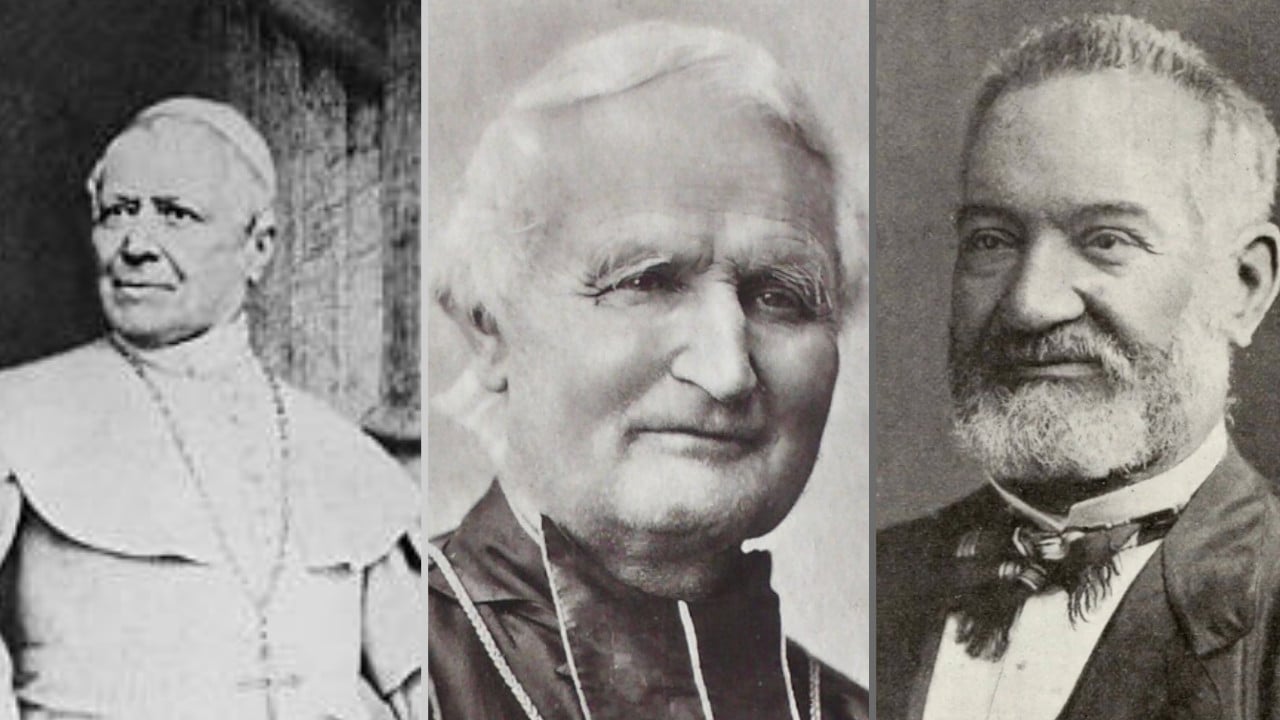
It was on February 27, 1854, surrounded by Freemasons, that Félicité de Lamennais, gazing at the bust of Marianne — symbol of the French Republic, which had replaced the statue of the Blessed Virgin Mary in his bedroom — died without receiving absolution from the Church. He would be buried by Father Lachaise, in a common grave, in accordance with his last wishes to be buried with the poor. When the gravedigger suggested that it would be fitting to place a cross on the grave of this “former” priest, Lamennais’ closest companions rejected this last Christian gesture. Clearly they knew that Félicité would not approve. 1
The apostate priest Lamannais had spent much of his life trying to transform the Catholic Faith and the Catholic Church according to the revolutionary Masonic ideas of the French Revolution. At the end of his career as chief “religious” proponent of the Liberty, Equality, and Fraternity of the Revolution, Lamennais would conceive of and preach the fusion of “all religions united in a single universal movement in order to contribute its spiritual aid and all its divine force to the world revolution. Such a religion would be the strongest solvent of every established order and every historical community that is of necessity imperfect and vulnerable. Therefore, the Gospel will be the best cement for a new humanity, one that is free, equal, and fraternal, built on justice, peace, and liberty.” 2
The walking contradiction, the ‘Liberal Catholic,’ emerges
Even though it was the teachings of Lamannais that were the object of condemnation in Pope Gregory XVI’s encyclical Mirari Vos, the Catholic intellectual elite, especially in France, were split on the resolve of some to transform the Catholic Church by sifting its teaching and practices to eliminate anything that was unconformable to the revolutionary ideas of 1789. Count Montalembert and Felix-Antoine-Philibert Dupanloup, Bishop of Orleans were the leaders of the group spoken of as “Liberal Catholics,” those hoping to achieve reconciliation between the Church and the post-Revolutionary world; their journalistic organ was Le Correspondant. On the other side were Louis Veuillot, editor of L’Univers, Bishop Pie of Poitiers, and Msgr. Freppel, Bishop of Angers, the “Ultramontanes,” who rejected any kind of marriage between Church and the Modern Liberal System.
For several decades, there were movements throughout the European world to change the patrimony that was the theology, philosophy, and practice of the Catholic Church from within. Since the beginning of the 19th century, an effort had been made in the German universities to “rethink” the Catholic Faith “with reference to modern problems raised by philosophy, history, and theology.” These were inspired by the teaching of a Viennese priest, Fr. Anton Gűnther, as well as by the University of Tűbingen. In September of 1863, the famous German theologian Dőllinger addressed a conference of Catholic scholars held in Munich in which he spoke in ringing tones for the theologian’s complete “freedom of movement in all matters not involving dogma,” and asked that error might be fought not “with the rod of authority but with scientific weapons” and even sought to oppose “German theology” to “Roman theology.” 3
It was only, however, with the August 1863 addresses of Count Montalembert to the Catholic Congress meeting at Malines that the reigning pontiff of the Catholic Church, Pope Pius IX, realized that he had to act.
The Congress that met at Malines was a meeting of Catholics of the highest social standing. Presided over by Baron de Gerlache, one of the Catholic founders of the Kingdom of Belgium, the Congress was intended to organize an effective Christian response to the general problems facing both Belgium and Europe as a whole. Montalembert addressed the Congress on the need to abandon “reliance” on privileges and State protection of the Catholic Religion.
In an almost proto-Modernist way, the aged French Count said that even though coercion had played a necessary role in the past, its very success in creating “mature,” “adult,” Christian men dictated its abandonment in modern times. Catholics must realize he concluded that liberal “freedoms,” “religious liberty, and the separation of Church and State,” now actually provided a superior basis for Catholic action than that offered by State protection in the past. Traditional systems in the 19th century, Montalembert insisted, merely promoted further revolution. His conclusion was that cooperation with the Children and Systems of the Revolution was the Church’s only hope and its greatest shield. The only chance for Counter-Revolution, in other words, was willful cooperation with the Liberal Revolution. 4
The Syllabus of Errors: The Church’s dogmatic response to liberalism
The Syllabus itself has its roots in 1860, when Bishop Gerbet of Perpignan published his Instruction pastorale sur diverses erreurs du temps present which censured 85 errors of modern times, including Liberal Catholicism. Bishop Gerbet sent the pastoral letter to Rome. This quickly resulted in Pope Pius IX asking a commission, which he had appointed, to choose from among the 85 propositions and to formulate a document based on their choice. When the bishops of the world met in Rome in 1862, the Pope presented them with a list of 61 errors taken from Gerbet’s letter. It is at this moment that we find Bishop Dupanloup entering our story. It was Dupanloup himself who killed this “proto-Syllabus” by labeling it an “outrage” to the modern world. When Pius IX wanted to use the writings of Louis Veuillot, the great Catholic counter-revolutionary, as the basis for a new anti-revolutionary encyclical, the Bishop of Orleans, Dupanloup dissuaded him from doing so. 5
The Malines Conferences of Montalembert were a challenge that the Shepherd of the Universal Church could not refuse. On December 8, 1864, the 10 year anniversary of the Solemn Proclamation of the Dogma of the Immaculate Conception, the encyclical Quanta Cura appeared with its attached list of condemned modern errors, known as The Syllabus of Errors. Rather than being based on the list provided by Bishop Gerbet or the draft created by Louis Veuillot, Pius IX simply compiled a list of modern errors from previous magisterial documents of himself and his predecessors, from encyclicals, allocutions, and pastoral letters. From these documents were culled 80 propositions “embracing the principal errors of our times.” Included in these errors of modern times were those that constituted the basis of the Liberal Catholic movement. Among the condemned propositions, the ones that were seen as the most forceful rejection of the Liberal cause were Error XV: “Every man is free to embrace and profess that religion which, led by the light of reason, he may have thought true”; Error LXXVII: In this age it is no longer expedient that the Catholic religion should be treated as the only religion of the State, all others worship whatsoever being excluded”; and most distressful of all for the Liberal Catholic mind, Error LXXX: “The Roman Pontiff can and ought to reconcile and harmonize himself with progress, with liberalism, and with modern civilization.” 6
The horrified reaction of the Liberal Catholics
Everything that the leader of “Liberal Catholicism,” Count Montalembert, had advocated in the Malines lectures had been condemned. The liberals’ concept of a “Free Church in a Free State” — a practical denial of the Social Kingship of Our Lord Jesus Christ — was explicitly denounced in sections LXXVII and LXXVIII of the Syllabus. In December 1864 and January 1865, it seemed impossible for the Liberals to get around this doctrinal and solemn condemnation of their first principles. This, really, was as it should be. They had read the Syllabus as it was given, a teaching to be taken at face value. Its purpose was made clear by Bishop Louis Pie who said that the Syllabus was directed towards “sincere Catholics who had given themselves the task of harmonizing the Church with the modern ideas.” 7 It was an attempt to call the Liberal Catholics back to true Catholic doctrine. The Liberals knew this and despaired. A Piedmontese newspaper declared that the Pope, now an implacable enemy of modern civilization, would outlaw the steam engine, the telegraph, and gas lighting in the Papal States. 8
The great Parisian dailies — Le Constitutionel, La Patrie, Le Journal des Debats, Le Siècle — found in that document proof of their contention that the Church was the enemy of human reason. From Rome, a British diplomat Odo Russell wrote to his government that, “The struggle is now no longer between the Pope and Italy alone, but between that Papacy and modern civilization.” 9 The external criticism culminated in January 1865, when the Imperial French government of Napoleon III issued a decree stating that no bishop could publish this document, from the pulpit or otherwise, since it contained, “propositions contrary to the principles upon which repose the constitution of the Empire.” 10
Read more: The Liberal Matrix: How civilization trained us to forget everything that came before
It was, however, the Liberal social and intellectual elite in Europe, which reacted in such a way that it was clear that they were being pushed to the edge of their highly qualified Catholic faith. According to Montalembert, “The Encyclical [Quanta Cura and the Syllabus] has disastrous consequences for myself and my friends.” Another liberal contributor to the Correspondant, Foisset said, “The Encyclical is the accepted faith. Le Correspondant has no more reason to exist.” 11 Moreover, Foisset indicated that the Syllabus presented a challenge to his own faith, “I have to save my faith. She is in peril and I have to demand for myself the word of Providence as to how it was able to permit this act.” 12
The Dispatch
Bishop Dupanloup of Orleans to the rescue of the sinking Liberal ship
Bishop Felix Dupanloup of Orleans was exactly the man to save the Liberal Catholic cause so that it could fight another day. He was a child of depravation, whose mother had sacrificed much to provide him with the education which she hoped would compensate him socially for his illegitimate birth. His entrance into the priesthood in 1825 was followed by years of extraordinary accomplishment, especially in the realm of education of the youth, both catechetical and secular.
Along with being an orator of great reputation, Dupanloup, as superior of the Saint Nicolas pre-seminary, so completely transformed that institution that admission to it was sought after by the most highly placed families in France. As Renan, himself a student at Saint Nicolas, states, “During those few years, the old house of the rue St. Victor became the school in France which sheltered the greatest number of historical or well-known names.” Moreover, through one of those under his spiritual direction, he converted Talleyrand to the Catholic Faith in 1838. His years of fighting for the liberty of Catholic education in the post-revolutionary French State, won him the admiration of the papacy and membership in the French Academy. Even here, however, Dupanloup based his defense of the legitimate rights of the Catholic Church upon the revolutionary “rights of man” of 1789, “We accept, we proclaim the generous spirit, the true spirit of the French Revolution, and besides, what else are we now doing other than paying tribute to this authentic spirit of the French Revolution when we ask for the freedom of teaching, promised in the Charter, and with it all the legitimate religious liberties.” 13 His 28 years as bishop of Orleans were years in which he initiated everything from synods, parish visits, organization of catechesis, to introduction of the Roman Liturgy. 14
The pamphlet in which Dupanloup attempted to save the Liberal cause after its doctrinal defeat was entitled, Le convention du 15 septembre et l’encyclique du 8 decembre. It is here that we find an ecclesiastical tactician. Rather than attack the ideas of the Syllabus itself, which would have meant the death of his cause, Dupanloup joined his reinterpretation of the Syllabus to an attack on the government of Emperor Napoleon III of France for its plan to withdraw its troops from Papal Rome, leaving the Holy City open to conquest by the Liberal Masonic forces attempting to unify all of the Italian States into a centralized Nation-State. Dupanloup, therefore, would take the offense with regard to the Roman Question, while seeming to defend the Syllabus against those who would “misinterpret” it. 15 On either issue then, Dupanloup would appear to be a defender of the Papacy and of the current order, while providing an opening for Liberal Catholicism to dodge the fatal bullet sent its way by Pius IX. 16
According to Dupanloup, “the encyclical has not been interpreted, it has been misinterpreted. Further, the government itself is strangely mistaken about it.” 17 In the case of Roman documents, it was necessary to observe, “elementary rules of interpretation.” The condemnation of a proposition “does not necessarily imply that its opposite is being affirmed,” nor should the condemnations be viewed as “universal and absolute.” 18 According to Dupanloup, an unbiased reading should pay attention to “all the terms and all the slightest nuances.” The Pope, according to the great ecclesiastical liberal, had condemned only “unlimited liberty,” not “whatever is good in progress, whatever is truly useful in modern civilization, whatever is truly liberal and Christian in Liberalism.” 19 The Bishop of Orleans stated that, “The Church is not the enemy of political liberty”; on the contrary, “I dare to say that, in this regard, no spirit is more liberal than hers.” 20
Enjoying this article? Donate today!
Along with this evasion and complete falsification of the Pope’s magisterial teaching, Dupanloup presented a theoretical justification for his interpretation, which would serve as the central notion of Liberal Catholicism from then on. At the center of this justification, Dupanloup drew the distinction between thesis and hypothesis. The Church, he argued, had certain absolute rights (thesis), which in actual practice required modification (hypothesis), “That which is permissible in hypothesis is sometimes false in thesis.” 21
Thus, in thesis, the Church was intolerant of other religions and claimed exclusivity of truth and practice, but in practice (hypothesis) it tolerated other religions — which in modern circumstances had to be tolerated. An example, seeming to justify this idea, was the fact that Jews and Protestants were allowed to practice their respective religions even in Rome. Such a distinction would allow the Liberal Catholic to act in the political sphere with a complete duality of mind, he would act practically based on the notion that the true Christian order ordained by the Church could not be implemented, while at the same time, theoretically — and, perhaps, doctrinally, affirming “the ideal” in his head. This would be continued until Vatican II when the “ideal” would be rejected and the situation, which has been so long tolerated, would be affirmed as the new, secular “ideal.”
Did Pius IX approve?
Is this what Pope Pius IX meant? Was the Syllabus to be simply an academic exercise in which an unattainable ideal was to be reiterated? Was the Syllabus really a liberal document? That this might be the case was all that the Liberals needed for the time being. As Werner de Merode, the Pope’s Minister of Arms, wrote: “We will now be able to reconcile obedience to St. Peter and the ability to live in peace with the laws and French custom. 22 338 bishops from around the Catholic world complimented Dupanloup for his pamphlet. The Bishop of Orleans had shown that the Pope was not inalterably opposed to progress and civilization. 23 The gas lights would stay on!
But did Pope Pius IX actually affirm the interpretation that Bishop Dupanloup had given to the Syllabus? In order to make it appear as if he did, Dupanloup maneuvered in Rome to get a papal letter of approbation attached to his pamphlet. Another French bishop, a Mgr. Place, acted on Dupanloup’s behalf in this matter. He was successful in that he got Mgr. Mercurelli of the Curia to compose such a letter for the Pope’s consideration. Pius IX, apparently, was about to accept Mercurelli’s letter when Louis Veuillot intervened. Providentially, he was in Rome at the time and when he received a copy of Dupanloup’s pamphlet from Mercurelli, he found the letter to be “ridiculous … odious.” 24
The problem for Veuillot was that all the bishops who wrote letters in praise and support of the Syllabus were sent letters of thanks and appreciation from the Pope. Veuillot believed that if Dupanloup was sent such a letter, the public would take that to indicate papal approval for Dupanloup’s liberal interpretation of the document. 25
Veuillot’s contention was that Dupanloup’s thesis was meant to cover up “the errors concerning the Church which are the particular sin of Liberal Catholicism.” 26 Since ecclesiastical decorum “had” to be upheld — Archbishop Marcel Lefebvre, over 100 years later, said that failure to condemn the erroneous interpretation of the Syllabus by Dupanloup resulted in Liberal Catholicism’s survival 27 — the original complimentary letter would be modified.
Orleans would be complimented, but there would be some reservations in the brief. Veuillot was informed by Mgr. Bernardi that Dupanloup could not display the letter because it would contain a left-handed compliment. The Pope terminated his compliments to the Bishop of Orleans with what appears to be an admonition. Whereas Pius praised with warm enthusiasm the political statements defending the Pope against the action of the French Empire, he, also, “expressed his hope that the bishop of Orleans in any further explanation of the Syllabus would speak more doctrinally than he had previously or to “refute with more energy the erroneous interpretations.” 28
To see Pius IX’s real opinion and intent on this matter, we can not only consider the prima facie meaning of the condemnations in the Syllabus, but, also, consider the statements which he made during a meeting with the British diplomat Odo Russell. Russell writes, “I told the Pope that I had studied the document [the Syllabus ] … but that I honestly confessed I could not reconcile the original text with the Bishop of Orleans’ commentary … I begged his Holiness to tell me whether I might consider the Bishop’s interpretation of the original text as correct. He replied that no one had the right to interpret the Pope’s words, the plain meaning of which could be seen in the original texts of the documents, pastorals, and encyclicals to which the Syllabus referred.” 29
In this statement, Pius IX affirmed the original intent and meaning of the Syllabus, rejected any Liberal “interpretation,” but, unfortunately, failed to “name names” and thereby smother Liberal Catholicism in its cradle. The same thing occurred some 90 years later, when Pope Pius XII did not “name names” in his encyclical condemning Neo-Modernism, Humani Generis.
- Brother Francis of Mary of the Angels, “Lamennais, The Apostate Visionary” in Resurrection: The Catholic Counter-Reformation in the 21stcentury (June 2002), p. 18. ↩︎
- Ibid. ↩︎
- Henri Daniel-Rops, History of the Church of Christ, vol. 8, trans. John Warrington (New York: E.P. Dutton, 1965), p. 281. ↩︎
- John Rao, Removing the Blindfold: 19th Century Catholics and the Myth of Modern Freedom (Kansas City, MO: Angelus Press, 2014), p. 162ff. ↩︎
- Marian Kowalski, “The French Liberal Catholics and Louis Veuillot from the Syllabus of Errors to the Vatican Council, 1864-1869” (unpublished thesis) (Ottawa: University of Ottawa, 1966), pp. 73-74. ↩︎
- Ibid., pp. 75-76. ↩︎
- Ibid., p. 77. ↩︎
- Ibid., pp. 77-78. ↩︎
- Ibid., p. 78. ↩︎
- Ibid., translation mine. ↩︎
- Ibid., pp. 78-79. Translation mine. ↩︎
- Ibid., p. 79. Translation mine. ↩︎
- Georges de Nantes, “Mgr. Freppel: A bishop prepared to fight” in Resurrection: The Catholic Counter-Reformation in the 21st century (June 2002), p. 3. ↩︎
- J.F. Sollier, “Dupanloup, Felix” in The Catholic Encyclopedia, vol. V (New York: The Encyclopedia Press, 1913), p. 202. ↩︎
- Kowalski, p. 80. ↩︎
- John Rao, Black Legends and the Light of the World: The War of Words with the Incarnate Word (St. Paul, MN: Remnant Press, 2012), pp. 483-484. ↩︎
- Yves Chiron, Pope Pius IX: The Man and the Myth (Kansas City, MO: Angelus Press, 2005), p. 206. ↩︎
- Ibid. ↩︎
- Ibid. ↩︎
- Ibid. ↩︎
- Kowalski, p. 80. Translation mine. ↩︎
- Ibid., p. 82. Translation mine. ↩︎
- Ibid. ↩︎
- Ibid., p. 84. Translation mine. ↩︎
- Ibid., pp. 84-85. ↩︎
- Ibid., p. 86. Translation mine. ↩︎
- Marcel Lefebvre, Against the Heresies (Kansas City, MO: Angelus Press, 1997), p. 198. ↩︎
- Kowalski, p. 87. Translation mine. ↩︎
- Ibid., pp. 88-89, Note 68. ↩︎